
Introduction
Want to learn the fundamentals of Trademark Law? Read our complete Trademark Law Guide.
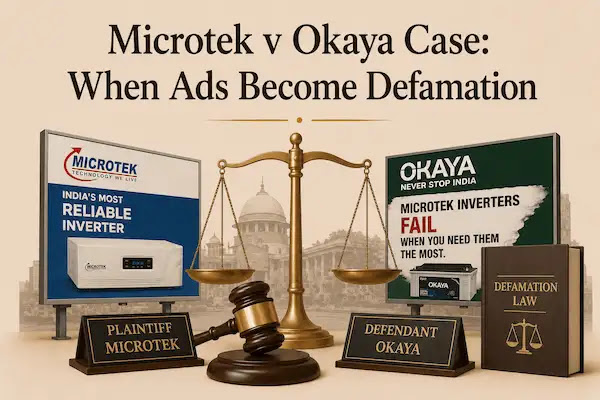
Two battery companies were competing in the same market, an unrelated design order from the Hon’ble Court involving different parties instigated a WhatsApp campaign that told dealers across Haryana, Uttar Pradesh, and other states that 10,000 Microtek batteries stood seized. The case Microtek International Private Limited v. Sukhveer Singh & Ors. came before the Delhi High Court. Hon’ble Justice Neena Bansal Krishna granted interim injunctive relief against several Okaya dealers and employees before the end of the day, directing them to remove and take down the impugned advertisements within 24 hours. The restraint covered content circulating on WhatsApp and Facebook.
At what point does a comparative advertisement cross into disparagement, and what does a registered trademark owner reach for when it does? Battery and electronics sector brand disputes occupy a well-established corner of Indian trademark litigation, and the analysis of trademark infringement and brand protection on this blog has covered how those disputes typically unfold. What this case adds to that picture is a form of trademark attack that operates entirely outside the deceptive similarity framework, relying instead on false factual claims about a competitor’s legal standing and product quality to damage a rival’s position in the dealer network.
The Battery Market Rivalry and the Disputed Advertisements
What Microtek Alleged
Microtek International Private Limited holds registered trademarks for its inverter battery products and carries an established market presence in the segment. The defendants are authorised dealers, distributors, and branch personnel of Okaya Power operating across Haryana, Uttar Pradesh, and other states. Several defendants are reportedly former Microtek directors who subsequently moved to Okaya entities, a fact that adds a dimension to this dispute beyond the advertising claims themselves.
Microtek built its case around three specific assertions that the defendants’ advertisements made and that Microtek challenged as false. The advertisements claimed that 10,000 Microtek batteries stood seized under a court order, whereas the actual seizure involved approximately 1,200 batteries across multiple brands. The advertisements portrayed Microtek’s batteries as inferior in quality, making direct negative assertions about the company’s registered trademark products. And the advertisements suggested that Microtek was a party to the underlying design litigation, when in fact Microtek had no connection to that suit and the proceedings involved entirely different parties.
Microtek’s central argument was that Defendant No. 11 took a court order from a design infringement suit between unrelated parties and used it as the factual foundation for a defamatory campaign against Microtek’s registered trademarks. The advertisements constructed a false narrative from a real legal document and then distributed that narrative through WhatsApp and Facebook to a dealer network spanning multiple states.
The Defendants’ Position
Several defendants appeared on advance notice and denied that their clients had created or circulated the advertisements. The argument before the court was that certain employees had forwarded the content as WhatsApp display statuses and had since been reprimanded for doing so. Counsel gave undertakings before the court that the defendants would not publish or circulate misleading or factually incorrect advertisements in the future. The legal team for Microtek was led by Senior Advocate Sandeep Sethi, alongside Advocates J.V. Abhay, Aishwarya Mukherjee, Krisna Gambhir, and Shreya Sethi.
The Legal Framework for Comparative Advertising in India
Sections 29(8) and 30(1) of the Trade Marks Act 1999
Indian trademark law addresses comparative advertising through two provisions that operate in tandem. Section 29(8) of the Trade Marks Act 1999 establishes when advertising constitutes infringement of a registered trademark. It provides that a registered trademark is infringed by any advertising of that trademark if such advertising takes unfair advantage of, or is contrary to honest practices in industrial or commercial matters, or is detrimental to the distinctive character or repute of the mark.
Section 30(1) creates the qualifying exception. It permits the use of a competitor’s trademark in advertising where that use is in accordance with honest practices in industrial or commercial matters and does not take unfair advantage of, or is not detrimental to, the distinctive character or repute of the mark. Practitioners looking for a complete grounding in how these provisions interact within the full Indian trademark framework will find the overview at Trademark Law in India useful.
Reading Sections 29(8) and 30(1) together, the law produces a conditional permission. A trader may compare its products with a competitor’s, including by naming the competitor’s registered trademark. The permission holds as long as the comparison rests on honest, verifiable, and proportionate claims. The moment a comparison relies on fabricated facts, misleads consumers about a legal proceeding, or attacks a competitor’s reputation through false assertions, the section 30(1) safe harbour disappears and infringement liability under section 29(8) arises.
The Honest Practices Test
The honest practices test is the analytical centre of comparative advertising jurisprudence under the Trade Marks Act. Indian courts have shaped it through a sequence of decisions, beginning with broad constitutional grounding and progressively working out the operational boundaries.
- Dabur India Ltd. v. Colortek Meghalaya Pvt. Ltd. (FAO (OS) No. 625/2009, decided February 2, 2010 by a Division Bench comprising Justice Madan B. Lokur and Justice Mukta Gupta) laid down four foundational principles. An advertisement is a form of commercial speech protected under Article 19(1)(a) of the Constitution of India. It must not be false, misleading, unfair, or deceptive. Some degree of exaggeration in the form of puffing is acceptable and need not be treated as a serious representation of fact. But while glorifying its own product, an advertiser must not denigrate or disparage a rival’s product.
- Dabur India Ltd. v. Wipro Limited, Bangalore added a distinction practitioners cite often: a defendant can claim its product is better than the plaintiff’s, but it cannot claim that the plaintiff’s product is inferior to its own. The first is a positive assertion about one’s own goods. The second is a negative attack on a competitor’s goods, and that distinction is the operative line in disparagement law.
- PepsiCo Inc. v. Hindustan Coca Cola Ltd. supplemented the analysis with a three-factor test for assessing whether an advertisement has crossed into disparagement: the intent of the advertisement, the manner of the advertisement, and the storyline and message the advertisement seeks to convey. Dabur v. Colortek subsequently amplified this by adding the overall effect of the advertisement as a fourth element, asking whether the advertisement promotes the advertiser’s product or disparages a rival’s.
Courts applying this framework have also drawn the distinction between truthful and untruthful disparagement. A comparison that is by and large truthful may be permissible even if it reflects poorly on a competitor. A comparison that rests on false assertions of fact is not, and it falls into the territory of trade libel.
How Indian Courts Have Drawn the Line
From Puffing to Trade Libel
The older Indian position on comparative advertising disputes drew on the tort of malicious or injurious falsehood. That tort required the plaintiff to establish three things: the defendant’s statement was false, the defendant acted with malice, and the plaintiff suffered actual financial damage. The malice requirement in particular made the tort difficult to use in market competition contexts, where the motivations of commercial rivalry are hard to separate from any specific intent to injure a competitor.
Courts today no longer require that a statement be proved false in a strict technical sense. Substantial falsity assessed against the effect on a reasonable consumer is the relevant standard. Courts no longer insist on proof of subjective malice; the test has become largely objective, asking whether the advertisement is disparaging in its overall effect on a reasonable audience. And courts do not require proof of actual financial loss as a precondition for interim injunctive relief. The practical consequence is that the threshold for obtaining interim relief in a comparative advertising dispute in India today is considerably lower than it was two decades ago. A plaintiff who can show that a competitor’s advertisement contains a false assertion of fact targeting a registered trademark and would mislead reasonable consumers has an established route to interim injunctive relief.
When False Facts Enter the Picture
The role of digital platforms in brand attacks has become one of the more actively litigated areas of Indian trademark law in recent years. This blog has previously covered how trademark misuse in digital advertising contexts operates, including in the Hindware v. Google analysis of keyword advertising and platform liability before the Delhi High Court. What Microtek v. Sukhveer Singh & Ors. adds is the use of WhatsApp and Facebook as distribution channels for a false factual campaign that reached dealers across multiple states within hours, with immediate damage to the trademark’s standing in the distribution network.
The advertisements in this case were not quality comparisons of the kind courts examined in Dabur v. Wipro or PepsiCo v. Hindustan Coca Cola. They contained specific, verifiable factual claims about a court proceeding and the number of products seized under that proceeding. A claim that 10,000 Microtek batteries were seized is not a hyperbolic marketing assertion or an inflated opinion. It is a representation of a specific legal and commercial fact, and it was false. False statements of fact of that kind lose the protection of the puffing defence entirely and constitute trade libel regardless of how they are packaged as advertising material.
The distinction matters because in puffing and generic disparagement cases, courts weigh the intent of the advertisement, its storyline, and its overall commercial effect. In trade libel, the focus shifts to whether the defendant made a false statement of fact that would cause a reasonable person receiving it to form a negative view of the plaintiff’s trademark or products. The Microtek advertisements cleared that threshold on their face.
What the Delhi High Court Decided
The Hon’ble Court restrained Defendants 1 to 6, comprising authorised dealers, distributors, and branch heads of Okaya operating across Haryana, Uttar Pradesh, and other states, from displaying or circulating the impugned advertisements on WhatsApp and Facebook. The court also directed the defendants to remove and take down the advertisements within 24 hours and issued notice to Defendants 1 to 6 and directed Defendants 7 to 11 to file written statements within 30 days.
Comparative advertising is permissible only as long as it does not cross into disparagement or trade libel. Advertisements found to be defamatory towards a rival brand warrant interim restraint. On the facts before the court, the advertisements met that threshold without difficulty. They did not compare battery quality in a general or exaggerated way. They made false factual claims about a legal proceeding, attributed a seizure to a company not involved in the underlying litigation, and inflated the number of products involved by more than eight times the actual figure.
The defendants’ denial of authorship did not shield them from the interim order. The court’s direction restrained dealers, distributors, and branch personnel from circulating the material regardless of whether they originally created it. Employees who forwarded the content as WhatsApp statuses fell within the same restraint. The obligation to remove the content rested on the defendants irrespective of the chain of original circulation.
One dimension the court will examine more closely at the merits stage is the involvement of former Microtek directors now associated with Okaya entities. If individuals with prior institutional knowledge of Microtek’s business, operations, and trademark portfolio played any role in designing or circulating the campaign, questions beyond trademark disparagement may arise at trial.
Also Read: Calcutta HC Returns ITC Plaint for Skipping Section 12A Mediation
Conclusion
The advertisements in this case were not produced by an overzealous marketing team that got carried away with a quality comparison. They took a real court order from a case to which Microtek was a complete stranger, multiplied the number of seized batteries by more than eight times, falsely attributed the proceedings to Microtek’s registered trademark products, and circulated the resulting narrative through WhatsApp and Facebook to a dealer network spanning multiple states. That is not comparative advertising by any reading of the Trade Marks Act 1999. That is a coordinated effort to damage a competitor’s market reputation through false factual claims, and the direction to remove the content within 24 hours was the measured and correct judicial response.
I think the merits stage will be more revealing. The involvement of former Microtek directors who now operate within Okaya entities raises the question of how this campaign originated. If individuals who previously held positions at Microtek participated in designing or disseminating the advertisements, the dispute may extend into breach of fiduciary duty and misuse of commercial knowledge, questions that sit alongside the trademark disparagement claim but run on separate tracks. The court’s findings on that dimension, when they arrive, will determine whether this matter ends at Section 29(8) of the Trade Marks Act 1999 or expands into something with wider implications for how former employees can legitimately compete.
A trader’s right to compare its products with a competitor’s, and even to portray that competitor’s products unfavourably, does not extend to making false statements of fact about that competitor’s legal proceedings or product quality. WhatsApp statuses and Facebook posts circulated to a dealer network constitute advertising for these purposes. And a false factual claim in that material about a registered trademark owner’s products or legal standing is trade libel, regardless of how it is framed as competitive market communication.