
Introduction
New to Copyright Law? Start with our complete Copyright Law Guide.
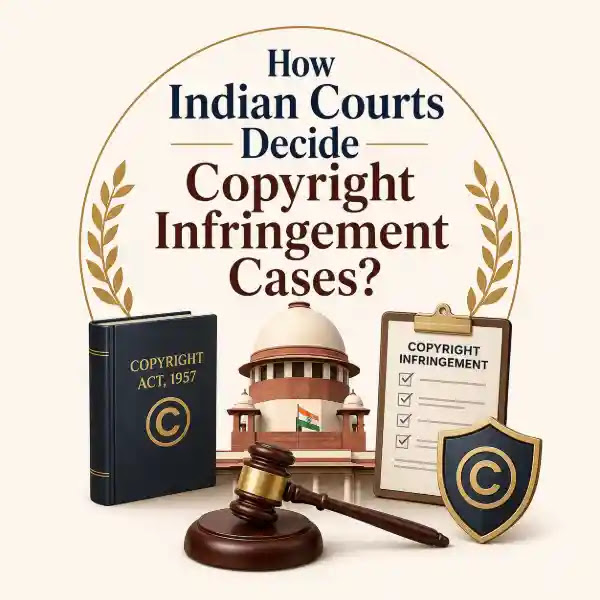
Copyright cases in Indian courts span franchise disputes, plagiarism claims between novelists, and YouTube channels hit with foreign copyright strikes. Beneath each of these sits the same set of foundational questions.
Is This Something that Copyright Protects?
Before asking whether someone infringed a copyright, a court usually asks whether the work in question attracted copyright protection at all. Two related principles govern this threshold.
The Originality Principle
Here, originality is required, not Novelty unlike in patents. Copyright protection under Section 13 of the Copyright Act, 1957 requires that the work be “original.” Originality in copyright does not mean the same thing as novelty in patent law. An original work is not one that has never existed before; it is one that originated with the author. What Indian courts have required, following the Supreme Court in Eastern Book Company v. D.B. Modak, (2008) 1 SCC 1, is a minimum degree of creativity, sometimes called the “modicum of creativity” standard.
Sheer industry, labour, or effort applied to organising or presenting material that any person would arrange the same way is not enough. The Court in that case examined whether a law publisher could claim copyright in its copy-edited version of Supreme Court judgments. The raw text of judgments belongs to the public domain under Section 2(k), but the publisher’s editorial additions (headnotes, paragraph numbering, and cross-referencing) reflected sufficient creative input to qualify as protectable derivative works.
This principle cuts both ways. Raw footage of floods, storms, or news events does not automatically qualify as a copyrightable cinematographic work. In Associated Broadcasting Company Limited v. Google LLC & Ors. (CS(COMM) 9/2024, decided 28 February 2026), the Delhi High Court observed that recordings of natural events such as hurricanes and floods may not meet the originality threshold because they lack sufficient creative input on the part of the recorder. There is no authorial decision embedded in pointing a camera at an event unfolding before you.
The Merger doctrine
It limits protection at the edges. Where an idea can only be expressed in a very limited number of ways, protecting the expression would effectively protect the idea itself, and copyright refuses to allow this. In such cases, Indian courts have held that the idea and expression “merge,” and the resulting expression gets no copyright protection. The Delhi High Court in Wiley Eastern Ltd. v. Indian Institute of Management, (1995) SCC OnLine Del 784, recognised this doctrine, which now forms part of the standard copyright analysis when the subject matter is functional or when few genuine expressive choices were available to the author.
Does Protection Extend to This?
Assuming the work qualifies, the next question is what within the work is actually protected. This is where the most frequently invoked principle operates.
Idea-Expression Dichotomy
Copyright protects expression, not ideas. The idea-expression dichotomy is not a mere technicality. It is the structural reason why copyright can coexist with a free market in ideas. A doctor can write a book about a surgical technique; copyright protects the text of the book, but it does not give the doctor a monopoly on the surgical technique itself.
The Supreme Court articulated this principle for Indian jurisprudence in R.G. Anand v. Delux Films, AIR 1978 SC 1613. The plaintiff alleged that his play had been copied in the making of a film. The Court held that there can be no copyright in a theme, a plot idea, or a general subject matter. Copyright attaches to the particular manner in which an idea is expressed: the dialogue, the scenes, the specific arrangement of the narrative, and not the underlying concept. If the defendant took inspiration from the idea but clothed it in different expression, there was no infringement.
Courts have reaffirmed this consistently. In the litigation between the digital storytelling platforms Humans of Bombay (HoB) v. People of India (PoI) before the Delhi High Court (Justice Prathiba M. Singh), the court held that the concept of a storytelling platform for sharing human interest stories from across India could not be owned by any single entity. What HoB could protect was its original photographs, its specifically written narratives, and its distinctive manner of telling those stories. The idea of the format was free for anyone to use; the specific expressive content was not.
The same principle resolved a 2026 literary dispute. In David Davidar v. Sivassundari Bose (2026 DHC 3666, decided May 2026), the Delhi High Court dismissed a copyright infringement suit against the author David Davidar, whose novel The House of the Blue Mangoes was alleged to have plagiarised an unpublished manuscript. The Court found that both works drew from the same historical and cultural material: the Nadar community of Tamil Nadu, early 20th-century historical events, customs and traditions. Such historical and cultural facts belong to the public domain. No author can claim exclusive rights over them. When two authors write about the same period and community, certain similarities are unavoidable. Overlap in subject matter does not constitute copyright infringement.
Has Infringement Actually Occurred?
Once a work clears both the originality threshold and the scope-of-protection question, the infringement analysis begins.
Now, the plaintiff must prove access and substantial similarity. Access alone is not enough; neither is proof that the defendant had seen or read the plaintiff’s work. The actual question is whether the defendant’s work is substantially similar to the plaintiff’s protected expression. Substantial similarity in Indian law is tested through what R.G. Anand described as the lens of a reasonable person, not a legal expert and not a person searching for differences, but a lay reader or viewer assessing their overall impression of the two works.
Courts have repeatedly held that similarity in idea, theme, genre, or historical setting does not constitute substantial similarity in protectable expression. When two works share a time period, a community, or a subject, some degree of similarity is simply unavoidable. As the Delhi High Court put it in Davidar case: “When two authors address the same subject matter, some degree of similarity is unavoidable due to the shared central concept; however, these similarities or coincidences alone do not constitute piracy or plagiarism.“
Before comparing works, courts effectively filter out the unprotectable elements, i.e., historical facts, ideas, themes, standard genre conventions, and elements dictated by the nature of the subject matter. What remains after filtration is the protectable expression, and it is only this that gets compared.
Fair Dealing under Section 52 of the Copyright Act 1957
Indian copyright law does not use the term “fair use.” It uses “fair dealing,” which is a more defined and closed-category exception under Section 52 of the Copyright Act. This is not a minor terminological difference. American fair use is a four-factor open-ended balancing test that a court can apply flexibly. Indian fair dealing under Section 52 is a closed list, it includes private use including research, criticism or review, reporting of current events, judicial proceedings, educational reproduction, and a few others. If a use does not fit one of the categories, the Section 52 defence is unavailable.
Courts have interpreted the listed categories substantively rather than mechanically.
The “reporting of current events” exception is real. Section 52(1)(a)(iii) protects fair dealing with any work while reporting a current event or current affair. In Associated Broadcasting Company Limited v. Google LLC & Ors. (February 2026), the Delhi High Court applied this exception to defend TV9 Network’s use of brief third-party video clips covering events like Hurricane Laura, the Israel-Hamas conflict, and the Chinese balloon incident, embedded within full-length composite news programmes. Justice Tejas Karia held that the use fell squarely within the exception: the clips were 4 to 5 seconds long, embedded within substantial original commentary and analysis, and not reproduced as standalone content.
The Court relied on a principle from India TV Independent News Service Pvt. Ltd. v. Yashraj Films Pvt. Ltd., on the rule that the law does not concern itself with trifles (de minimis non curat lex). When the portion used is trivial and causes no market harm to the original, it does not attract liability. The Court also noted the inverse test: “short extracts followed by long comments” tend toward fair dealing; “long extracts followed by short comments” tend away from it.
Transformative use
Courts have borrowed the concept of transformative use from US jurisprudence, though without adopting the American fair use framework wholesale. In Chancellor Masters & Scholars of the University of Oxford v. Narendra Publishing House, the Delhi High Court’s Division Bench held that a guidebook re-examining mathematical questions from a textbook, providing reasoning and walking students through solutions, was a “review” within Section 52, and additionally transformative. The Court refused to grant an injunction against the publisher. Where a secondary work adds intellectual value rather than substituting for the original commercially, the fair dealing inquiry is more likely to resolve in the secondary user’s favour.
Fair dealing is a defence, it is not a blanket licence. The burden lies on the person claiming the exception to demonstrate that the use was genuinely within one of the enumerated categories and that the nature and extent of the use were proportionate. The Delhi High Court in University of Oxford v. Rameshwari Photocopy Services, (2016) 68 PTC 386, held that mass photocopying of entire book chapters for students was not automatically protected simply because the copying occurred inside a university; the analysis must look at whether the use was genuinely educational and limited.
Moral Rights under Section 57 of the Copyright Act
Economic rights in a copyright can be assigned whereas moral rights cannot. Section 57 of the Copyright Act recognises two: the right of paternity (to be credited as the author) and the right of integrity (to protect the work from distortion, mutilation, or modification that would prejudice the author’s honour or reputation). After the 2012 amendment, these rights survive even after the economic copyright has expired. They are perpetual.
The most significant Indian judgment on moral rights is Amar Nath Sehgal v. Union of India, 2002 (25) PTC 56 (Del). The sculptor Amar Nath Sehgal had created a large bronze mural for a Government of India ministry. Decades later, the mural was demolished. The Delhi High Court held that this constituted a violation of his moral right of integrity. The government had, by destroying the work, prejudiced the author’s honour. The Court ordered compensation and directed that the remains of the mural be returned to the artist.
So, a filmmaker who adapts a novel can purchase the right to make the film, but the novelist’s moral right to prevent a distortive adaptation that damages their reputation survives the assignment of economic rights.
Enforcement of Copyrights in the Digital Age
Traditional injunctions are website specific and static. An order restraining a specific website from hosting copyrighted films is effective only until the operator moves to a new domain or mirrors the content at a different URL. So, the legal jurisprudence developed the concept of dynamic injunction to solve this problem.
A dynamic injunction extends automatically to mirror sites, redirect sites, and alphanumeric variations of blocked URLs, without requiring the rights holder to file a fresh suit each time. The Delhi High Court delivered this in UTV Software Communication Ltd. v. 1337X.to, and it has been routinely applied in content piracy matters since. More recently, the “Dynamic+” formulation has emerged in orders like Warner Bros. Entertainment Inc. & Ors. v. animesugez.to & Ors. (Delhi HC, December 2025), where the Court restrained existing rogue websites streaming content owned by major global studios (Netflix, Disney, and Apple among them) and simultaneously empowered rights holders to block future mirror and redirect sites without fresh proceedings.
The Bombay High Court extended the dynamic injunction to social media in Applause Entertainment Private Limited v. Meta Platforms Inc. & Ors., where Instagram pages systematically exploiting clips from the web series Scam 1992 were restrained under a dynamic order capable of reaching new infringing pages as they appeared.
The core logic is that online copyright infringement is iterative. Blocking one address while leaving the operator free to create another addresses nothing. The injunction must cover the entire act, not just the current address.
Also Read: Zee Entertainment v. BSNL: Madras High Court Permits Withdrawal of Copyright Suit
Copyright in Digital Works (GUI, Website Layout, and Trade Dress)
Section 2(c) of the Copyright Act defines “artistic work” to include paintings, sculptures, drawings, engravings, photographs, and works of “artistic craftsmanship.” Indian courts have extended this to cover the visual architecture of digital interfaces.
In IndiaMart Intermesh Limited v. Ashok Kumar & Ors. (CS(COMM) 600/2026, Delhi HC, 26 May 2026), the Court accepted IndiaMart’s copyright claim in its website’s distinctive graphical user interface, specifically the arrangement of the search bar on the landing page, the category icons, the search result format, and interface elements like “call now” and “get better price.” Fake websites that slavishly replicated this visual presentation were found to have infringed IndiaMart’s copyright under Section 2(c), independently of the trademark infringement claim.
Hence, a business investing in a distinctive, original digital interface holds a copyright asset, not just a trademark in its name. That asset can be enforced against imitators who copy the look and feel of the product even without copying the name.
The Groundless Threats Remedy under Section 60 of the Copyright Act
Copyright law in India is not a one-way enforcement mechanism. Section 60 of the Copyright Act protects persons who receive threats of copyright infringement proceedings, allowing them to sue for a declaration that the alleged acts do not constitute infringement. This provision has become particularly relevant with the rise of copyright strike mechanisms on digital platforms.
In Associated Broadcasting Company Limited v. Google LLC & Ors. (supra), the Delhi High Court granted summary judgment in TV9’s favour under Section 60 after holding that the foreign media entities had issued copyright strikes on YouTube backed by no genuine legal proceedings in India, and restrained them from making further groundless threats. The Court held that using platform-enforcement mechanisms as a substitute for actual litigation, particularly as a settlement pressure tactic, falls within the ambit of Section 60 relief.
The corollary is equally important: where the person making the threat actually institutes a substantive infringement suit, the Section 60 application by the accused does not survive independently. In David Davidar case, the Court dismissed Davidar’s Section 60 suit against Bose on the ground that once Bose filed her own infringement suit, there was no longer a threat but actual litigation.
Open Questions on Copyright
The first is AI and training data. Whether feeding copyrighted works into AI training datasets constitutes reproduction under the Copyright Act?, and if so whether it qualifies as fair dealing, is a question courts have not yet answered substantively. The Act’s current framework was drafted for human authors. How “authorship,” “originality,” and “fair dealing” apply to machine-generated content or AI training corpora remains open.
Next, blockchain-based timestamping as evidence. Registration under Section 48 of the Copyright Act is not mandatory in India. Courts are increasingly being asked to consider blockchain timestamps, which can establish a creation date with precision, as evidence of priority in ownership disputes. This has practical implications for creators who do not register but wish to prove they created a work first.
Both questions will eventually be answered through the same doctrinal framework covered above.