
Introduction
New to Copyright Law? Start with our complete Copyright Law Guide.
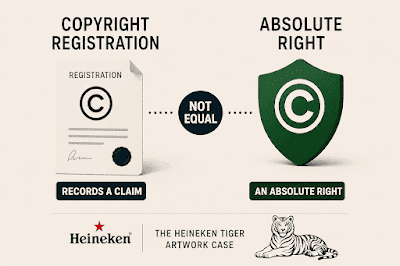
It is often presumed that “Once a copyright is registered, it is safe.” But a copyright registration under Indian law is an administrative record. The Copyright Office records the claim made by an applicant. It does not examine whether the work is original, whether it was genuinely created by the person claiming authorship. These questions are not resolved at the stage of registration.
They arise, if at all, only when the registration is challenged. A recent decision of the Delhi High Court in Heineken Asia Pacific Pte. Ltd. v. Vijay Keshav Wagh makes this principle clear. A copyright registration obtained for a product label was found to be a copy of an internationally recognised artistic work, and the Court directed its removal from the Register of Copyrights. The case carries key principles about the limits of copyright registration, the intersection between copyright and trademark law, and the procedural safeguards that exist to prevent the system from being misused.
What is Copyright Registration?
Under the Copyright Act, 1957, copyright subsists in an original work from the moment it is created. Registration is optional, not a precondition for protection. Section 44 of the Act provides for the maintenance of a Register of Copyrights, and Section 45 permits any person claiming authorship to apply for registration of their work. Registration carries evidentiary value. A registered copyright creates a prima facie presumption in favour of the registered owner in legal proceedings. However, the presumption is rebuttable. Registration does not validate the originality of the work, confirm the identity of the true author, or prevent an aggrieved party from seeking its removal if the registration was wrongly obtained. The certificate of registration is not a final finding on originality. It is a record of a claim.
The Proviso to Section 45: Special Rule for Labels and Marks
The proviso to Section 45 of the Copyright Act, 1957 introduces an important additional condition when the work being registered is an artistic work used as a label or mark in connection with goods. In such cases, the Copyright Office must be satisfied that the applicant has the right to use that mark before registration is granted. An artistic work used on a product label frequently performs a dual function. It is a creative expression and, simultaneously, a brand identifier. If the same artistic work is already registered or applied for as a trademark by someone else, granting copyright registration to a second person amounts to lending apparent legal legitimacy to an act of copying.
To give effect to this requirement, the law mandates a specific procedural step. The applicant must declare that no trademark application or registration exists for any mark deceptively similar to the artistic work being registered. The Trade Marks Registry must also issue a mandatory search certificate confirming that no conflicting trademark exists on its register. That certificate is placed before the Registrar of Copyrights so that the assessment of the applicant’s right can be made before registration is granted. Where this condition is not met, the registration that follows is vulnerable to challenge.
What Happened in This Case?
Heineken Asia Pacific Pte. Ltd., a Singapore-based company and part of the global Heineken group, is the owner of the well-known TIGER artistic work, a distinctive tiger device that has been associated with Tiger Beer across international markets for decades. Heineken’s TIGER marks are registered in India. Heineken’s rights are additionally recognised in India by virtue of the Berne Convention, to which Singapore is a signatory.
The respondent, Vijay Keshav Wagh, obtained copyright registration for an artistic work titled “SHREE SAKSHAT” bearing Registration No. A-116796/2017 dated 04.05.2017. The SHREE SAKSHAT label incorporated Heineken’s TIGER artwork as its foundation. The modifications made to the original were minimal: a letter V was placed in the backdrop of the TIGER artwork, the word “SHRI” in Hindi was added at the top, and the word “SAKSHAT” in English appeared at the bottom of the letter V. These additions did not substantially alter the character or nature of the underlying artistic work. Heineken filed a petition under Section 50 of the Copyright Act, 1957 before the Delhi High Court seeking rectification of the Register of Copyrights by removal of the SHREE SAKSHAT registration.
What the Court Found
The Court, presided over by Justice Tushar Rao Gedela, examined the two artistic works and found that Heineken’s TIGER artwork had been copied entirely in the SHREE SAKSHAT label. The minor additions made by the respondent did not constitute originality. The essential character of the underlying work remained identical to Heineken’s TIGER device. The respondent argued that no exclusive rights could be claimed over the TIGER artwork because several brands use the word “TIGER” or related tiger imagery, and the mark had therefore become diluted. The Court rejected this argument. The Court also identified a critical procedural failure at the stage of registration. The mandatory search certificate issued by the Trade Marks Registry before the copyright registration was granted had failed to include Heineken’s previously registered TIGER trademarks on the register.
This meant the Registrar of Copyrights did not have before them the information required to assess whether the SHREE SAKSHAT work was original or whether the applicant had the right to use it. The proviso to Section 45 was therefore not effectively complied with. This procedural gap allowed a registration that ought never to have been granted. The Court directed the Registrar of Copyrights to remove the SHREE SAKSHAT artistic work from the Register.
Section 50: The Power to Rectify the Register
Section 50 of the Copyright Act, 1957 provides the mechanism through which an aggrieved party can approach the High Court for rectification of an entry in the Register of Copyrights. A registration may be challenged and removed where it was made without sufficient cause, is erroneous or defective, or was obtained through a process that did not comply with the requirements of the Act.
Copyright registration is an administrative act and administrative processes can fail. Where a registration is obtained without complying with mandatory procedural requirements, or where the registered work lacks the originality that copyright law demands, the High Court retains the power to intervene and correct the record. The existence of a registration certificate does not place that registration beyond challenge. Section 50 ensures that a wrongly registered copyright does not permanently cloud the rights of the true owner of the original work.
When Copyright and Trademark Law Operate Together
One of the significant features of this case is the recognition that an artistic work used on a product label can be simultaneously protected under both copyright law and trademark law. These two areas of law are distinct, but they are not mutually exclusive. Where an artistic work functions as a trademark, identifying the commercial source of goods in the marketplace, and a second party copies that work onto their product’s label, the rights holder can invoke both copyright law and trademark law at the same time. Copyright law addresses the reproduction of the original creative work. Trademark law addresses the deception of consumers regarding the source of goods and the protection of established commercial goodwill.
The proviso to Section 45 is the mechanism that connects these two areas. By requiring the Copyright Office to verify whether an artistic work proposed for registration conflicts with a registered trademark, the law prevents the copyright registration system from being used to override existing trademark rights. Where that check is not properly carried out, the resulting registration is left open to removal. And where the artistic work also functions as a trademark, both copyright and trademark law can be brought to bear simultaneously against the person who copied it.
The Broader Picture
Two practical points follow from this case for anyone dealing with copyright registration for labels, packaging designs, or brand artwork. First, copyright registration does not validate originality. The Copyright Office records what it is told. If the mandatory search certificate mechanism fails, or if an applicant makes a false declaration, the registration that results is built on a flawed process. That flaw can be exposed when the registration is challenged under Section 50. A certificate of registration is not a finding that the work is original, and it is not a shield against a challenge from the true owner of the original. Second, where an artistic work also functions as a trademark, the copying of that work has legal consequences under two bodies of law simultaneously. A brand owner whose trademark artwork is copied onto a competitor’s label can invoke copyright law and trademark law together. That dual exposure is relevant not only to the brand whose work has been copied, but also to anyone who obtains copyright registration for a label design without first ensuring that the design is genuinely original and does not copy an earlier trademark artwork.
Also Read: Zee Entertainment v. BSNL: Madras High Court Permits Withdrawal of Copyright Suit
Conclusion
Obtaining copyright registration for a label or packaging design that copies someone else’s original artistic work does not protect your brand. The registration can be challenged and removed. And where that artistic work also functions as a trademark, both copyright and trademark law can be brought to bear simultaneously. A copyright certificate is a record, not a verdict. Originality is a question that courts answer, not a conclusion that flows from a bureaucratic stamp.