This comprehensive roundup covers critical Indian IP law developments in July 2026, including landmark AI copyright rulings, trademark disputes, and patent updates.
The Madras High Court recently granted an ad interim injunction against AI training using scraped content, highlighting a divergence from recent Delhi High Court rulings.
This week’s IP digest covers critical developments across Indian and international courts. Key highlights include the Bombay High Court's application of the 'bare possibility' test in pharmaceutical disputes and the Delhi High Court's landmark ruling on dynamic injunctions for live sports broadcasting. We also track the GI certification of Tezpur litchi, Google’s latest AI copyright defense, and the cancellation of the 'Glass Skin' trademark registration. From procedural registry updates to global AI patent litigation, this digest provides essential updates for practitioners tracking the rapidly evolving Intellectual Property landscape in India and abroad.
Understanding copyright infringement in India requires navigating complex principles like the originality threshold, the idea-expression dichotomy, and the scope of fair dealing. Courts assess infringement through the lens of a reasonable person, filtering out unprotectable elements such as historical facts or generic themes before comparing works. With the rise of digital piracy and AI, legal doctrines like dynamic injunctions and moral rights have become vital for creators. This guide breaks down the core legal frameworks that govern modern disputes, helping rights holders distinguish between actionable piracy and unavoidable similarities in shared subject matter.
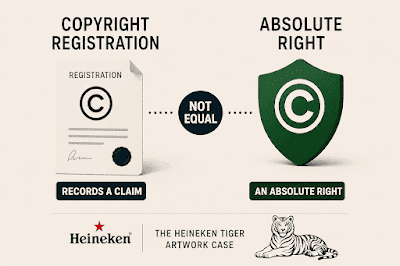
Is a copyright registration proof of ownership? The Delhi High Court’s ruling in Heineken Asia Pacific v. Vijay Keshav Wagh confirms that copyright registration is merely an administrative record of a claim, not a definitive verdict on originality. This case highlights the critical importance of the proviso to Section 45 and the necessity of mandatory search certificates when registering label artwork. We examine why copyright and trademark law are not mutually exclusive and how brand owners can rectify a falsely obtained registration. Protect your intellectual property by understanding these essential legal safeguards today.
•8 min read
Free Email Newsletter
Stay Ahead in IP Law with Its IP Time
Receive concise weekly and monthly IP Law updates.