The Madras High Court recently allowed Zee Entertainment to withdraw its copyright infringement suit against BSNL and others regarding the film 'SUPER DUPERR'.
The Madras High Court ruled that an interim injunction cannot be granted in copyright disputes where the chain of title is contested and plagued by rival claims.
The Delhi High Court in Hindustan Unilever v. Kwick Living settles territorial jurisdiction by leveraging defendant admissions, ensuring expedited interim relief adjudication.
The Madras High Court in Screen Scene Media v. Dr. S. Venkatesh affirmed an interim injunction, ruling that cinematograph film ownership requires clear chain of title.
The Madras High Court in Eros Technologies Digital FZE v. Ayngaran International Films rules that Section 55 copyright infringement claims override private arbitration clauses.
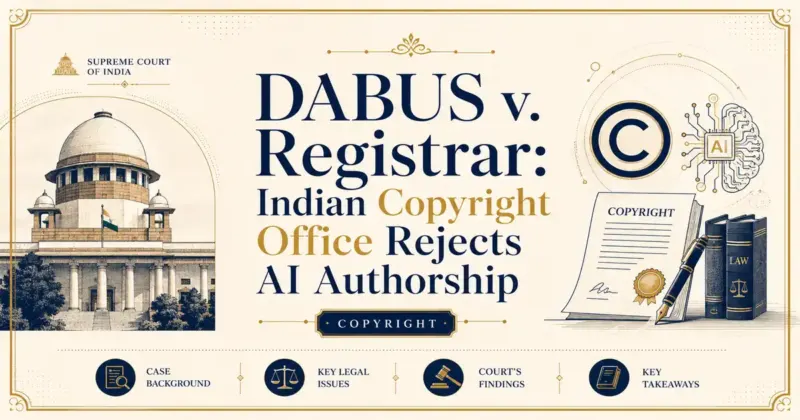
The Registrar of Copyrights has formally rejected the application naming an AI system, DABUS, as an author, reaffirming that statutory authorship under the Copyright Act 1957 is strictly reserved for legal persons. While algorithmic outputs may satisfy the originality standard under the Modak precedent, the person who initiates the creative process must be identified as the author. The order underscores that artificial intelligence lacks the legal personality necessary to hold property rights, and any attempt to grant such status remains a matter for Parliamentary legislative reform.
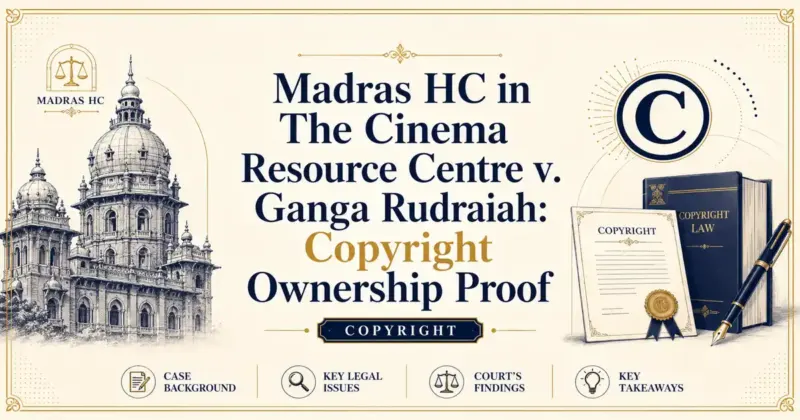
The Madras High Court has established that possession of photographic materials does not equate to ownership of copyright. In a ruling concerning historical film assets, the court denied injunctive relief because the plaintiffs failed to produce a written assignment proving a clear chain of title. This case serves as a critical precedent for IP practitioners, emphasizing that without valid legal instruments as per Section 17 of the Copyright Act, claimants cannot sustain a declaration of ownership. Establishing the initial authorship and the subsequent transfer of rights is non-negotiable in copyright litigation.
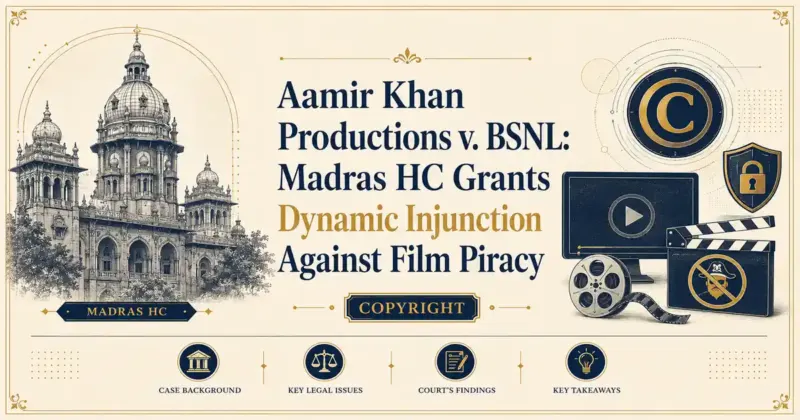
The Madras High Court’s decision to grant a dynamic blocking order against internet service providers underscores the judiciary's proactive stance in protecting cinematographic intellectual property. By invoking Section 13(1)(b) and Section 51 of the Copyright Act 1957, the court recognized that the immediate restraint of rogue websites is essential to preventing irreparable harm. This case serves as a vital precedent for IP lawyers, highlighting that comprehensive evidentiary schedules and precise adherence to Order XXXIX of the Civil Procedure Code are critical to securing effective interim relief.
The Madras High Court has issued a landmark dynamic injunction to combat film piracy, ordering multiple internet service providers to block access to both existing and future unauthorized mirror websites hosting copyrighted content. Grounded in Section 51 of the Copyright Act 1957, this ruling confirms that the Central Board of Film Certification (CBFC) certificate serves as prime facie evidence of ownership. Practitioners should utilize broad, future-facing prayer clauses to effectively neutralize digital piracy and prevent the persistent migration of infringing content to new domain names.
Copyright law in India protects the expression of ideas rather than ideas themselves, requiring a modicum of creativity to meet the statutory threshold for originality under Section 13. As established by Supreme Court precedent, originality is determined by the author's skill and labour, distinct from the mere sweat of the brow. Fair dealing provisions under Section 52 provide necessary exceptions for research and academic use, provided they do not infringe upon the owner's commercial rights. Understanding these principles is essential for balancing creator incentives with public access in the digital landscape.
•13 min read
Free Email Newsletter
Stay Ahead in IP Law with Its IP Time
Receive concise weekly and monthly IP Law updates.