
Procedural Conclusion in Copyright Infringement Litigation: Zee Entertainment v. BSNL
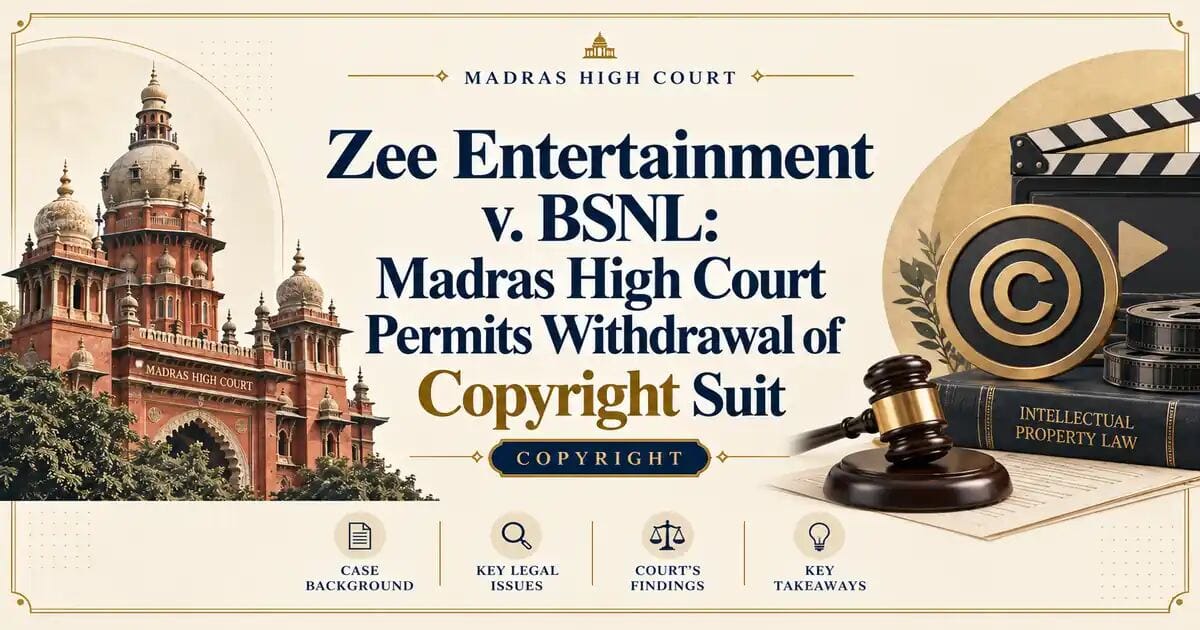
The Madras High Court, presided over by Hon’ble Dr. Justice A.D. Maria Clete, dismissed the suit filed by Zee Entertainment Enterprises Limited against Bharat Sanchar Nigam Limited (BSNL) and 32 other respondents as withdrawn, following an explicit endorsement made by the plaintiff’s counsel. The litigation, initiated under the Copyright Act, 1957, sought a permanent injunction to prevent the unauthorized digital distribution and online streaming of the cinematographic film “SUPER DUPERR” by various internet service providers and cable operators.
In Zee Entertainment Enterprises Limited Vs Bharat Sanchar Nigam Limited and 32 others, C.S(COMM DIV).102/2026, the court addressed a comprehensive prayer seeking to restrain a broad spectrum of digital service providers from facilitating or hosting content that infringed upon the plaintiff’s copyright-protected cinematographic film. The suit, which had reached the stage of active judicial consideration, concluded with the plaintiff seeking permission to withdraw the matter in its entirety, including the connected Original Applications (OA Nos. 290 and 291 of 2026).
Background and Material Facts
Zee Entertainment Enterprises Limited, the plaintiff, sought to protect its proprietary interests in the cinematographic work titled “SUPER DUPERR”. The litigation was structured as a classic quia timet and infringement action, targeting a large array of entities, including government-backed telecommunication providers, private internet service providers (ISPs), and cable network operators. The suit was instituted under the provisions of the Code of Civil Procedure, 1908, read with the Copyright Act, 1957, and the Commercial Courts Act, 2015, which provides a specialized framework for the swift adjudication of commercial disputes.
The plaintiff’s grievance centered on the anticipated and ongoing unauthorized dissemination of the film via various mediums, including internet streaming, cable television, and satellite services. The relief sought was extensive, requesting a permanent injunction against the named defendants and any other parties who might be identified in the future, effectively seeking a dynamic injunction to block access to websites and digital platforms hosting pirated versions of the work. Section 51 of the Copyright Act, which defines when a copyright is infringed, formed the substantive bedrock of the plaint, while Section 55 provides for the civil remedies, including injunctions, that a copyright owner may pursue against infringers.
The legal team representing the petitioner was led by Mr. S. Deepak of M/s. P.K. Law Firm. During the proceedings, Ms. Amutha Ganesh appeared on behalf of the eighth defendant, Tata Teleservices Ltd. The case, filed under the jurisdiction of the Commercial Division of the Madras High Court, adhered to the rigorous documentation requirements set forth in the Original Side Rules of the High Court, which govern the procedural formalities for civil litigation within the High Court’s jurisdiction.
Legal Issues and Judicial Reasoning
The central question before the Madras High Court involved the balance between the copyright holder’s rights to exclusivity and the operational responsibilities of ISPs and cable providers in managing digital content. The plaintiff invoked Section 62 of the Copyright Act, which pertains to the jurisdiction of the court for the institution of suits, ensuring that the matter was brought before the appropriate forum. However, the court did not reach a stage where it had to adjudicate on the merits of the infringement claims, nor did it have to grapple with the complexities of blocking orders or the liability of intermediaries.
The judicial process was truncated by the plaintiff’s own decision to withdraw the suit. Upon the matter being taken up for hearing on September 9, 2026, the counsel for the plaintiff informed the court of their intention to withdraw the proceedings. This decision was formalized through a written endorsement placed on the court bundle. Under the Indian legal framework, a plaintiff holds the right to withdraw a suit under Order XXIII of the Code of Civil Procedure, provided the court grants such permission. When the court is satisfied that the plaintiff intends to abandon the claim, it records the submission and issues an order of dismissal.
“When the matter was taken up for hearing today, the learned counsel for the plaintiff seeks permission of this Court to withdraw this Civil Suit and made an endorsement to that effect in the Court bundle.”
Hon’ble Dr. Justice A.D. Maria Clete
The court, recognizing the procedural sanctity of the plaintiff’s request, did not enter into the merits of the allegations concerning the unauthorized exhibition, transmission, or communication of the film “SUPER DUPERR”. By recording the submission and the endorsement, the court effectively terminated the litigation, leading to the closure of the connected applications that were filed alongside the main suit.
Decision and Significance
The Madras High Court’s order serves as a reminder of the procedural flexibility afforded to litigants in civil and commercial copyright matters. While the suit originally promised a deep exploration of the liabilities of ISPs and the scope of “dynamic” injunctions in the Indian digital domain, the outcome resulted in a quiet termination of the conflict. The court explicitly noted that there would be no order as to costs, acknowledging that the resolution was reached by the voluntary action of the plaintiff rather than through a protracted adversarial contest.
For IP litigators and corporate counsel, this matter highlights several practical takeaways:
- Voluntary Withdrawal: The ability to withdraw a suit without a judicial determination on merits allows parties to navigate changing commercial realities, such as successful out-of-court settlements, licensing arrangements, or shifts in the economic value of the copyrighted work.
- Procedural Compliance: The case underscores the necessity of strict compliance with the Original Side Rules and the Commercial Courts Act, 2015. Even in a simple withdrawal, the court requires a formal endorsement on the record to ensure that the termination of the lis is documented with precision.
- Dynamic Injunctions: Although this specific suit was withdrawn, the prayer structure itself indicates that plaintiffs continue to pursue broad, proactive relief against “future websites” and unknown entities, confirming that the legal strategy for protecting cinematographic works in India remains focused on curbing digital piracy at the source of transmission.
- Costs and Closure: The order confirming that there shall be “no order as to costs” is standard in cases where the parties have resolved their differences or the plaintiff has opted out of the litigation early, preventing unnecessary financial burdens on the respondents who had been joined to the suit.
The dismissal of Zee Entertainment Enterprises Limited Vs Bharat Sanchar Nigam Limited signifies the conclusion of this specific legal chapter. While it does not set a precedent regarding the substantive law of copyright infringement or intermediary liability, it stands as a pragmatic example of how commercial copyright disputes are managed within the Indian judicial system. By opting for withdrawal, the plaintiff managed to avoid a judgment that could potentially have served as a negative precedent had the defense of the ISPs been successfully argued. For the defendants, the dismissal provides immediate relief from the ongoing litigation and the associated compliance costs. The Madras High Court’s efficient handling of the withdrawal, ensuring that all connected applications were closed simultaneously, reinforces the efficacy of the Commercial Division in managing its docket, even when cases do not proceed to a final trial judgment.
The matter reflects the tactical nature of intellectual property litigation where the mere filing of a suit and the procurement of the notice phase can often achieve the desired commercial objective, rendering further judicial intervention unnecessary. Practitioners should note that the court’s intervention was limited solely to recording the withdrawal, thus preserving the parties’ freedom to approach the court again should future infringements of their intellectual property rights necessitate further legal action.
Case Details: Zee Entertainment Enterprises Limited Vs Bharat Sanchar Nigam Limited and 32 others | Case Number: C.S(COMM DIV).102/2026 | Court: Madras High Court | Date: 26-09-09
Presiding Bench: THE HON’BLE DR. JUSTICE A.D.MARIA CLETE