
Background and Material Facts
Looking to understand Copyright Law better? Read our complete Copyright Law Guide.
The appellant, M/s. Evergreen Media P. Ltd., is engaged in the business of distribution, exhibition, and exploitation of cinematographic films across various media platforms. The current legal dispute concerns the ownership and exploitation rights of 320 Tamil films listed in the schedule to the plaint in C.S. (Comm.Div.) No. 54 of 2024. The appellant traces its claim to an agreement dated March 19, 2012, executed with the first three respondents (M/s. O.K. Films, M/s. Ho Ho Films, and M/s. Ding Dong Bell Films). Under this agreement, the appellant asserts that it acquired exclusive copyright in all formats, including but not limited to digital, OTT, satellite, and future technological adaptations, in perpetuity.
The appellant further contends that the first three respondents, in turn, had acquired the negative rights to these films from the original producers or via subsequent legitimate assignments. Based on this chain of title, the appellant commenced legal action seeking a permanent injunction against the respondents to restrain them from infringing upon these copyrights. Alongside the suit, the appellant filed O.A. No. 173 of 2024 for an ad-interim injunction. The Madras High Court initially granted an ex parte injunction on March 5, 2024, which effectively halted the respondents from exploiting the films in question.
The dispute escalated when various third parties, including the fourth and ninth defendants, asserted their own independent claims to the copyrights of several films within the schedule. These respondents contended that the appellant’s title was not only unverified but contested by rival documents. Subsequently, the respondents moved to vacate the ex parte injunction through A.Nos. 567 and 568 of 2025. The learned single Judge, upon reviewing the rival claims and the lack of a clear title, vacated the interim order on April 21, 2025. This prompted the appellant to file the present appeals, OSA (CAD) Nos. 80 to 82 of 2025, before the Division Bench of the Madras High Court.
Legal Issues
The core legal challenge before the Division Bench was whether the appellant had established the three cardinal principles for the grant of an interim injunction: the existence of a prima facie case, the balance of convenience, and the potential for irreparable hardship. Central to this issue was the validity of the appellant’s title chain.
- Prima Facie Title: Whether the appellant, as an assignee, sufficiently demonstrated that its assignors (the first three respondents) possessed valid title to the 320 films, thereby enabling the valid transfer of rights to the appellant.
- Cloud over Title: Whether the existence of multiple, competing claims to the same cinematographic rights creates a cloud over the title that necessitates a formal declaration of ownership before injunctive relief can be granted under the Specific Relief Act.
- Procedural Necessity: Whether the pendency of an application to amend the plaint to include a prayer for a declaration of ownership effectively precludes the grant of an interim injunction until such title is proven.
These issues touch upon the scope of Order XXXIX Rule 1 of the Code of Civil Procedure (CPC), which governs the power of the court to grant temporary injunctions to protect property from damage or alienation during the pendency of a suit. The court also examined the requirements of Section 51 of the Copyright Act, 1957, which defines when a copyright is deemed to be infringed and sets the parameters for pursuing legal remedies against unauthorized use of protected works.
Court’s Reasoning and Findings
The Division Bench, led by Justice P. Velmurugan, upheld the order of the single Judge, affirming that the appellant had failed to clear the threshold required for an interim injunction. The Court observed that in cases of intellectual property disputes involving cinematographic works, the burden of proof rests heavily on the plaintiff to establish an unbroken chain of title.
The Court’s reasoning was anchored in the following critical observations:
1. Failure to Substantiate the Chain of Title
The Court emphasized the legal maxim that a party cannot transfer a better title than what they possess (nemo dat quod non habet). While the appellant produced an agreement from 2012, the respondents simultaneously produced conflicting documents asserting their own ownership over the same films. The Court found that without a trial to adjudicate the veracity of these rival documents, it was impossible to confirm whether the appellant’s assignors held any valid rights to convey in the first place.
2. The Requirement of Declaration
The Bench noted that the appellant, realizing the vulnerability of its claim, had filed an application to amend its plaint to include a prayer for a declaration of title. This development served as a judicial admission that the ownership rights were indeed in dispute. The Court opined that in the absence of a clear, undisputed title, an injunction serves as a disproportionate remedy. The Court held that when a plaintiff’s very ownership is clouded by substantial evidence from defendants, the primary relief should be a declaration of rights, and not merely a claim of infringement.
3. Balance of Convenience
The Court assessed the balance of convenience regarding the ongoing commercial exploitation of the films. The respondents, some of whom claimed to have been exploiting these rights since 2016, argued that the injunction caused them significant economic loss. The Bench reasoned that it would be inequitable to restrain parties who have been in continuous, albeit contested, operation when the plaintiff’s own claim to exclusive rights lacks prima facie verification.
Also Read: Zee Entertainment v. BSNL: Madras High Court Permits Withdrawal of Copyright Suit
Decision and Significance
The Division Bench dismissed the appeals and upheld the vacating of the ad-interim injunction. The Court directed that the suit proceed to trial, allowing both parties to present evidence, cross-examine witnesses, and have their title claims determined on merits. The Court explicitly stated that the observations made in the interlocutory stage were not to influence the final adjudication of the suit.
Significance for IP Practitioners
This judgment serves as a cautionary precedent for IP holders who rely on long-standing assignment agreements in the film industry. It reinforces the principle that copyright ownership is not merely a matter of executing a contract but requires a , unimpeachable chain of title.
- Due Diligence: The judgment highlights the necessity of rigorous due diligence when acquiring negative rights. When purchasing rights from producers or third parties, the assignee must ensure that the assignor’s title is not merely asserted but documented and verified.
- The “Clouded Title” Defense: The court has clearly indicated that when defendants introduce competing documents that raise a “cloud” over a plaintiff’s title, the court will likely decline interim relief. Practitioners must anticipate that in high-stakes commercial disputes, the mere production of a registered agreement may be insufficient if the defendant provides evidence suggesting a break in the title chain.
- Strategic Drafting: The decision underscores the importance of proper framing of the plaint. If there is even a remote risk that the defendant may challenge the underlying title, plaintiffs should incorporate a prayer for a declaration of title from the outset, rather than relying solely on claims for infringement and injunction.
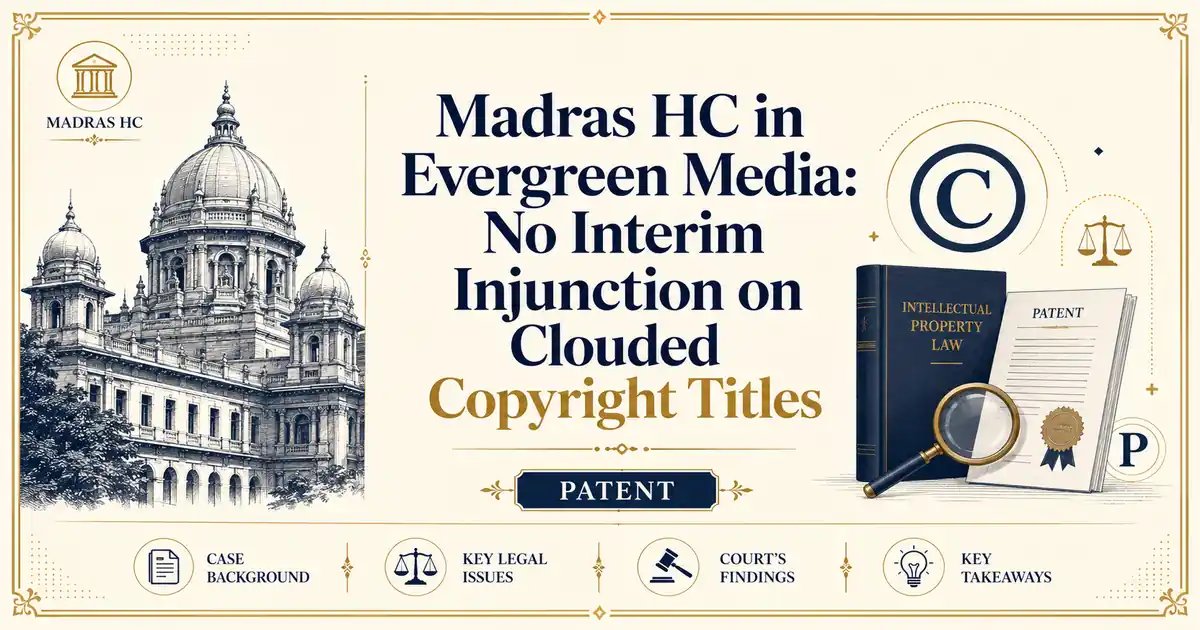
In summary, the Madras High Court’s decision in M/s. Evergreen Media P. Ltd. vs T.J. Ashok maintains the high evidentiary bar required for obtaining temporary injunctions in complex intellectual property litigation. By refusing to intervene in a battle of rival title documents at an interlocutory stage, the Court has affirmed the necessity of full-scale trials for resolving ownership disputes involving cinematographic works. This ensures that injunctions, which are essentially equitable remedies, are not used as tools to stifle legitimate business operations where the legal title remains in a state of flux.
Case Details: M/s.Evergreen Media P. Ltd., Vs T.J.Ashok,, OSA(CAD).80/2025, Madras High Court, 26-08-31