
This article was written by B. Srujana, a third year law student at Dr. Ambedkar Global Law Institute, Tirupati affiliated to Sri Venkateswara University, Tirupati.
Introduction
New to Copyright Law? Start with our complete Copyright Law Guide.
Everyone has heard of copyright at least once. So what does it actually mean? Copyright is a form of intellectual property, an exclusive right given to the person who created a work. If you’re humming a song, does that mean you hold copyright over it?
Copyright gives creators rights over their work, covering literary, musical, artistic, cinematic, and other creations. Creators get copyright automatically upon expression, without needing formal registration.
Idea and Expression Dichotomy
Idea and expression are the two key concepts in claiming copyright. An idea is a thought in the mind, while expression is that thought conveyed through a medium, whether literary, musical, artistic, or otherwise. Bare ideas are not protected under the Act; only their expression is.
Two people can have the same idea, but the way each expresses it, through arrangement, creativity, skill, and labour, determines who owns the resulting work.
Idea v. Expression of the Idea
Take movies as an example. Many films share themes like friendship, revenge, or family drama, yet each film is distinct because of how it presents that theme. Idea and expression are separate concepts, though in some cases the line between them is thin, where an idea can only be expressed in a limited number of ways.
Say you and a friend discuss a business idea for a food truck, and the next day your friend starts that business without you. Can you claim copyright over it? No. Copyright protects only the expression of an idea, not the idea itself.
Copyright itself is intangible, incorporeal property. It consists of a bundle of rights vested exclusively in the owner, in recognition of the creator’s intellectual and creative effort. It is an exclusive statutory right granted for a limited period, so the creator can reap the benefits of the work. Once that period ends, the work enters the public domain and becomes freely accessible to everyone. Copyright protects both published and unpublished works, and its symbol is ©.
In R.G. Anand v. Delux Films, the Supreme Court held that there is no copyright in an idea, subject matter, theme, plot, or historical or legendary facts. Infringement is confined to the expression of the idea or the manner of its arrangement.
Requirement of Originality
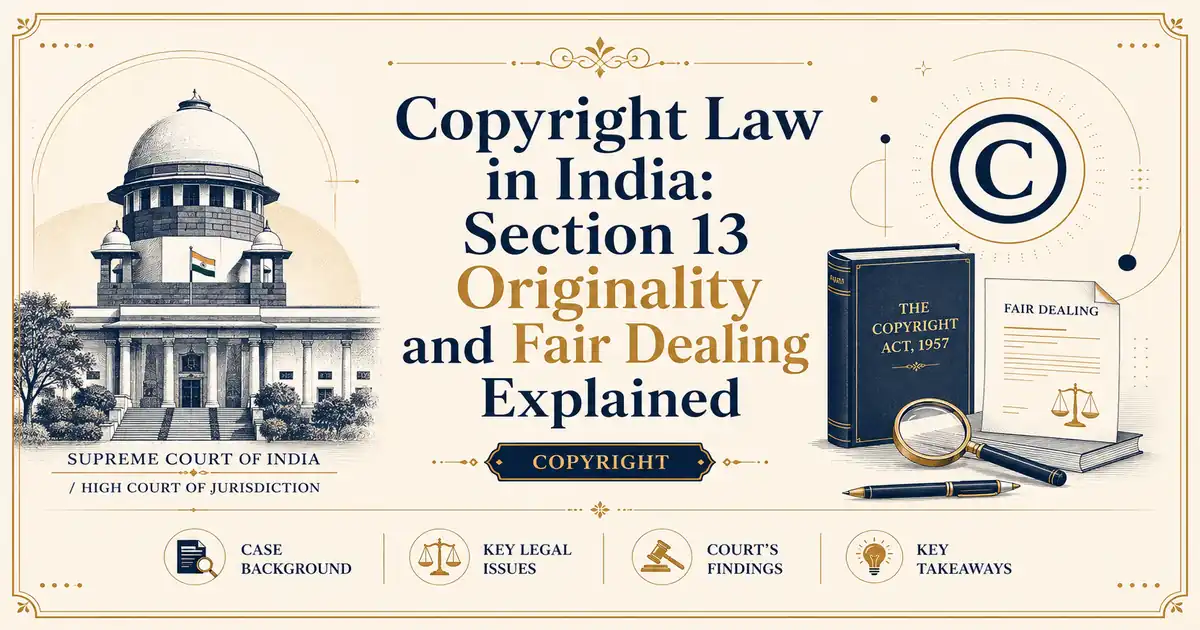
Copyright is an exclusive right conferred on creators who produce original work. Section 13 of the Copyright Act, 1957 provides that copyright subsists in original works, namely literary, musical, dramatic, and artistic works, as well as in secondary works such as cinematograph films and sound recordings.
The Act specifically requires originality, produced through the creator’s skill and intellectual effort. Secondary works also qualify as original work, since the filmmaker arranges the contributions of various authors and producers in a way that vests exclusive rights in the maker over the finished film.
In Eastern Book Co. v. D.B. Modak, 2008 (36) PTC 1 (SC), the Supreme Court addressed whether the publishers of Supreme Court Cases (SCC) could claim copyright over edited versions of judgments and associated editorial material. The ruling clarified the standard of “originality” under the Copyright Act, 1957, moving away from the “sweat of the brow” doctrine toward a “modicum of creativity” standard.
Origin and Development of Copyright Law in India
Copyright law entered India through an enactment during the East India Company’s regime, the Indian Copyright Act, 1847. Under that Act, the term of copyright was the author’s lifetime plus seven years post-mortem, though the total term could not exceed forty-two years.
In 1914, the legislature enacted a new Copyright Act, essentially an extension of the UK Copyright Act, 1911. The 1914 Act, with minor adaptations, remained in force until 1957, when India enacted its own independent copyright statute for the first time. The Act came into force on 21 January 1958.
Before its own Act, India followed the 1914 Act, which was itself tied to the British Copyright Act, 1911. The Indian Copyright Act, 1957 repealed the 1914 Act, which had incorporated virtually the whole of the Imperial Copyright Act, 1911. The 1957 Act has since been amended six times, in 1983, 1984, 1992, 1994, 1999, and, most significantly, in 2012. The 2012 amendment brought the Act in line with the WIPO Copyright Treaty and the WIPO Performances and Phonograms Treaty, strengthened performers’ and authors’ rights in the digital environment, and added accessibility provisions for persons with disabilities.
The Copyright Act, 1957
The Copyright Act, 1957 is the primary legislation governing copyright in India. As originally enacted, it contained 79 sections across 15 chapters, supplemented by the Copyright Rules, 1958. It came into force on 21 January 1958, and is now in conformity with international instruments generally, and the TRIPS obligations in particular. The Act protects the works of authors, including art, music, drama, and sound recordings, to preserve originality and prevent misuse.
If a short film is created from an existing movie, reusing the same characters and elements without the original creator’s permission, the Act protects the original creator, since the film is the product of their work.
What Can Be Copyrighted in India
- Artistic work. Section 2(c) of the Copyright Act, 1957 defines “artistic work.” This includes works like drawing, painting, and sculpture, and may also include maps, diagrams, plans, or charts. Architectural work is also included, though it has its own definition under Section 2(b). Any original work of art is protected under the Act.
- Cinematograph film. Section 2(f) defines “cinematograph film” as a work of visual recording, or images expressed through any medium, including any accompanying sound recording, that together make up a film. The producer of the film is considered its owner and holds exclusive rights to make copies, sell, hire, or offer the film for sale, and to communicate it to the public.
- Dramatic work. Section 2(h) defines “dramatic work” as compositions including recitation, choreographic work, or any entertainment performed before an audience. Cinematograph films are not included under this definition. A dramatic work is a performance, with or without words or music, arranged in a set order, but the arrangement of scenes or dialogue must exist in written form to claim copyright. For instance, if you’re watching a live drama, the scenes and dialogue were already scripted and rehearsed. The person who created that script is the author, and holds the exclusive rights to reproduce, communicate, or perform the work publicly, issue copies, translate it, or make adaptations.
- Literary work. Section 2(o) defines “literary work” as any writing, including books, novels, articles, or scripts, and also includes computer programmes and databases, whether in print or another written form. The copyright owner holds exclusive rights to sell or hire the work, and copyright applies to both published and unpublished literary works. In Agarwala Publishing House v. Board of High School and Intermediate Education, AIR 1967 All 91, the Allahabad High Court held that even examination papers fall within the definition of literary work, given the expression of thought involved in setting them.
- Musical work. Section 2(p) defines “musical work” as a work consisting of music and its graphical notation, not including any words or actions intended to be sung, spoken, or performed with the music. A song is really two separate works, the lyrics and the music. The person who writes the lyrics is the author of that part, protected as literary work, while the arrangement of the music belongs to the composer, who is the author of that separate musical work.
- Sound recording. Section 2(xx) defines “sound recording” as a recording of sound, regardless of the medium or method used to make it. Songs featuring a singer’s voice, with or without music, recorded speech, and podcasts are all examples. The author of a sound recording is its producer. Musical works and the sound recordings that embody them are treated as separate subject matter for copyright, with copyright in the music vesting in the composer, and copyright in the recording vesting in the producer. A sound recording must not, in the process, infringe the copyright in any underlying literary, musical, or dramatic work.
Who Is an Author
An author is the creator of a work and its first owner. For example, if A composes both the lyrics and music for a song, A is the first owner and author of that song.
- Author. Section 2(d) defines “author.” The author is entitled to first ownership of the work. For literary or dramatic works, the author is the creator; for a musical work, the composer; for cinematograph films or sound recordings, the producer. When a person creates a work through their own skill and creativity, they are the owner of the copyright.
- Composers and producers. Composers and producers are also included within the definition of “author.” Section 2(ffa) defines a composer as the person who creates a musical work, a melody or tune. Section 2(uu) defines a producer as the person who creates a cinematograph film or sound recording, and vests ownership in them. For instance, a teacher who writes a book on their own time is the author of that book; a music composer is the first owner of the copyright in the composition.
- Work of joint authorship. Section 2(z) defines “work of joint authorship” as a work produced through the collaboration of two or more authors, where the contribution of one author is not distinct from the contribution of the others. In such cases, all authors share copyright equally, unless a written contract provides otherwise.
First Owner of the Copyright
Section 17 of the Copyright Act, 1957 provides that the author of a work is ordinarily its first owner. But Section 17 also carves out categories of people who become the first owner even though they are not the author.
- Section 17(a). Proprietor of a newspaper, magazine, or periodical. For example, if X, a journalist, writes articles as a full-time employee of a newspaper, the newspaper owns the copyright.
- Section 17(b). A person who pays valuable consideration for a work, for instance engaging someone to produce a painting or photograph for payment, becomes the first owner.
- Section 17(c). An employer owns the copyright in work created by its employees, for example a logo designed for the company.
- Section 17(cc). The speaker, or the person on whose behalf an address is delivered, is the first owner. For public speeches, the speaker owns the copyright; where the speech is delivered on someone else’s behalf, that other person owns it.
- Section 17(d). The government is the first owner in the case of government works, for instance government-commissioned projects.
- Section 17(dd). Where a work is created for, or under the control of, a public undertaking (e.g., ONGC, BSNL), the undertaking is the first owner.
- Section 17(e). Work concerned with an international organisation (e.g., the UN) vests first in that organisation.
Protection Under the Copyright Act, 1957
Do we need protection for our work, and which works qualify? Yes. A creator’s work can be misused, copied, or credited to the wrong person, and the Copyright Act, 1957 protects against that. To claim protection, a work must be original, fixed in a tangible form, and meet the publication or nationality and domicile conditions set out in Section 13.
These elements matter because copyright recognises the author as the original owner of something newly created, and protects that ownership. But copyright does not protect ideas or information, only their expression, in literary, dramatic, musical, and artistic works. The rights attached to each category vary. The general term of protection is the author’s lifetime plus sixty years, though the starting point, whether from death or from publication, varies depending on the nature of the work.
The following works are protected under Section 13 of the Copyright Act.
- Literary works
- Musical works
- Dramatic works
- Artistic works
- Cinematograph films
- Architectural works
- Sound recordings
The Act does not protect independent creation of similar work. For instance, in a school project, students may all get the same topic, but the presentation, arrangement of headings, and other creative choices they each make are individually owned, not shared.
Registration of Copyright
Registration of copyright is not mandatory, but it serves as prima facie evidence of ownership in court. It’s a voluntary act. Copyright protection arises automatically in India the moment an original work is created, and registering it gives the author an official record of ownership.
Say a novel is registered in 2025, and someone else later publishes the same novel while denying it was copied. The registration helps prove who the original owner is. While registration is voluntary, it strengthens the author’s position, supporting ownership claims, making licensing easier, and simplifying proof of infringement in court.
Sections 44 to 50A of the Copyright Act, 1957 govern registration, covering application requirements, publication requirements, and any administrative or judicial corrections. The Register of Copyrights must record the names or titles of the works. Non-registration doesn’t take away the owner’s rights, but registration acts as prima facie evidence and strengthens the owner’s claim in court.
Process of Registration
- Preparation of application
- Fee payment
- Submission
- Examination
- Registration
- Certification
The registration procedure is set out in Chapter X of the Copyright Act, 1957. The applicant fills out the application under Section 45 with the required documents, pays the prescribed fee, and submits it for examination. If the authorities require additional information, they’ll request it. Once all requirements are satisfied without objection, the work is registered, and certified copies can be obtained as provided under the Act.
Fair Dealing Under the Indian Copyright Act
Fair dealing is an important exception to copyright protection under Section 52 of the Copyright Act, 1957. It permits limited use of copyrighted work without the owner’s permission, for purposes like private research, criticism, review, reporting, and academic or educational use.
Indian fair dealing works differently from the US “fair use” doctrine it’s sometimes compared to. Section 52 is a closed list of specific permitted acts, including private use and research, criticism and review, reporting of current events, judicial proceedings, and a defined set of others, rather than an open-ended balancing test. That said, courts (for instance, in India TV Independent News Service v. Yashraj Films and Civic Chandran v. Ammini Amma) have drawn on factors like the purpose of the use, the amount copied, and the effect on the market for the original work, when deciding whether a particular use falls within one of Section 52‘s categories.
For instance, A writes an article on labour law. Y, a student, uses the article for academic purposes without A’s permission. Using someone else’s work for personal, educational, or research purposes isn’t infringement, unless the user copies the same article and publishes it as their own.
Conclusion
Copyright is a form of intellectual property that gives a person who creates a work, whether dramatic, artistic, musical, or otherwise, exclusive rights over it, in recognition of their own skill and thought. The Act ensures no one can claim copyright over work they didn’t create, and protects the owner’s right to their work. But that protection attaches only once the work is expressed, not to the bare idea behind it. There is no copyright in an idea, subject matter, theme, plot, or historical or legendary fact. A historical drama performed today by one person and tomorrow by another cannot be claimed as anyone’s copyright, unless the structure or performance itself was fixed in writing beforehand. A recipe’s method may not be protected, but its written explanation or a distinctive presentation of it can raise separate copyright questions.
Copyright protection exists to encourage creators and reward their creativity. The Copyright Act, 1957 protects against unauthorised use of a creator’s work, allowing them to earn from their intellectual property by licensing it, assigning it, or putting it to commercial use.
Also Read: Zee Entertainment v. BSNL: Madras High Court Permits Withdrawal of Copyright Suit
References
- Intellectual Property Law, Vijay Law Series, 4th edition
- The Copyright Act, 1957 (Bare Act). Available at indiacode.nic.in
- Eastern Book Co. & Ors. v. D.B. Modak & Anr., (2008) 1 SCC 1. Available at indiankanoon.org
- R.G. Anand v. Delux Films & Ors., AIR 1978 SC 1613. Available at Supreme Court judgment (sci.gov.in)
- Agarwala Publishing House v. Board of High School and Intermediate Education, AIR 1967 All 91. Available at indiankanoon.org