Skip to content
Subscribe

Browse the archive

Category: Copyright

Copyright

Music Licensing in Restaurants: Bombay HC Injunction Guide

Publicly playing music in any commercial establishment constitutes a 'communication to the public' under the Copyright Act, 1957, requiring valid public performance licences from rights holders. The Bombay High Court confirmed that exclusive licensees, such as PPL, have the statutory standing to enforce these rights and seek injunctive relief without needing to be registered as a copyright society under Section 33. Consequently, commercial operators cannot use ambient music or third-party streaming subscriptions as a defense for unlicensed public playback, as these do not grant the necessary commercial performance authorizations.
12 min read
Copyright

ANI v OpenAI: Navigating AI Training and Copyright Law in India

The ANI v. OpenAI litigation places Section 52 of the Copyright Act 1957 at the center of India's AI regulatory debate. With the Delhi High Court weighing whether unlicensed training of large language models on copyrighted news content constitutes fair dealing, the outcome will dictate the future of generative AI in India. While the DPIIT explores compulsory licensing, the current impasse highlights the legislative gap left by the 2012 amendment. Simultaneously, the Thaler application regarding AI authorship challenges the interpretation of Section 2(d)(vi) for autonomous, non-prompted machine outputs.

11 min read
Copyright

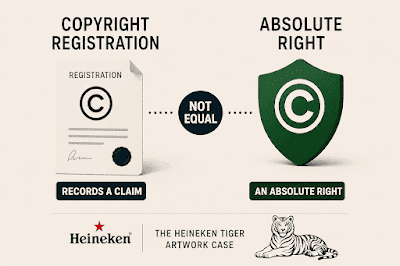
Heineken v Wagh: Why Copyright Registration Is Not a Verdict

Copyright registration in India serves as an administrative record of a claim rather than a conclusive verdict on originality. The Delhi High Court in Heineken Asia Pacific Pte. Ltd. v. Vijay Keshav Wagh reaffirmed that registrations obtained for labels lacking originality or violating the Section 45 proviso—requiring search certificates for conflicting trademarks—are vulnerable to rectification under Section 50. Brand owners must ensure their label designs are truly original, as the intersection of copyright and trademark law allows for dual enforcement when artistic works are copied onto commercial products.

8 min read
Copyright

Disney and Universal Win: US Court Allows MiniMax AI Trial

Courts are now actively permitting copyright infringement claims regarding AI training data to proceed to trial, signaling a major shift in legal risk for generative AI developers. The refusal of the US court to dismiss the Disney, Universal, and Warner Bros v. MiniMax case confirms that utilizing copyrighted works without authorization for model training constitutes a legally sufficient claim for direct and secondary infringement. For Indian IP practitioners, this sets a critical precedent for how global courts evaluate the unlicensed ingestion of protected content in commercial AI systems.

2 min read