
Introduction
Looking to understand Copyright Law better? Read our complete Copyright Law Guide.
Every brand that posts Reels on Instagram has done it. A trending Bollywood track drops in the background, the clip goes up, and the marketing team moves on. Nobody reads the fine print. Nobody checks whether using music from Instagram’s built-in library to sell ethnic wear, skincare, or sneakers is legally any different from a college student posting a dance video on a Friday night.
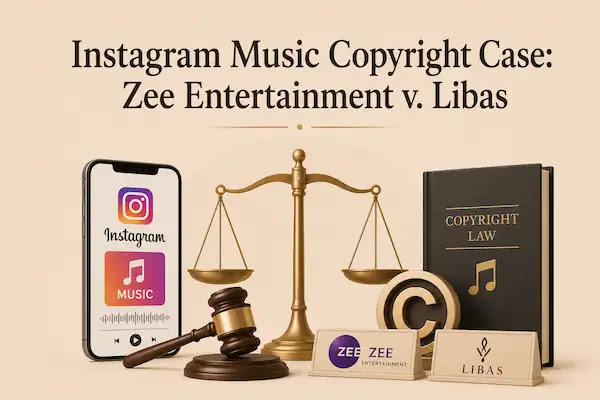
The defendant was Zivore Apparel Private Limited, the company behind the apparel brand Libas. The tracks at issue were Jugraafiya, Lehra Do, Piyu Bole, and Uyi Amma, all part of Zee’s repertoire and all present in Instagram’s music library. Libas used them in promotional Reels on its Instagram account to market its products. Zee said that amounted to copyright infringement. Libas said the music was right there in Instagram’s library, available for any business account to use.
Justice Tushar Rao Gedela, on 29 May 2026, rejected Libas’s position at the prima facie stage, accepted an undertaking from the brand not to use Zee’s repertoire pending adjudication, and referred the dispute to mediation at the Delhi High Court Mediation and Conciliation Centre with a direction to appoint a senior mediator familiar with the subject matter. The case sits at the crossroads of platform-level licensing architecture, commercial copyright exploitation, and the line between a personal user and a brand with a product catalogue to sell.
Background
Zee Entertainment operates Zee Music Company, which holds a catalogue of over 19,000 sound recordings. The company licenses its music across streaming platforms, radio, television, and digital media through structured commercial agreements. The arrangement with Meta Platforms, Instagram’s parent company, sits at the centre of this dispute. Zee and Meta had a licensing agreement that made Zee’s music available in Instagram’s built-in music library. That agreement, per Zee’s case, was limited in scope. It authorised individuals and entities to access the music strictly for personal, non-commercial use. It did not extend to using the music as background audio in promotional video content created by a corporate entity to advertise and sell consumer products as per Zee.
Understanding what copyright protects is necessary before understanding this dispute. Under Section 14(e) of the Copyright Act, 1957, the owner of copyright in a sound recording has the exclusive right to communicate that recording to the public. Separately, under Section 14(a), the owner of copyright in the underlying musical and literary works retains the exclusive right to perform those works in public and to make any sound recording in respect of them. When a brand synchronises a Bollywood track with a commercial video and distributes it on Instagram to an audience of potential customers, multiple rights are engaged simultaneously. The communication to the public, the synchronisation of the musical work with video content, and the direct commercial purpose of driving product sales all fall squarely within the bundle of rights that a copyright owner holds under the Act.
The question for the court was whether Zee had licensed any of those rights to Libas, directly or through its arrangement with Meta. Zee said it had not whereas Libas said the existence of the music in Instagram’s library was sufficient authorisation.
The Business Account Argument
Libas’s position before the Court was that Instagram makes music available in its library to all account types, including business accounts. The Reels feature itself is designed for brands to create short-form video content. Instagram offers analytics, branded content tools, and shopping integrations specifically for business accounts. If Instagram’s own platform architecture accommodates and encourages business use, the argument goes, then using the music that Instagram itself places in its library cannot amount to copyright infringement. The Court looked at this argument and found it wanting at the prima facie stage.
Justice Gedela examined Instagram’s Music Guidelines and the related policy documents. Those documents state that music available in the Instagram library can be used by individuals and entities strictly within the terms specified and cannot be used for any commercial purpose. The Court noted that Instagram places the compliance obligation on the user, not on Meta. A business account’s ability to access and technically use the music does not translate into a licence to use it for commercial exploitation. The existence of a feature in a platform’s interface is not the same as obtaining a licence from the copyright owner.
A licensor can only grant what it owns or is authorised to grant. Meta’s arrangement with Zee covered personal, non-commercial use. Meta could not, through its platform interface, extend broader commercial rights to users when those rights had not been conveyed to Meta in the first place. The principle applied in the analogous context of the Zee-Nykaa dispute, which was filed in April 2026 and raised an identical structural question, captures it simply. A party cannot transfer what it does not have.
The Court also rejected Libas’s request to implead Meta as a necessary party to the proceedings. The absence of a valid licence from Zee was, at this stage, the central question, and that question did not require Meta’s presence to be answered.
The Sync Rights Dimension
When Bollywood music is matched to a video and distributed commercially, what gets triggered is not simply a licence to play a song. A synchronisation licence authorises the combination of a musical work with a visual work. The sync right sits within the bundle of exclusive rights conferred on the copyright owner under the Act and ordinarily requires a separate, specific negotiation.
In simple terms, a streaming licence allows a user to listen to a song, a performance licence allows a venue to play it publicly and a synchronisation licence authorises the pairing of that music with video for a specific use. When Libas used Jugraafiya or Lehra Do as background music in a promotional Reel, the act involved synchronising Zee’s sound recording and the underlying musical composition with a visual sequence designed to sell kurtas. That is precisely the territory that a sync licence governs, and it is territory that falls entirely outside the scope of what a platform’s general music library arrangement grants to its users. Courts have repeatedly held that the duration of unauthorised use does not determine whether infringement occurred. In Shemaroo Entertainment Ltd. v. News Nation Network Pvt. Ltd., the Bombay High Court explicitly recognised that infringement analysis carries a qualitative dimension, not merely a quantitative one. Whether the clip was fifteen seconds or sixty seconds in the background of a Reel is beside the point if the use was commercial and unlicensed.
For more on how Indian courts draw these lines in copyright cases, including the originality threshold and what constitutes communication to the public, refer to our detailed analysis on copyright infringement principles under Indian law.
What Happened at the Hearing
By the time the matter came before the Court, Libas had already removed three of the four Reels that Zee had identified in its pre-suit correspondence. The fourth Reel had been taken down from Libas’s Instagram profile but remained accessible through a direct URL. Libas accordingly sought a direction to Meta to remove it at the server level.
Senior Advocate Abhishek Malhotra, appearing for Zivore Apparel, expressed the company’s willingness to negotiate a commercial arrangement with Zee. On instructions, the company gave an undertaking that it would not use any music from Zee’s repertoire available in Instagram’s music library until the Court finally decided the injunction application. The Court accepted and bound Libas to that undertaking.
Justice Gedela then referred the matter to the Delhi High Court Mediation and Conciliation Centre, directing the Centre to nominate a senior mediator with subject matter familiarity. The next date for the case was set for 7 September 2026.
A Pattern Zee Is Establishing
In April 2026, Zee filed a copyright suit against Nykaa, India’s largest listed beauty and fashion retailer, alleging unauthorised use of Zee’s songs in twelve Instagram Reels. Zee sought damages of approximately Rs. 2 crores. Nykaa subsequently moved the Court to implead Meta as a party, arguing that the platform’s role in the licensing chain needed examination. In a separate and significantly larger dispute filed the same month, Zee sued JioStar, the Reliance-Disney joint venture, seeking approximately Rs. 25 crores in damages, alleging that JioStar continued to use Zee’s music across television and streaming content after licensing agreements expired. The Delhi High Court directed JioStar to ensure no ongoing infringement pending the next hearing.
Read together, these cases point to a systematic gap in how corporate India approaches digital content licensing. Large brands with in-house legal and compliance teams, sophisticated marketing operations, and audiences of millions have been treating Instagram’s music library as a royalty-free toolkit for brand content. They were wrong. The courts have begun saying so.
Section 51 and Why Fair Dealing Does Not Apply
Section 51 of the Copyright Act, 1957 defines when copyright is infringed. The doing of any act that only the copyright owner is authorised to do, without a licence from the owner or without a licence otherwise permitted by the Act, constitutes infringement.
Libas could not point to a licence from Zee. The platform licence Zee had granted to Meta was explicitly restricted to non-commercial use, and the Court found no basis to read that licence as extending to brand promotional content.
The fair dealing exception under Section 52 of the Act provides a closed list of permitted acts. That list covers private or personal research, criticism or review, reporting of current events, and certain educational uses. Commercial advertising for a fashion brand does not appear anywhere on that list. The Delhi High Court in Civic Chandran v. Ammini Amma and the decisions in Super Cassettes Industries Ltd. v. Hamar Television Network Pvt. Ltd. both established that a defence of fair dealing collapses entirely when the copyright owner’s work is used for a commercial purpose. A promotional Reel selling kurtas through a popular film track is a commercial use in the most direct sense of the phrase.
The Broader Picture
If you are a company that uses Instagram Reels as part of your content marketing, then this order is crucial. Instagram’s music library is licensed for personal use. When your brand account uses that library to create content that promotes products, drives sales, or builds commercial recognition for your business, the use is commercial. The platform does not give you a copyright licence from the sound recording owner when it makes the music available in its interface. Those are two different things.
Deleting the Reel after a notice does not eliminate liability for the period during which the content was live. Courts look at the period of commercial exploitation, the purpose, and the actual damage to the copyright owner’s ability to licence the work commercially. In the Libas case, the Court was not satisfied that Zivore’s removal of the Reels addressed the underlying legal question. It accepted the undertaking as a procedural step but still referred the parties to mediation, with a formal hearing date in September.
The correct approach, going forward, involves either obtaining a synchronisation licence directly from the copyright owner for each track used in brand content, or building a library of commercially cleared, royalty-free audio tracks for marketing purposes. Routing the content through a creator’s personal account, as some brands have attempted, does not change the analysis. The purpose of the content, not the nature of the account, determines whether the use is commercial.
For a detailed understanding of copyright licensing principles and how courts approach public performance and commercial exploitation, read our analysis of the Bombay High Court’s approach to copyright licensing and public performance. It covers the distinctions between different categories of use that are directly relevant to what brands face in Instagram music disputes.
Also Read: Zee Entertainment v. BSNL: Madras High Court Permits Withdrawal of Copyright Suit
Conclusion
Justice Gedela drew a line at the prima facie stage that Indian courts have been inching toward across multiple digital copyright cases. The line separates what a platform makes technically accessible from what a copyright owner has legally authorised. The Instagram music library, however convenient its interface, is not a blanket licence for commercial use. A brand posting Reels to sell products is not doing what the platform licence was designed to permit. The Court found this clear enough to accept an undertaking and push the parties toward a commercial resolution before even deciding the injunction application.
The Zee litigation pattern across Libas, Nykaa, and JioStar suggests that media companies with large catalogues are now actively auditing how their music appears in brand content online. A song that appears as background audio for thirty seconds in a clothing brand’s Reel is, from a copyright perspective, a use of a sound recording for direct commercial exploitation. The owner of that recording has rights and those rights require a licence. The Instagram feature that made the track selectable in two clicks does not substitute for one.
Brands that have built their social media presence on the assumption that platform-level access equals copyright permission are now operating on borrowed time. The question is not whether this enforcement trend continues as it surely will. The question is whether your brand will be among those that correct course before a notice lands, or after.