
Skip to content
Subscribe

Browse the archive

Tag: Bombay High Court

patent

Bombay HC: Patent Office Must Substantiate Rejections

In Deepak Nitrite Limited v. Assistant Controller of Patents, the Bombay High Court has reprimanded the Patent Office for the 'bald invocation' of common general knowledge in refusal orders. Justice Arif S. Doctor emphasized that quasi-judicial authorities must identify specific sources and provide reasoned links when rejecting patent claims for lacking an inventive step. The court’s decision highlights a recurring pattern of non-speaking orders and reiterates that patent applicants are entitled to transparent, well-reasoned analyses. This ruling serves as a vital reminder of the standards required for a sustainable patent refusal.
9 min read
trademark

Bombay HC: Corporate Restructuring and Trademark Rights

The Bombay High Court’s ruling in John Cockerill Hamon SA v. Hamon Cooling Systems addresses a critical issue for corporate law: what happens to trademark rights when a subsidiary is separated from its parent group? Justice Arif S. Doctor held that a licensee cannot claim independent proprietary rights over a mark used under permission. This case serves as a warning for companies navigating post-restructuring brand use, highlighting the dangers of inconsistent pleadings and the legal weight of admissions made before the Trademark Registry regarding prior ownership and brand usage.

13 min read
Copyright

Bombay HC Ruling on Logo Access and Reverse Passing Off

The Bombay High Court's ruling in Atyati v. Cognizant offers a masterclass in documenting independent creation for design marks. Justice Sharmila U. Deshmukh dismissed the copyright infringement suit, emphasizing that the 'reasonable opportunity of access' is a strict threshold that requires more than mere speculation. Furthermore, the court recognized reverse passing off as a viable legal claim in India, even while ruling against it on the facts. This decision is essential reading for companies undergoing rebrands, highlighting the importance of maintaining contemporaneous documentation to shield against claims of copying.

8 min read
trademark

Blue Cross Wins MEFTAL-SPAS Trademark Case in Bombay HC

The Bombay High Court has issued a permanent injunction in favor of Blue Cross Laboratories, halting the sale of 'MEFIAL-SPAS' by Alto Healthcare. This case serves as a masterclass in pharmaceutical IP enforcement, combining trademark infringement and copyright claims to protect a long-standing brand identity. With a significant cost award of Rs. 10 Lakhs, the court reaffirmed its strict stance against blatant imitators. This article examines the court’s application of the deceptive similarity test, the importance of registering packaging artwork, and the consequences of failing to contest commercial IP litigation.

10 min read
patent

Qualyst Case: Bombay HC Limits Patent Remand Powers

Can the Indian Patent Office use a court-ordered remand as an excuse to restart an entire patent examination? The Bombay High Court's ruling in Qualyst Transporter Solutions LLC v. Assistant Controller of Patents clarifies that a remand for a breach of natural justice does not grant the Patent Office a blank check. We analyze why the court restricted the Controller from introducing new prior art or fresh objections, ensuring that procedural corrections focus on existing records. This decision sets a vital precedent for limiting re-examination scope after remand.

7 min read
trademark

Boundary Disputes: Indian Express Trademark Case Analysis

The Bombay High Court has delivered a definitive ruling on trademark boundaries in the long-standing Indian Express family dispute. By upholding an injunction against Express Publications (Madurai), the court clarified that permitted users of a licensed mark cannot expand their commercial activities—such as ticketed events—beyond the specific geographic and functional scope defined by their consent decree. This analysis breaks down the legal principles of derivative marks, the binding force of court-recorded settlements, and why trademark licensees cannot operate outside the clear limitations of their agreements, regardless of their promotional aspirations.

12 min read
trademark

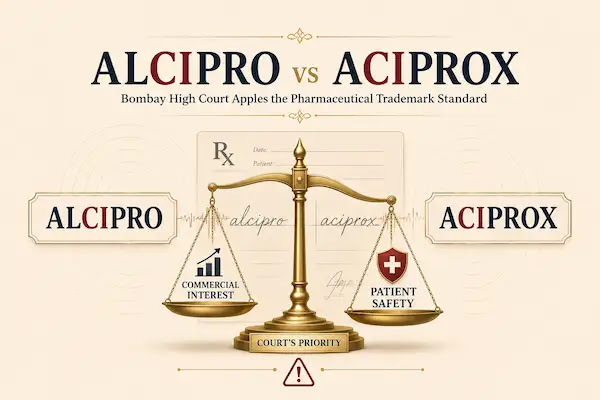
Alkem v. Numen: Bombay HC on Pharma Trademark Confusion

In the recent case of Alkem Laboratories v. Numen Pharma, the Bombay High Court clarified the high standard for pharmaceutical trademarks in India. By applying the bare possibility test, the court reinforced that in the drug industry, even a remote risk of confusion is sufficient to warrant an injunction. The ruling highlights that phonetic similarity and the overall commercial impression of marks take precedence over technical arguments about different drug classes. For companies, this serves as a stern reminder that patient safety overrides minor differences in pharmaceutical branding and composition.

9 min read