


Skip to content
Subscribe

Browse the archive

Tag: Natural Justice

trademark

Natural Justice in Trademark Refusals: Purpos Planet Ruling

The Delhi High Court's ruling in Purpos Planet v. The Registrar of Trade Marks reinforces the fundamental requirement for quasi-judicial bodies to provide reasoned, speaking orders. When the Registry refuses a trademark application without addressing the applicant's substantive submissions—such as the anti-dissection rule or prior registrations—it violates natural justice. This case highlights the necessity of thorough examination practices and the right of applicants to receive a detailed explanation for rejection. The decision serves as a critical reminder that Registry orders must engage with the specific legal contentions raised by trademark applicants.

13 min read
patent

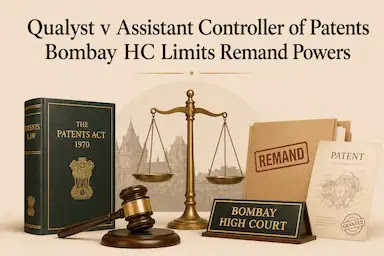
Qualyst Case: Bombay HC Limits Patent Remand Powers

Can the Indian Patent Office use a court-ordered remand as an excuse to restart an entire patent examination? The Bombay High Court's ruling in Qualyst Transporter Solutions LLC v. Assistant Controller of Patents clarifies that a remand for a breach of natural justice does not grant the Patent Office a blank check. We analyze why the court restricted the Controller from introducing new prior art or fresh objections, ensuring that procedural corrections focus on existing records. This decision sets a vital precedent for limiting re-examination scope after remand.

7 min read
patent

When Patent Offices Ignore Replies: A Procedural Guide

A recent Delhi High Court ruling has reaffirmed that the patent examination process is not merely a formality. When the Patent Office issues a rejection order that fails to engage with the applicant's responses, it violates fundamental principles of natural justice. This article analyzes the case of VIB VZW v. Controller of Patents, where the court set aside a flawed rejection. We break down the necessity of the five-step inventive step test and why applicants must document every argument to ensure a fair and reasoned decision-making process.

9 min read