
Introduction
New to Copyright Law? Start with our complete Copyright Law Guide.
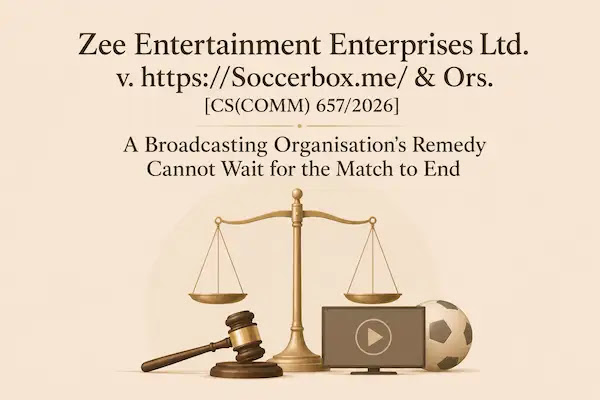
On June 3, 2026, the Delhi High Court granted an ex-parte ad-interim dynamic injunction in Zee Entertainment Enterprises Ltd. v. Soccerbox [CS(COMM) 657/2026] case, restraining five rogue websites from hosting, or communicating any content from the FIFA World Cup 2026. The order also directed Domain Name Registrars (DNRs), Internet Service Providers (ISPs), the Department of Telecommunications (DoT), and the Ministry of Electronics and Information Technology (MeitY) to block those platforms on a real-time basis and to extend that blocking automatically to any mirror sites, redirect URLs, and rogue mobile applications that Zee subsequently notified to them during the tournament.
The facts are that Zee Entertainment acquired exclusive media and broadcasting rights for the FIFA World Cup 2026 in India through a Rights Confirmation Letter dated June 1, 2026. The tournament is scheduled from June 11 to July 19, 2026, and Zee planned to broadcast all matches across cable, satellite, broadband, IPTV, and mobile technology systems, including on its OTT platform ZEE5. Within two days of that rights confirmation, Zee’s investigators found that several websites had already announced publicly that they would broadcast them, without any authorisation from Zee or FIFA. Zee’s investigators also identified these platforms as someone who had broadcasted IPL 2026 matches earlier that year and continued operating with no apparent consequence.
Issue
The question before the Court was whether Zee, as the holder of exclusive broadcast reproduction rights under Section 37 of the Copyright Act, 1957, satisfied the conditions for an ex-parte ad-interim dynamic injunction that operated prospectively and in real-time, covering not only the five named defendant websites but also any future mirror variants, redirect URLs, and rogue mobile applications that Zee identified and notified to the blocking authorities at any point during the tournament, without the need for a fresh court application for each new infringing address.
Doctrine
Broadcast Reproduction Rights Under Section 37
Section 37 of the Copyright Act, 1957 gives every broadcasting organisation a special right known as the broadcast reproduction right. This right subsists for twenty-five years from the beginning of the calendar year following the year in which the broadcast takes place. Without the licence of the right-holder, no person may re-broadcast the broadcast, cause it to reach a public audience against payment of charges, make any sound recording or visual recording of the broadcast, reproduce any such recording, or sell or rent those recordings. This right protects the broadcast signal itself and operates independently of any underlying content copyright. A FIFA World Cup match on screen carries multiple intellectual property layers. FIFA and its commercial rights holders hold rights in the event. The footage attracts copyright as a cinematograph film. The broadcasting organisation that transmits the live signal acquires the broadcast reproduction right in that transmission. An unauthorised entity which captures and re-transmits the feed infringes Section 37 regardless of whether it also disturbs any underlying content copyright.
The Dynamic Injunction
A static injunction names specific URLs, IP addresses, or domain names and directs ISPs to block those identifiers. That approach hit a structural wall in digital piracy matters. An operator whose domain a court ordered blocked would register a replacement within hours of the order, and seeking fresh litigation for each successor domain meant that by the time a new order arrived, the operator had already moved again.
UTV Software Communications Ltd. v. 1337x.to & Ors. was the Delhi High Court case that first articulated the legal basis for a dynamic injunction, one that authorised the right-holder to notify ISPs and DNRs of newly identified infringing addresses without obtaining a separate court order for each one. The doctrine acknowledged that the infringer’s ability to move faster than the litigation cycle required an injunction that moved with it, not one fixed to addresses that the infringer had already abandoned.
Sports broadcasting cases pushed this further. In Star India Private Limited v. Jio Live.TV [2023 SCC OnLine Del 6095], Justice Prathiba M. Singh restrained rogue websites from streaming the ICC Men’s Cricket World Cup 2023 and directed DoT and ISPs to block further offending websites on notification by the plaintiff, with no requirement for fresh applications to court. The Court specifically noted that rogue websites with a prior piracy record would in all likelihood repeat the infringement during a live event. To know more important copyright doctrines, click here.
The Zee Entertainment case extended the doctrine to a third frontier. Justice Banerjee covered mobile applications alongside browser-based websites, recognising that such operations had shifted streaming delivery to app-based channels and that a dynamic injunction confined to web domains would leave that channel entirely unaddressed.
Analysis
The Court found a prima facie case of copyright infringement on two grounds. Zee held documented exclusive rights through the Rights Confirmation Letter dated June 1, 2026, and Zee’s investigators found the same websites that had already broadcasted IPL 2026 matches publicly announcing their intention to broadcast FIFA World Cup 2026 content before the tournament even began.
On the balance of convenience, the Court found that it tilted decisively in Zee’s favour. The FIFA World Cup occupied a fixed thirty-eight-day window. Every match that an aggregator transmitted during that window caused permanent revenue loss for Zee through lost ZEE5 subscriptions and reduced advertising value, and no post-event damages award could restore the commercial worth of exclusive rights that such sites had already consumed.
The Court’s core reasoning addressed the structural problem with ordinary orders in a live-event context. Justice Banerjee found that masked operators instantaneously created alphanumeric, mirror, and redirect variants of their infringing websites the moment courts blocked the original addresses. Waiting for individual blocking relief for each successive domain meant intellectual property rights would be otiose before each new order arrived. The Court extended the same reasoning to mobile applications, which replicated the browser-based function of the blocked websites and operated through a channel that domain-level blocking orders did not reach. The operators also concealed their physical addresses to evade detection, making direct enforcement against the registrants impractical and directing the Court toward DNRs and ISPs as the effective enforcement layer.
The past piracy conduct of the named defendants carried independent weight. The Court found that platforms that had already demonstrated a willingness and capacity to broadcast such content without authorisation during IPL 2026 would in all likelihood repeat that conduct for the FIFA World Cup 2026. The threat Zee identified was not speculative; it was a continuation of a demonstrated pattern.
On directions, the Court required the DNRs to lock and suspend the domain name registrations of all named defendants, to extend that direction to any future variants that Zee notified, and to disclose registrant identities, email addresses, and IP details. The Court directed the ISPs to immediately block access to the named platforms and to future variants, including associated mobile application domains, on notification by Zee in real-time. The Court further directed DoT and MeitY to ensure strict compliance by ISPs operating under their regulatory purview. To prevent misuse of the open-ended blocking power, the Court required Zee to file affidavits before the Court each time it notified further such websites or applications, keeping the exercise of the dynamic injunction on record and subject to judicial oversight.
Also Read: Zee Entertainment v. BSNL: Madras High Court Permits Withdrawal of Copyright Suit
Conclusion
This order makes a point that earlier dynamic injunction cases in such sports implied. The piracy enforcement problem in live events is not fundamentally a legal problem but a temporal one. A broadcasting organisation that holds exclusive rights to a live event suffers the damage during the event window, not after it. Static orders that require a return to court for each new domain or mirror site cannot operate within that window. The dynamic injunction, now extended here to mobile applications and their associated domains and UIs, is the only remedy that tracks the speed of the infringement.
The step that matters most in this order for practitioners is the extension to mobile applications. Earlier dynamic injunction orders in sports cases, including Star India v. Jio Live.TV, focused on website domains. The Zee Entertainment order treats app-based ones as an equivalent enforcement problem and confirms that the broadcast reproduction right under Section 37 covers that channel equally. A Section 37 claim supported by a documented rights acquisition and evidence that the named defendants previously copied comparable content will support a pre-event dynamic injunction covering websites, mirrors, redirects, and mobile applications together, with no requirement for repeated court visits once the event begins.