
Introduction
Looking to understand Copyright Law better? Read our complete Copyright Law Guide.
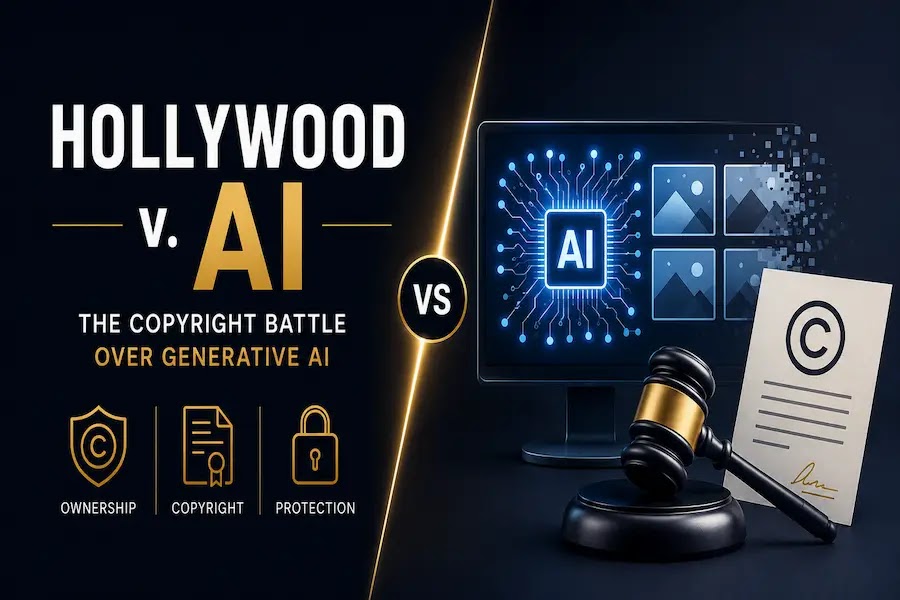
The MiniMax AI copyright lawsuit is emerging as one of the most significant legal battles in the debate over artificial intelligence and copyright law. Major Hollywood studios, including Disney, Universal, and Warner Bros, have accused the Chinese AI company of using copyrighted works without authorization to train its generative AI systems. The case now moves toward trial after a federal court refused to dismiss key copyright claims.
What Happened?
Disney, Universal, Warner Bros, and a coalition of major entertainment studios filed a copyright infringement lawsuit in September 2025 against MiniMax, a Shanghai-based AI company, in the US District Court for the Central District of California. The case centres on MiniMax’s Hailuo AI service, which lets users generate images and videos of iconic characters, Darth Vader, Wonder Woman, Spider-Man and others, through simple text prompts.
The studios alleged this capability existed because the AI model had been trained on unauthorized copies of their works. On May 26, 2026, a federal judge denied MiniMax’s attempt to have the case dismissed. That ruling is not a verdict on infringement.
It is a threshold finding: the studios presented a claim legally sufficient to proceed to trial. But what the court allowed forward tells you exactly where this area of law is heading.
The complaint pressed two forms of infringement. Direct infringement: training the AI on copyrighted works without authorization. Secondary infringement: enabling users to reproduce protected characters through the service. Both claims survived. The training data question, which the AI industry has long treated as unsettled, is now headed for active examination at trial.
MiniMax’s own marketing complicated things considerably. The company deployed recognizable copyrighted characters in promotional materials and explicitly invoked Hollywood by name. That is not a neutral fact in a copyright case. It is evidence of deliberate commercial reliance on content that was never licensed.
Jurisdiction
Being headquartered in Shanghai offered no protection. The US court found jurisdiction adequate to proceed despite the defendants being foreign.
Also Read: Zee Entertainment v. BSNL: Madras High Court Permits Withdrawal of Copyright Suit
Conclusion
Courts are now willing to let training data copyright claims go to trial. That changes the legal risk profile of every AI product built on unlicensed third-party content, regardless of where the company is based.