
Introduction
Looking to understand Trademark Law better? Read our complete Trademark Law Guide.
The mark ‘MOTI MAHAL’ traces back to 1920, when Late Mr. Kundan Lal Gujral opened his first restaurant under that name. Over the next century, the brand expanded from seven standalone restaurants to a global franchise network of over 100 outlets across the USA, UAE, Bahrain, Japan, Singapore, and India. The brand celebrated its centenary in October 2020.
What happened?
After the founder’s death, his descendants took over. Plaintiff No. 1, Moti Mahal Delux Management Services Pvt Ltd, was incorporated on 23 November 2004. Plaintiff Nos. 2-3 and Defendant No. 2 are all recorded as co-owners of the foundational MOTI MAHAL trademark registrations. The son of Defendant No. 2 has also initiated rectification proceedings before the Trademark Registry against one of these registrations. There is a family dispute running in the background.
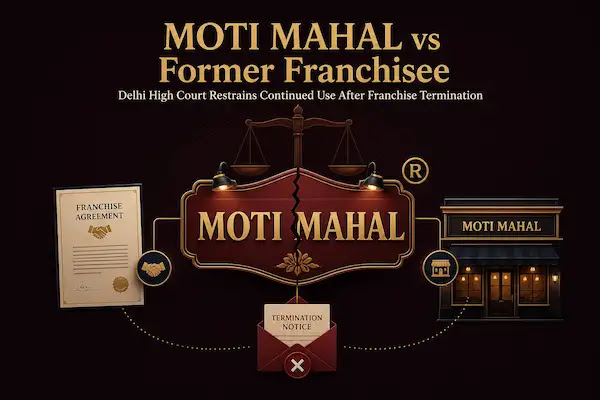
What triggered this particular suit was not the family dispute. It was a franchise relationship that soured.
In 2022, Defendant No. 1, M/s Zikra Hotels and Restaurants LLP, entered into a Franchise Agreement with Plaintiff No. 1 to run a restaurant under the name ‘MOTI MAHAL DELUX TANDOORI TRAIL’ at Prayagraj. The agreement was for 72 months. By the plaintiffs’ account, the franchisee stopped paying franchise fees from July 2021 onwards (the non-payment appears to have predated the agreement’s formal execution, which warrants scrutiny at trial) and accumulated dues of Rs. 7,69,440/- plus a penalty claimed at Rs. 2,53,12,327/-. A termination notice followed on 18 December 2025. Then a Cease and Desist Notice on 11 January 2026. The defendant did not respond to either.
Online investigation by the plaintiffs revealed that Defendant No. 1 was not only continuing to operate the restaurant under ‘MOTI MAHAL DELUX TANDOORI TRAIL’ but had also started using the core marks ‘MOTI MAHAL’ and ‘MOTI MAHAL DELUX’ independently. Its presence spanned Google, Gobibo, Makemytrip, Zomato, Swiggy, Facebook, and Instagram. On that basis, the plaintiffs filed the commercial suit and moved for an urgent ex-parte ad-interim injunction.
The Trademark Portfolio
Before examining the Court’s reasoning, it is worth cataloguing the IP assets in play. Plaintiff Nos. 2-3 and Defendant No. 2 jointly hold:
- MOTI MAHAL (No. 580007): Class 29, registered 28.08.1992, user claim from 1947, valid till 28 August 2026 (renewal is imminent)
- MOTI MAHAL (No. 1249495): Class 42, registered 13.11.2003, user claim from 1947, valid till 2033
- MOTI MAHAL (No. 2219470): Class 43, registered 13.10.2011, user claim from 1947, valid till 2031
Plaintiff No. 1 exclusively holds registrations for MOTI MAHAL GROUP (Classes 35, 41, 43), MOTI MAHAL MANAGEMENT SERVICES (Class 35), and TANDOORI TRAIL (Classes 29, 42, 43 across multiple registrations), all with user claims from 2003 onwards.
The plaintiffs also claim copyright under Section 17 of the Copyright Act, 1957 in the distinctive oval device mark used across their branding. International registrations exist across the USA, UAE, Bahrain, Japan, and Singapore.
Goodwill was evidenced through franchise revenue data from Rs. 24.40 crore in 2010-2011, growing to Rs. 47.13 crore in 2023-2024, with advertising expenditure rising sharply from Rs. 8.76 lakh to Rs. 33.07 lakh across the same period.
Issues Before the Court
At this interim stage, the Court addressed the following:
- Whether Defendant No. 1’s continued use of ‘MOTI MAHAL DELUX TANDOORI TRAIL’, ‘MOTI MAHAL DELUX’, and ‘MOTI MAHAL’ after termination of the franchise agreement was unauthorized?
- Whether the impugned marks are deceptively similar to the plaintiffs’ registered trademarks?
- Whether the three-pronged test for an ex-parte ad-interim injunction under Order XXXIX Rules 1 & 2 CPC (prima facie case, balance of convenience, irreparable harm) was satisfied?
- Whether the plaintiffs were entitled to exemption from pre-institution mediation under Section 12A of the Commercial Courts Act, 2015?
Court’s Findings
On post-termination use and contractual estoppel
The Delhi High Court’s reasoning on the core trademark issue is anchored squarely in the franchise agreement itself. Clauses 5.4 and 5.5 contained an express acknowledgment by Defendant No. 1 that it had no right in the name ‘MOTI MAHAL DELUX TANDOORI TRAIL’ during the term. Clauses 6.1-6.3 and 6.6 prohibited the franchisee from directly or indirectly identifying itself with Plaintiff No. 1 or any of its registered marks.
The Court held that once the franchise agreement was terminated by notice dated 18 December 2025 (consequent to admitted non-payment of franchise fees), Defendant No. 1 could not have continued using the mark ‘for any reason whatsoever.’ The continued use thereafter was, in the Court’s words, ‘not bona fide and appears to be unauthorised.’
This is a clean application of the principle that a former licensee’s post-termination use of the licensor’s mark constitutes infringement. The contractual clauses served as an express acknowledgment of the mark’s ownership. That acknowledgment operates against the defendant.
On deceptive similarity
The Court carried out a visual comparison of the rival marks in tabulated form. The plaintiffs’ marks (‘MOTI MAHAL’, ‘MOTI MAHAL GROUP’, ‘MOTI MAHAL MANAGEMENT SERVICES’, ‘TANDOORI TRAIL’) were placed against the defendant’s impugned usage (‘MOTI MAHAL’, ‘MOTI MAHAL DELUX’, and the full composite ‘MOTI MAHAL DELUX TANDOORI TRAIL’ device mark in the red-and-gold oval format).
The Court found the visual comparison demonstrated deceptive similarity bound to cause confusion and deception in the minds of an unwary consumer who might believe the services of Defendant No. 1 either emanate from Plaintiff No. 1 or are associated with it. It specifically noted that the defendant had ‘slavishly copied’ the plaintiffs’ marks (including the oval device) and that this demonstrated not just infringement but mala fide intent.
On goodwill and reputation
The revenue data and advertising expenditure figures over 15 years were accepted as clearly establishing the immense goodwill attached to the MOTI MAHAL mark. The Court also noted the plaintiffs’ vigilance (multiple oppositions before the Registrar, prior injunction orders from this Court and District Courts) as evidence that the brand owner had consistently enforced its rights.
On the three-pronged test for interim injunction
The Court’s conclusion is stated at paragraph 39:
“Having regard to the above, it is evident that the plaintiffs has made out a prima facie strong case in its favour. The balance of convenience appears to be tilted in favour of the plaintiffs at this stage. The plaintiffs shall suffer irreparable loss and injury which may not be adequately compensated in monetary terms in case ex-parte ad-interim injunction order is not passed.”
- On prima facie case: the franchise agreement, the termination notice, the C&D notice, the documentary evidence of ongoing use post-termination, and the registered trademark portfolio taken together gave the Court sufficient grounds.
- On balance of convenience: a 100-year-old restaurant brand with 100+ active franchises globally has considerably more to lose from continued unauthorized use of its mark than a single-outlet franchisee has to lose from a temporary suspension.
- On irreparable harm: brand injury in the food and hospitality sector is difficult to quantify. Consumer confusion once created is not easily undone.
On Section 12A exemption
The Court followed the Supreme Court’s ruling in Yamini Manohar v. T.K.D. Keerthi, (2024) 5 SCC 815, which holds that where a commercial suit contemplates urgent interim relief, parties are exempt from the pre-institution mediation requirement under Section 12A of the Commercial Courts Act, 2015.
The Relief Granted
The ex-parte ad-interim injunction operates until the next date of hearing. In terms:
Defendant No. 1, along with its principals, partners, officers, employees, agents, distributors, suppliers, affiliates, subsidiaries, franchisees, licensees, representatives, group companies, and assigns, is restrained from running, advertising, selling, offering for sale, marketing, or promoting any restaurant or catering business under the marks ‘MOTI MAHAL’, ‘MOTI MAHAL DELUX’, ‘MOTI MAHAL DELUX TANDOORI TRAIL’, and the oval device.
Separately, the Court directed Defendant No. 1 to remove all references to the impugned marks from its restaurant boards and hoardings, menus, cutlery, crockery, brochures, advertising material, e-commerce platforms, and social media pages, within two weeks of receipt of the order.
The matter is next listed before the Joint Registrar (Judicial) on 6 August 2026 for completion of service and pleadings, and before the Court on 29 October 2026.
Legal Principles from the Order
1. Post-termination use by a licensee/franchisee is not protected use. The franchise relationship confers only a temporary, contractually-bounded right to use the mark. Once the agreement ends (whether by expiry or termination), continued use is infringement, and express contractual acknowledgment of non-ownership strengthens that conclusion.
2. The franchise agreement itself can be the strongest weapon. Practitioners often focus on the trademark registrations when advising on IP protection. This order illustrates that carefully drafted franchise agreements, with express acknowledgment clauses and post-termination restrictions, can be equally decisive when injunctive relief is sought.
3. Online presence on aggregator platforms counts as infringing use. The Court’s direction to take down listings from Zomato, Swiggy, Makemytrip, and other platforms reflects a practical understanding of how restaurant brands actually operate today. IP enforcement that stops at the physical signboard but ignores Swiggy listings is incomplete.
4. Urgent IP suits are exempt from pre-institution mediation under Section 12A. Where interim relief is genuinely urgent, parties cannot be forced through mediation as a precondition. This is particularly relevant in passing off and infringement matters where the damage accumulates daily.
5. Goodwill evidence from revenue and advertising data is persuasive at the interim stage. Year-wise revenue and advertising expenditure over 14+ years is not just commercially significant. It is legally significant as proof of the mark’s acquired distinctiveness and the proprietor’s legitimate stake in protecting it.
Also Read: Calcutta HC Returns ITC Plaint for Skipping Section 12A Mediation
Conclusion
The claim that the franchisee failed to pay fees ‘from July 2021’ is curious because the franchise agreement itself was executed in mid-2022. The plaintiffs may need to clarify whether the fee arrears predate the franchise agreement (possibly under a prior or oral arrangement), or whether there is a drafting error in the plaint.
The family dimension (Defendant No. 2 as a co-registrant of the foundational MOTI MAHAL marks, and his son running rectification proceedings before the Trademark Registry) adds a layer of complexity that the Court has not addressed at this stage. When Defendant No. 2 and his son enter the picture, the question of who has the right to sub-license the mark, and to whom, will become relevant.
Also read: IndiaMart Trademark Case
Note: This is an ex-parte ad-interim order passed at the threshold of the suit. The defendants have not yet entered appearance, and the findings recorded here are prima facie in nature. The matter is next listed before the Court on 29 October 2026.