
Introduction
New to Trademark Law? Start with our complete Trademark Law Guide.
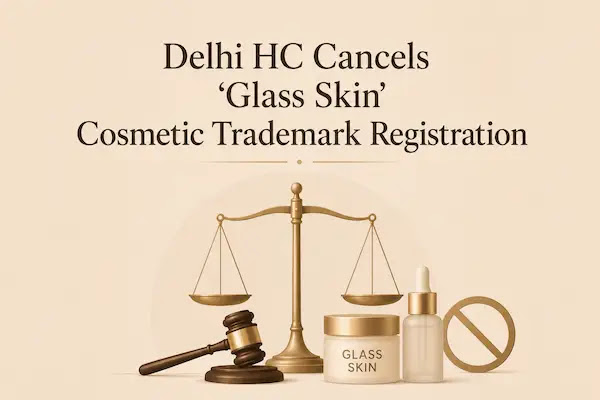
Picture this. You file a trademark application for “GLASS SKIN” in 2019, on a proposed-to-be-used basis. You get it registered in Class 3. Then, years later, you use that registration as a weapon on Amazon to pull down a competitor’s product listings, forcing them off the platform. That is exactly what happened here. And on 5 June 2026, the Delhi High Court had a clear answer that the registration should never have existed.
The case, Renee Cosmetics Private Limited v. Ms. Rupali Sharma & Anr., is not complicated in its outcome, only in what it reveals about how the Trade Marks Register gets used. An entire skincare trend, borrowed from Korean beauty vocabulary and now ubiquitous across every mass-market brand in India, was sitting on the Register as someone’s exclusive property. Garnier used “glass skin.” Nykaa used “glass skin.” Lakme, L’Oréal, Mamaearth, Nivea, all of them used it. The respondent herself had used the term in a descriptive manner on her own product. Yet she held the registration and wielded it against a competitor who simply wanted to describe what her product does.
Background
Renee Cosmetics Private Limited, incorporated in October 2019 and operating under the “RENEE Cosmetics” brand, filed an application on 28 January 2025 to register the mark “RENEE GLASS SKIN SPF 50.” That application triggered a legal notice from the respondent, Ms. Rupali Sharma, who held a registered trademark for “GLASS SKIN” in Class 3 (which covers cosmetics, skincare, and personal care products). The respondent claimed infringement.
Renee denied the allegation and filed a rectification petition under Section 57 of the Trade Marks Act, 1999, seeking cancellation of the “GLASS SKIN” registration on the ground that the term is entirely descriptive and incapable of distinguishing any one person’s goods from those of another. In October 2025, before the Court could hear the matter, Amazon removed Renee’s product listings on the basis of the respondent’s registered rights. To read more about the basics of trademark law, click here.
The respondent’s registration, the Court noted, had been filed on a “proposed-to-be-used” basis. Indian trademark law permits an applicant to file without any prior use, which means a trader can claim a term before they have ever actually sold anything under it. That mechanism works well for genuinely invented marks. For descriptive terms that the industry already uses freely, it becomes a problem.
Absolute Grounds and the Descriptiveness Bar
Section 9(1)(b): The Core Prohibition
Section 9(1)(b) of the Trade Marks Act, 1999 prohibits registration of trademarks that consist exclusively of marks or indications that may serve, in trade, to designate the kind, quality, quantity, intended purpose, value, geographical origin, time of production, or other characteristics of the goods or services. A trader who wants to sell a moisturiser that gives your face a glassy, luminous appearance should be free to say so. If one company owns “GLASS SKIN,” every other company in that space must either license the term or use roundabout language to describe the same thing. That is not what trademark law intends. Marks exist to identify source, not to lock up the language of a product category.
The Court, drawing on McCarthy on Trademarks and Unfair Competition, identified the key spectrum. Arbitrary or invented marks, words with no connection to the goods (think “APPLE” for computers or “KODAK” for cameras), enjoy the highest degree of protection. At the other end sit purely descriptive marks, words that directly tell the consumer what the product is or does. Between them, somewhere in contested territory, sit suggestive marks that require the consumer to exercise imagination to understand the connection to the product.
The respondent’s argument was that “GLASS SKIN” is suggestive, not descriptive. The Court found it unpersuasive.
The Suggestive vs. Descriptive Distinction
The argument for suggestiveness would run like this. “Glass” is not literally a description of skin; skin is not made of glass; the consumer must travel from “glass” to “translucent, clear, luminous complexion” by mental exercise. On that journey of imagination, the term earns protection.
The Court was not persuaded. It found that the term “GLASS SKIN” has been in widespread use across the beauty and skincare industry to describe a specific Korean beauty trend associated with transparent, luminous, and flawless skin. The jump from “glass skin” to “a product that helps you achieve a clear, hydrated, luminous complexion” requires no imagination at all. Anyone who has opened a skincare app or walked through the cosmetics aisle of a pharmacy understands what the phrase means without further guidance. It is a descriptor, not an identifier.
The Court put it directly. To suggest that consumers encountering “GLASS SKIN” on a cosmetic product would be unable to understand what the product sought to achieve would be “absurd.”
The Cases That Frame This Decision
Godfrey Phillips India Ltd. v. Girnar Food & Beverages (P) Ltd.
The Supreme Court’s 2004 judgment in Godfrey Phillips India Ltd. v. Girnar Food & Beverages (P) Ltd., (2004) 5 SCC 627 is the starting point for any analysis of descriptive trademarks in India. The dispute was over the mark “SUPER CUP” for tea. The Division Bench of the Delhi High Court had held that “SUPER” and “CUP” together formed a descriptive, laudatory expression not entitled to protection. The Supreme Court held that a descriptive trademark may still be protected if it has assumed a secondary meaning that identifies it with a particular product or source.
Godfrey Phillips gave Indian trademark law two propositions that have survived intact. First, descriptiveness is not automatically fatal; acquired distinctiveness, what the Act calls secondary significance, can redeem an otherwise unregistrable mark. Second, the court must examine the evidence actually placed on record, not assume that long use or advertising spend automatically establishes secondary meaning.
The Glass Skin case sits squarely within that framework. The Court applied the first proposition to find that “GLASS SKIN” is descriptive. It applied the second to find that the respondent had placed no material on record to establish secondary significance.
Marico Limited v. Agro Tech Foods Limited
The Delhi High Court’s Division Bench judgment in Marico Limited v. Agro Tech Foods Limited, 2010 (44) PTC 736 (Del.) is equally instructive. Marico held registered trademarks “LOSORB” and “LO-SORB” for edible oils and also claimed an unregistered mark in the expression “LOW ABSORB.” When Agro Tech used “WITH LOW ABSORB TECHNOLOGY” on its Sundrop packaging, Marico sued.
The Division Bench held that “LOW ABSORB” only describes a characteristic of the product, specifically the oil’s property of reducing absorption during frying. The Court refused to restrain Agro Tech and went further to caution traders against attempting to appropriate descriptive expressions. Those who rush to grab a descriptive expression before anyone else should be discouraged from claiming it as an exclusive trademark when that word bears an indication of the product’s kind, quality, use, or characteristic. That caution applies with equal force to “GLASS SKIN.”
Pidilite Industries Limited v. Vilas Nemichand Jain
The Bombay High Court in Pidilite Industries Ltd. v. Vilas Nemichand Jain, 2015 (64) PTC 185 (Bom) clarified how secondary significance must be proved. Evidence of extent of use, sales figures, and advertising expenditure alone does not establish secondary meaning. Something more is required, specifically, proof that the relevant trade understands the word as identifying the plaintiff’s goods and no one else’s. The Court made clear that demonstrating volume of use is not the same as demonstrating that consumers associate the mark exclusively with one source.
In Glass Skin, the respondent produced nothing that met that threshold.
The Section 57 Route: Rectification and Cancellation
The vehicle for Renee’s challenge was Section 57 of the Trade Marks Act, 1999, which gives the High Court (and the Registrar) power to cancel or vary a registration on the ground, among others, that the mark was registered without sufficient cause or is wrongly remaining on the Register. It is a corrective mechanism. The Register of Trade Marks is meant to be a reliable record of valid, distinctive marks, not a graveyard of descriptive terms that should never have been registered in the first place. When a registration fails the distinctiveness test in Section 9 and the proprietor cannot establish secondary significance, the entry is “wrongly remaining on the Register” within the meaning of Section 57(2). The Court’s language in this case tracked that formulation precisely. The registration was “without sufficient cause” and “wrongly remaining on the Register.”
It is also worth noting that Renee filed the petition under Section 57 read with Section 31 of the Act. Section 31 provides that original registration of a trademark is prima facie evidence of its validity. That prima facie presumption is, by its nature, rebuttable. Renee rebutted it. The Court found, on the totality of material placed on record, that the mark was descriptive from inception.
The Amazon Factor: Platform IP Enforcement and Its Risks
Amazon’s intellectual property complaint mechanism, which allows brand owners to file takedown requests against listings that use registered marks, operates on the basis of registration. The platform does not adjudicate validity, only existence. When the respondent invoked her “GLASS SKIN” registration, Renee’s product listings came down in October 2025, while the litigation was pending.
This is a pattern that has become more frequent in e-commerce disputes. A registration, even of a descriptive term, gives the registrant real-world commercial power on platforms that treat the Register as a proxy for legitimacy. The consequence is that the competitive harm from a bad registration is immediate, while the legal remedy takes time. Registration under the Trade Marks Act is not conclusive proof of validity. Section 31 makes it prima facie evidence only. Courts can and do cancel registrations that never should have been granted. The difficulty is that the affected party must fight that battle in court while their business suffers on the platform.
What the Court Actually Decided
The Hon’ble Court allowed Renee’s rectification petition in its entirety and directed the Registrar of Trade Marks to cancel and remove the registration of “GLASS SKIN” in Class 3 within four weeks. No costs were awarded.
The related infringement suit filed by the respondent against Renee remains listed before the Joint Registrar on 13 October 2026. That suit will now have to contend with the cancellation order. A plaintiff who no longer holds a valid trademark registration in the suit mark cannot maintain an infringement claim under Section 29 of the Act.
The judgment does not address whether “GLASS SKIN” could, in theory, become protectable with sufficient evidence of acquired distinctiveness over time. The question remains open in principle. Given how widely the term is used across the Indian skincare market, and given the respondent’s own descriptive use of it, the practical answer is that the bar for secondary significance would be exceptionally high.
Also Read: Calcutta HC Returns ITC Plaint for Skipping Section 12A Mediation
Conclusion
The facts of this case are, in one sense, a story about opportunism. The respondent filed for “GLASS SKIN” in 2019 on a proposed-to-be-used basis, at the precise moment when K-Beauty terminology was gaining traction in Indian consumer culture. A generic industry term ended up in one person’s hands, available as a commercial weapon.
The examination process at the Trade Marks Registry exists to filter out Section 9 violations at the application stage. A trademark examiner reading a 2019 application for “GLASS SKIN” in Class 3 should have raised a descriptiveness objection on the spot. The K-Beauty trend was not obscure. “Glass skin” was already in widespread use globally. That the mark cleared examination and achieved registration points to a gap in how the Registry handles terms that borrow from popular lifestyle vocabulary. “GLASS SKIN” describes exactly what the product does, and in the clearest possible terms. The industry uses it that way, consumers understand it that way, and the respondent herself used it that way. Descriptive terms belong to the trade and no single player gets to fence them off.
For those tempted to register popular lifestyle phrases, the Register is not a mere parking lot. Descriptive terms cannot be acquired by the simple act of filing first. For those whose businesses are disrupted by registrations of generic terms, platform takedowns cause real harm while litigation takes its course. The Glass Skin case took from 2025 to 2026 to resolve. That is a full year of a business being commercially constrained by a registration that should never have existed.