
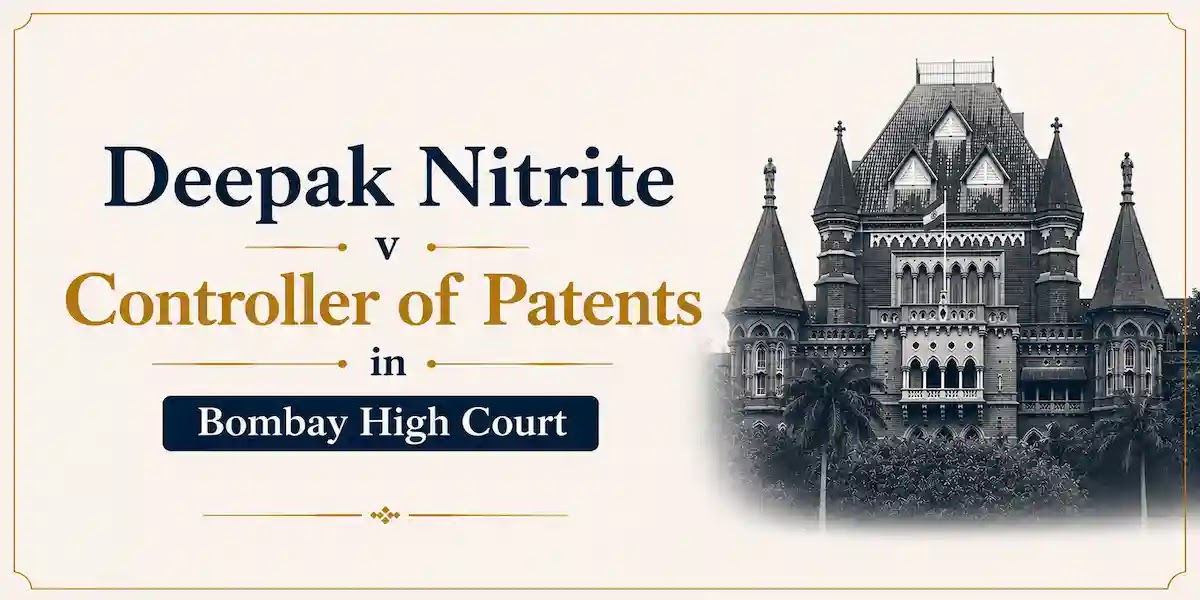
The Bombay High Court decided Deepak Nitrite Limited v. The Assistant Controller General of Patents and Designs, on 6th July 2026. The Petition, filed under Section 117A of the Patents Act, 1970, challenged the refusal of Deepak Nitrite’s application for a free flowing food grade sodium nitrite and its production method, refused solely on the ground that the claims lacked inventive step under Section 2(1)(ja).
Introduction
Want to learn the fundamentals of Patent Law? Read our complete Patent Law Guide.
Hon’ble Justice Arif S. Doctor set aside the refusal and remanded the application for fresh consideration, but the judgment reads as much bigger than a single remand. It reads as a pointed, somewhat exasperated catalogue of a recurring problem at the Indian Patent Office, where Controllers invoke the phrase common general knowledge as though it were a self proving fact rather than something that requires a source, a date and a reasoned link to the claims being rejected. For patent practitioners, the decision offers a compact statement of what an inventive step analysis must contain to survive judicial scrutiny, and a reminder that the courts are increasingly unwilling to let bare assertions pass as reasoning.
Background and Dispute
Deepak Nitrite Limited filed a Patent Application titled “A Free Flowing Food Grade Sodium Nitrite and Production Method Thereof”. The application contained two categories of claims. Claims 1 to 3 covered the product itself, a sodium nitrite composition distinguished from prior art by its particular impurity profile. Claims 4 to 8 covered an integrated process comprising several sequential steps, namely dissolving sodium nitrite powder in water to form a liquor, heating that liquor under controlled temperature, feeding it to an evaporator to obtain a slurry mass, filtering the slurry through a centrifuge to separate the wet cake from the mother liquor, drying the wet cake in a unit equipped with a cold zone, and finally coating the dried material with a food grade anti caking agent.
The Assistant Controller of Patents and Designs at the Mumbai Patent Office refused the entire application by an order dated 2nd March 2023. On the product claims, the order held that a reduction in impurities cannot amount to an inventive step because it is common general knowledge that no compound is ever completely pure. On the process claims, the order isolated the filtration step, described it as a routine laboratory technique, and refused the claims on that basis. Deepak Nitrite challenged the order before the Bombay High Court under Section 117A of the Patents Act.
Petitioner’s Arguments
Mr. Hiren Kamod, appearing for the Petitioner, attacked the refusal on two distinct fronts corresponding to the two categories of claims. On the product claims, he pointed out that the Impugned Order itself acknowledged the claimed product differed from the prior art in its impurity profile, yet dismissed that difference through a single unsupported sentence about the impossibility of complete purity. He submitted that the order cited no reference, treatise, standard text or any other identifiable source for this asserted common general knowledge, did not examine whether the specific impurity profile claimed by Deepak Nitrite was itself disclosed or suggested anywhere in the cited prior art, and never engaged with the Petitioner’s submissions explaining why the controlled impurity profile mattered for achieving a free flowing, food grade end product.
On the process claims, Mr. Kamod argued that Claim 4 disclosed an integrated sequence of six distinct steps working together, and that the inventive contribution lay in the synergy and specific sequencing of those steps taken as a unit. He submitted that the Impugned Order refused the entire process by isolating the filtration step alone, calling it a common laboratory practice, and never once considered the process as an integrated whole, which rendered the order a classic non reasoned refusal. He placed reliance on Medipack Global Ventures Private Limited v. Assistant Controller of Patents and Designs, F. Hoffmann La Roche Ltd. v. Cipla Ltd., Groz Beckert KG v. Union of India and Ors. and AGFA NV and Anr. v. The Assistant Controller of Patents and Designs to draw out a structured test for inventive step analysis. That test requires the Controller to identify the person skilled in the art, identify the inventive concept in the patent, impute the common general knowledge available to such a person at the priority date, identify the differences between the claimed invention and the prior art, identify the source of any asserted common general knowledge, consider the invention as a whole rather than in isolated parts, and give independent reasons supporting the ultimate conclusion.
Respondent’s Arguments
Mr. Yashodeep Deshmukh, appearing for the Respondent, opened by defending the Impugned Order in its entirety, submitting that the Controller had examined the application and applied his mind before refusing it, and that the Petition ought to be dismissed outright. When the Court specifically asked him to point to where the Impugned Order contained an independent analysis of inventive step for the process claims, measured against the test laid down in F. Hoffmann La Roche, Mr. Deshmukh fairly conceded that no such analysis existed in the order. He went further and accepted that it would have been more appropriate for the Controller to have considered the process claims as an integrated whole, and on that basis did not oppose a remand for Claims 4 to 8.
On the product claims, however, Mr. Deshmukh maintained his opposition to a remand, arguing that the difference in impurity profile was in any event accounted for by common general knowledge and that the Impugned Order was sustainable on that footing. When the Court asked him directly what, in his submission, constituted that common general knowledge and where in the record it could be found, Mr. Deshmukh was unable to answer the question.
Analysis of the Court
The Bald Invocation of Common General Knowledge
The central holding of the judgment concerns the product claims, and it is delivered without much room for ambiguity. Justice Doctor held that it is wholly impermissible for a Controller, acting in a quasi judicial capacity under Section 15 of the Patents Act, to invoke common general knowledge as a self sufficient ground for refusal without setting out and substantiating the sources of that knowledge as of the priority date of the application. The Court relied on the Delhi High Court’s decision in AGFA NV v. Assistant Controller of Patents and Designs, which requires a Controller to identify the actual source of any asserted common general knowledge and to demonstrate that the source predates the priority date of the application under examination.
The Court went further, describing a bald assertion of common general knowledge, made without identifying any source or basis, as not merely impermissible but arbitrary and contrary to the principles of natural justice. Allowing such an approach, the Court observed, would effectively permit a Controller to pass an order on his own ipse dixit, relying on undisclosed or personal knowledge without recording any reasons an applicant could actually test or challenge. That failure, the Court noted, strikes directly at an applicant’s ability to mount an effective challenge to the refusal, since a party cannot meaningfully contest a source it has never been told exists.
Failure to Consider the Process as a Whole
On the process claims, the Court accepted the Respondent’s own concession that the Impugned Order lacked any independent inventive step analysis measured against the applicable test, and that isolating a single step within a multi step integrated process, without examining the process as a whole, cannot sustain a refusal. Since the Respondent did not press for a contrary finding on this limb once the concession was made, the Court’s reasoning here is brief, but its consequence is significant. A refusal built by picking apart one step of a claimed process, while ignoring how that step functions in combination with the rest, does not meet the standard the Patents Act requires of a reasoned order.
A Recurring Pattern at the Patent Office
What elevates this judgment beyond a routine remand is the extended discussion that follows the operative findings. The Court noted that the Respondent’s counsel had, upon instructions, informed the Court that the Patent Office now assigns remanded applications to a Controller different from the one who passed the original order, a procedural safeguard the Court accepted as a positive step. But the Court was equally direct in stating that this safeguard does not address the deeper problem, which is Controllers passing orders that merely reproduce objections raised earlier in the proceeding without any independent application of mind.
The Court listed a set of recurring infirmities it has repeatedly encountered across a string of recent decisions, including Amogreentech Co. Ltd. v. Assistant Controller of Patents & Designs, Navya Network Inc. v. Assistant Controller of Patents and Designs, JFE Steel Corporation v. Controller of Patents & Designs and Medipack Global Ventures Private Limited v. Assistant Controller of Patents and Designs, alongside the Delhi High Court’s decision in Huhtamaki OYJ v. Controller of Patents. Those infirmities include denial of a fair opportunity to meet objections, failure to consider an applicant’s submissions and evidence, absence of reasoned findings on statutory objections, inadequate claim construction and inventive step analysis, reliance on hindsight or unsupported assertions of common general knowledge, improper combination of prior art, mechanical reproduction of material without independent reasoning, and non speaking orders that frustrate effective appellate review.
The Court observed that the difficulty does not lie in an absence of departmental standards, since the standards required for a properly reasoned order have already been laid down repeatedly by multiple courts. The difficulty lies in the recurring failure to apply those standards, which forces courts to set aside and remand orders even in cases where the Controller’s ultimate conclusion might, on a proper analysis, have been sustainable. The Court described this pattern as resulting in an avoidable consumption of judicial time, duplication of effort within the Patent Office itself, and additional delay and expense for applicants who are entitled to a definitive answer on their applications within a reasonable time.
Also Read: Calcutta HC Revokes Letters Patent Leave in Maitra Servicenter Dispute
Practical Conclusion
The case Deepak Nitrite Limited v. The Assistant Controller General of Patents and Designs sets out a standard that ought to be uncontroversial and yet, on the evidence of this judgment and the string of decisions it cites, plainly is not being met consistently. An inventive step finding grounded in common general knowledge is only as strong as the source behind that knowledge. Where a Controller cannot identify that source, and where the Controller’s own counsel cannot identify it either when asked directly in open court, the refusal has no legs to stand on regardless of how confidently it was worded in the original order.
The Controller had a genuine point available on the product claims, since impurity profiles are indeed a well established basis for distinguishing chemical compositions, and a properly sourced common general knowledge objection citing an actual pharmacopoeial standard or industry specification might well have withstood scrutiny. Instead, the order rested on an unsupported generalisation about purity that any first year associate could have flagged as insufficient. The process claims fared no better, refused through a piecemeal reading that the Respondent’s own counsel could not defend once pressed. Patent Office orders that skip the analytical steps courts have laid down again and again do not just lose in appeal, they cost applicants years of pendency for objections that a properly reasoned first instance order could have resolved correctly the first time.
Case: Deepak Nitrite Limited v. The Assistant Controller General of Patents and Designs, Commercial Miscellaneous Petition No. 107 of 2025, High Court of Judicature at Bombay. Coram: Hon’ble Mr. Justice Arif S. Doctor.