
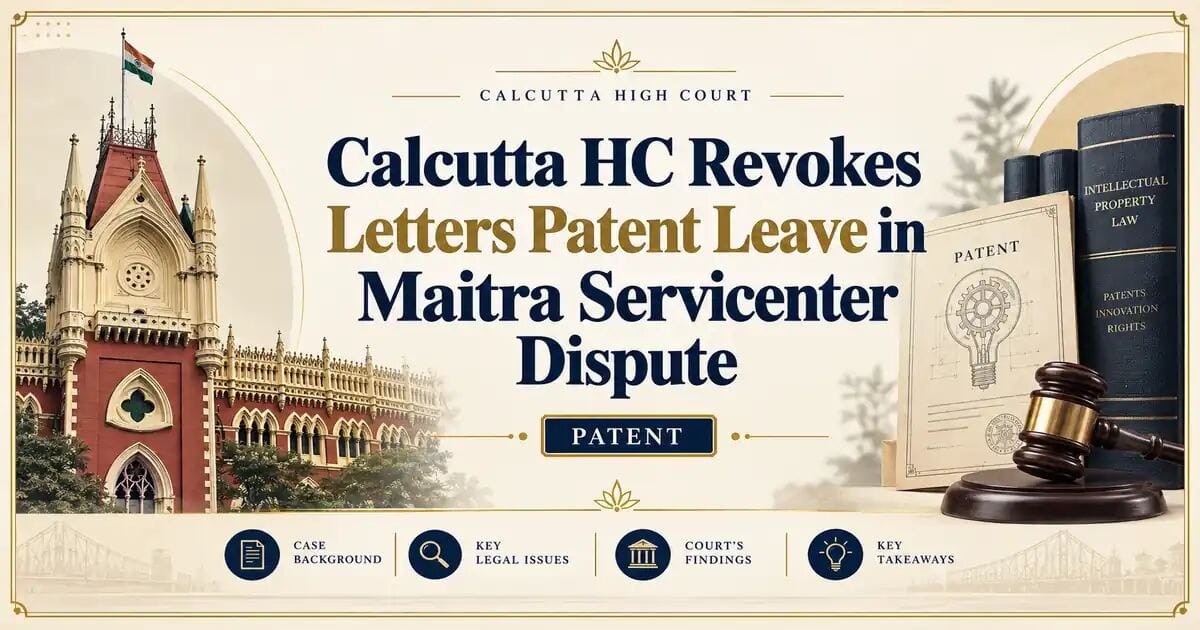
Commercial litigators attempting to manufacture territorial jurisdiction through tenuous online links face a fatal roadblock under this judicial directive. By clarifying that the initial grant of leave does not insulate a plaint from a rigorous jurisdictional audit at the interim stage, the Calcutta High Court has armed defendants with a powerful tool to defeat forum shopping. In SRI SOMNATH MONDAL vs. MAITRA SERVICENTER AND ORS., the Court established that a forum must revoke statutory leaves the moment it detects a complete absence of territorial nexus. This holding carries immediate, severe consequences. Relying on incidental social media publications to establish cause of action within a preferred forum will no longer survive close judicial scrutiny during interlocutory hearings.
This judicial determination is a net positive for corporate defendants targeted by speculative lawsuits. Previously, plaintiffs used the lenient standards of the initial presentation stage to secure ex-parte orders based on minimal digital footprints. Justice Aniruddha Roy has disrupted this pattern. The decision ensures that unless a plaintiff establishes a solid territorial connection, any interim relief will be denied and the plaint returned.
Factual Background and Procedural History
Struggling to understand Patent Law? Read our complete Patent Law Guide.
The dispute arose from a commercial conflict initiated by the plaintiff, Sri Somnath Mondal, who filed a commercial suit designated as CS-COM/94/2026 before the Commercial Division of the Calcutta High Court. Alongside the main suit, the plaintiff moved an interlocutory application, GA-COM/1/2026, seeking urgent injunctive relief. On August 4, 2026, when the plaint was first presented, the Court granted the plaintiff three vital procedural permissions. First, it granted leave under Clause 12 of the Letters Patent, 1865, which regulates the territorial jurisdiction of chartered High Courts when a cause of action arises only in part within their limits. Second, it granted leave under Section 12A of the Commercial Courts Act, 2015, which governs the requirement for mandatory pre-institution mediation except in cases of urgent interim relief. Third, the Court granted leave under Order II Rule 2 of the Code of Civil Procedure, 1908, which prevents the splitting of claims.
These initial procedural victories quickly encountered resistance. The reliefs claimed in the plaint revealed that Sri Somnath Mondal was primarily seeking the specific performance of an agreement or understanding between himself and Maitra Servicenter alongside Defendant Nos. 1 to 3. However, none of these primary defendants resided, carried on business, or personally worked for gain within the territorial limits of the Calcutta High Court. Paragraph 36 of the plaint contained the jurisdictional averments. To bridge this geographic gap, the plaintiff asserted that a social media publication, located at page 146 of the injunction application, established the necessary territorial link to Calcutta.
The defense mounted a swift, highly coordinated opposition on September 10, 2026. Representing the plaintiff, Ms. Shamolima Sarkar, along with Mr. Suptrick Shyamal, Ms. Sonali Sengupta, Ms. Nisha Das, and Ms. Paromita Barik, urged the Court to maintain the suit. On the other side, Mr. Rupak Ghosh, appearing with Mr. Ayan Dutta for Defendant No. 3, raised a fundamental jurisdictional objection. He contended that the suit was essentially a suit for land because the partnership firm’s immovable assets were situated entirely outside the High Court’s territorial limits. Simultaneously, Mr. Pushpendu Chakraborty appeared for Defendant Nos. 4, 5, and 6, representing the interests of the involved Oil Company. Under active questioning from the Court, the plaintiff’s legal team ultimately requested the return of the plaint so it could be filed before the correct jurisdictional Commercial Court.
The Jurisdictional Battleground: Core Legal Issues
This case brought several major statutory and procedural questions to the forefront. First, the Court had to determine the exact scope of its power to review territorial jurisdiction at the interlocutory stage. Specifically, does a judge possess the authority to conduct a deeper, more searching inquiry into territorial jurisdiction during an interim injunction hearing than at the initial filing stage? This question directly affects litigation strategy. If the court has this power, defendants can aggressively challenge jurisdiction early on, neutralizing hostile injunction applications before the litigation gains momentum.
Second, the litigation forced a scrutiny of digital cause of action boundaries in commercial disputes. Can a plaintiff rely on an incidental social media publication to anchor territorial jurisdiction for a suit that fundamentally seeks specific performance of a business agreement? Litigators frequently attempt to use digital actions to establish a jurisdictional hook. This case tests the legal validity of that practice.
Third, the court had to decide if the revocation of leave under Clause 12 of the Letters Patent automatically nullifies companion leaves. Specifically, does it affect leaves granted under Section 12A of the Commercial Courts Act and Order II Rule 2 of the Code of Civil Procedure? For corporate legal counsel, this issue is vital. If the primary territorial leave is revoked, the entire procedural foundation of the suit is compromised.
The High Court’s Doctrinal Reasoning and Findings
Justice Aniruddha Roy delivered a precise, procedurally rigorous analysis that delineates the boundaries of judicial power at the interlocutory stage. The Court drew a sharp distinction between the mechanical acceptance of plaint averments at the filing stage and the active scrutiny required during injunction hearings. At the time of presentation, the court merely reviews the written words of the plaint to grant leave under Clause 12 of the Letters Patent. However, this initial administrative approval does not bind the court during subsequent adversarial hearings. When a plaintiff seeks an equitable remedy like an injunction, the judicial duty expands.
To clarify this standard, the Court articulated a vital principle. A prima facie case is not merely about the strength of the substantive claim; it must also encompass a clear demonstration of territorial competence. If a court lacks the inherent authority to hear a matter, any interim order it issues becomes a legal nullity. Therefore, the court must conduct a searching inquiry into its own jurisdiction before granting any injunctive relief. Justice Aniruddha Roy summarized this position with absolute clarity:
“…while granting leave under Clause 12 of the Letters Patent, 1865, the Court shall only look at the averments made in the plaint, whereas while adjudicating an application for injunction, even at the ad interim stage also, Court is empowered to cause a deeper enquiry including enquiry relating to the jurisdiction of the Court. Prima facie case includes the point of jurisdiction of the Court.”
Hon’ble Justice Aniruddha Roy
Applying this test, the Court found the plaintiff’s jurisdictional arguments entirely lacking. A review of paragraph 36 of the plaint showed that no part of the actual cause of action occurred within the territorial limits of the Calcutta High Court. The primary defendants, Maitra Servicenter and the individuals comprising the partnership, operated entirely outside these boundaries. Sri Somnath Mondal attempted to bridge this gap by presenting a social media publication. The Court, however, remained unconvinced. Justice Roy recognized that allowing a single online publication to dictate jurisdiction in a specific performance suit would allow plaintiffs to choose any forum they pleased. This rejection represents a significant check on the misuse of digital actions to establish jurisdiction.
Consequently, the Court revoked the previously granted leave under Clause 12 of the Letters Patent. Because the territorial foundation of the suit had crumbled, the companion leaves could not survive. The Court therefore revoked the leave granted under Section 12A of the Commercial Courts Act, 2015, which governs pre-institution mediation requirements. Similarly, the leave granted under Order II Rule 2 of the Code of Civil Procedure, 1908, fell. This cascading revocation demonstrates that supplementary statutory leaves are entirely dependent on the primary territorial jurisdiction of the forum.
Rather than dismissing the suit outright, the Court directed the return of the plaint. This directive allows the plaintiff to present the suit before the appropriate jurisdictional Commercial Court. To minimize financial prejudice, Justice Roy ordered the return of the court fees paid by Sri Somnath Mondal, allowing those fees to be utilized in the subsequent filing. The Court also clarified that this transfer would not prejudice either party on the merits of the case.
Also Read: Traditional Knowledge Digital Library in India: Patent Examination
Strategic Significance and Key Takeaways for Practitioners
For corporate litigators and IP counsel, this decision acts as a corrective measure against forum shopping. The ruling is a major victory for defendants facing speculative lawsuits in inconvenient forums. Plaintiffs frequently drag out-of-state defendants into prestigious jurisdictions by citing minor online interactions. Under this precedent, defendants can stop these tactics at the very first hearing. They do not need to wait months for a formal rejection of the plaint under Order VII Rule 11 of the CPC. Instead, they can raise the jurisdictional issue during the interim injunction stage, forcing an immediate review.
Conversely, this ruling is a clear setback for plaintiffs seeking to exploit digital footprints for jurisdictional advantage. Intellectual property owners and commercial litigants who rely on social media posts, website views, or online ads to justify filing in a specific city must reconsider their strategy. If the core of the dispute involves contract performance or physical assets located elsewhere, a casual digital publication will not suffice. To avoid having their plaints returned and their injunction applications denied, plaintiffs must ensure their pleadings show a substantial, physical connection to the chosen court.
Practitioners advising on commercial agreements must also note the Court’s treatment of partnership assets. If an agreement involves assets situated across different states, draft clear forum selection clauses to avoid jurisdictional confusion. This case shows that even if a court initially grants statutory leaves, those leaves can be revoked if the underlying facts do not support them.
Additionally, the return of court fees offers a practical solution. The Calcutta High Court’s order to return the fees paid by Sri Somnath Mondal shows a pragmatic approach to procedural errors. This ensures that while jurisdictional boundaries are strictly maintained, plaintiffs are not unfairly penalized financially for filing in the wrong forum.
Ultimately, this judgment brings needed discipline to commercial litigation. By linking the concept of a prima facie case directly to territorial jurisdiction, the Court has closed a loophole often used to secure unfair interim advantages. Lawyers must now ensure their jurisdictional basis is solid before seeking urgent relief.
Case Details: SRI SOMNATH MONDAL vs. MAITRA SERVICENTER AND ORS. | Neutral Citation: 2026:CHC-OS:385 | Case Number: CS-COM/94/2026 | Court: Calcutta High Court | Date: 10-09-2026
Presiding Bench: Hon’ble THE HON’BLE JUSTICE ANIRUDDHA ROY
Appearances: For the plaintiff : Mr. Suptrick Shyamal, Sr. Adv.