
Introduction
Looking to understand Patent Law better? Read our complete Patent Law Guide.
Can an invention qualify for patent protection if the knowledge underlying it has existed for centuries?
This question raises a significant issue in patent law. The patent system is intended to incentivise genuine inventions, yet traditional knowledge may already contain information underlying a claimed invention. The difficulty arises when such knowledge is not readily identifiable through conventional prior-art searches. This problem is commonly described as biopiracy, the unauthorised or inappropriate appropriation of biological resources and associated traditional knowledge, including attempts to obtain intellectual property rights over knowledge that is already known.
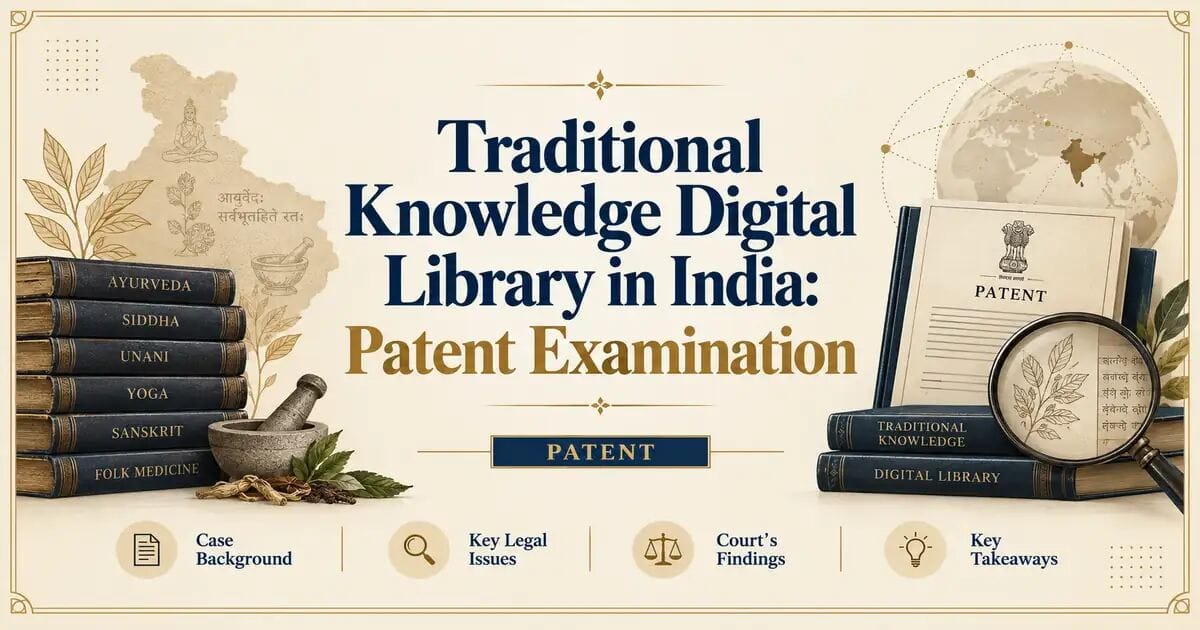
India’s experiences with turmeric, neem and basmati demonstrated the limitations of relying solely on challenges after potentially problematic patents had been granted. In response, India established the Traditional Knowledge Digital Library (TKDL) in 2001 to make documented traditional knowledge available in a structured and searchable form. While TKDL functions as a digital repository, its significance extends beyond preservation: it operates as a defensive intellectual property mechanism, enabling patent examiners to identify documented traditional knowledge as prior art and assess whether a patent application satisfies the requirements of patentability.
What is Biopiracy & Why Was TKDL Created?
The concept of biopiracy becomes particularly relevant when viewed through the patent system. Patent protection is based on the requirement that an invention must satisfy the applicable standards of patentability. Previously available knowledge may constitute prior art, but traditional knowledge can be difficult to identify because it is often preserved in historical texts and sources that are not easily searchable by patent examiners.
Much of India’s traditional knowledge is preserved historically in texts and manuscripts in languages such as Sanskrit, Hindi, Arabic, Persian, Urdu and Tamil. Although these materials may constitute evidence of existing medicinal knowledge, they were not easily accessible or comprehensible to patent examiners at international patent offices.
The turmeric and neem disputes demonstrate the practical consequences of this problem. In the turmeric case, India challenged a US patent on the wound-healing use of turmeric by showing that this use was already part of the traditional knowledge, leading to the patent’s revocation. Similarly, evidence of the traditional use of neem was used to challenge a European patent concerning its antifungal properties, which was eventually revoked. These cases highlighted the need for a system that could make India’s traditional knowledge more accessible during patent examination and contributed to the development of the TKDL.
TKDL was not created to give traditional knowledge a new form of ownership or proprietary right. Its main aim is to make existing traditional knowledge accessible during patent examination so that it can be identified before a patent is granted. By providing patent examiners with access to relevant traditional knowledge as prior art, TKDL helps prevent patents from being granted for knowledge that is already known.
Legal Framework for Traditional Knowledge and Biological Resources
In India, biopiracy is addressed through a combination of patent and biodiversity laws. The Patents Act 1970, through Section 3(p), provides that an invention that is simply traditional knowledge or an aggregation or duplication of known properties of components that have traditionally been known to people is not patentable.
The legal framework also includes biological resources. The Biological Diversity Act 2002 regulates access to biological resources and associated traditional knowledge and provides for the fair and equitable sharing of benefits arising from their use. The Biological Diversity (Amendment) Act 2023 subsequently amended this framework, with the relevant provisions coming into force on 1 April 2024.
Patent applications involving traditional knowledge or biological material may also be subject to specific requirements and disclosure of the source and geographical origin of biological material. Thus, two related issues are being tackled here: preventing existing traditional knowledge from being converted into an inappropriate patent monopoly and regulating access to India’s biological resources and associated traditional knowledge.
Structure: CSIR, Ministry of AYUSH & TKRC Classification
The Traditional Knowledge Digital Library (TKDL) was founded in 2001 as a joint initiative of the Council of Scientific and Industrial Research (CSIR) and the Ministry of AYUSH with the aim to collate traditional medicinal knowledge of India in a manner suitable to be utilized in the patent review process. During the development of TKDL, expertise from the domains of traditional systems of medicine, science, IT and IP was brought together. An important component of TKDL is the Traditional Knowledge Resource Classification (TKRC), which organizes traditional medicinal knowledge in a systematic manner that facilitates searching and comparing with the relevant patent claims. TKRC is also linked to the International Patent Classification (IPC) so that relevant traditional knowledge can now be identified more easily. TKDL also translates and organizes knowledge from traditional systems like Ayurveda, Siddha and Unani with the help of international language technology. Thus, TKDL is not just about preserving traditional knowledge but also about making it accessible at the time of patent review.
How is TKDL Used in Patent Examination
The TKDL website serves as a safety net during the processes of patent examination, as it identifies documented Indian traditional knowledge as potential prior art. When the patent in question is based on traditional knowledge, this database can be searched to monitor whether the inventor’s idea has already been in the public domain, making the patent examiner’s job much easier. By organizing the information on traditional sources, the database has organised traditional knowledge sources under the Traditional Knowledge Resource Classification (TKRC). By doing this, it has eliminated the language/format barriers, which made it impossible to get proper information about the knowledge previously attributed to the task of conducting an efficient prior art search. If any traditional knowledge is found, it will be considered during the examination of this application. Thus, TKDL does not give rights to historical knowledge; it provides the proof that the knowledge existed before.
Notable Successes: Turmeric, Neem and Basmati
Turmeric and Neem Controversy
The turmeric and neem cases became significant illustrations of the challenges of safeguarding indigenous knowledge through the patent system. In the case of turmeric, a patent was issued in the US allowing use of turmeric for treating wounds. India opposed this patent by providing evidence that this information already came under Indian traditional knowledge. Eventually the patent was revoked. Likewise, a European patent concerning neem was contested when it was shown that the fungicidal characteristics of neem were already known in India. The patent in question was also revoked by the European Patent Office. These situations confirmed that indigenous knowledge had the potential for becoming pertinent prior art, yet the challenges associated with finding and submitting such evidence after the fact were also documented.
Controversy over Basmati Rice
The Basmati rice controversy is another example of the difficulties involved in safeguarding Indian traditional biological resources and traditional knowledge. In 1997, RiceTec was awarded a patent in the United States on an invention related to Basmati rice, which caused India to raise objections because RiceTec was claiming a patent and using the term “Basmati” with reference to rice grown outside the traditional area for the production of Basmati rice. India challenged some of the claims made by RiceTec, but RiceTec actually decided to drop some claims and modify the others. What makes the Basmati rice case different from the turmeric and neem cases is the fact that the Basmati rice controversy was not simply a case of a patent being cancelled because of traditional knowledge. However, the Basmati rice case showed the limitations of the use of traditional intellectual property measures for the protection of traditional knowledge, traditional practices, resources and traditional reputation. Basmati, together with turmeric and neem, exposed the gaps in India’s TK-protection framework, turmeric and neem prompted creation of TKDL.
Limitations of TKDL
Although this system is very important in terms of defending intellectual property rights, there are some limitations of TKDL. The first and foremost role of TKDL is to prevent any patent from being issued in the wrong manner by providing the documented traditional knowledge as prior art while reviewing the application for patents. TKDL claims no ownership over the traditional knowledge it documents and it does not allow the community to earn any monetary gain from the traditional knowledge due to its commercial use. The second limitation of TKDL is that it is dependent on the documented traditional knowledge.
Criticism to TKDL
Nonetheless, some issues arise about accessibility and classification. TKDL can be defined as a database that is not available for the public to access. Access to the database is permitted only to authorized patent agencies, though the government approved widening access beyond patent offices via paid subscription in 2022, rollout remains limited. In this regard, though restricted access may decrease the chances for misuse, it results in numerous difficulties when attempting to verify the data independently. Furthermore, the translation of different traditional knowledge systems to commonly used classifications such as TKRC results in losing the richness of traditional knowledge which makes it contextual in nature. Hence, different controversies regarding the legitimacy of traditional knowledge documentation procedures used during patent verification exist among experts.
Conclusion
The TKDL provides an example of how intellectual property laws can combat biopiracy by documenting traditional knowledge and making it accessible as prior art for the purpose of patent registration. However, the system remains largely passive, as it stops unjust patent-protecting monopolies, but does not provide stakeholders with ownership rights or compensation. In short, TKDL serves as a mechanism for the protection of traditional knowledge from patent abuse, yet achieving this goal naturally requires additional means of protecting the rights to traditional knowledge.
Also Read: Calcutta HC Revokes Letters Patent Leave in Maitra Servicenter Dispute
References
- World Intellectual Property Organization, ‘Protecting India’s Traditional Knowledge’ WIPO Magazine (1 June 2011) https://www.wipo.int/en/web/wipo-magazine/articles/protecting-indias-traditional-knowledge-37721
- Council of Scientific and Industrial Research, ‘Traditional Knowledge Digital Library Unit (TKDL)’ (CSIR) https://www.csir.res.in/en/documents/tkdl
- The Patents Act 1970, s 3(p).
- Office of the Controller General of Patents, Designs and Trade Marks, Guidelines for Processing of Patent Applications Relating to Traditional Knowledge and Biological Material (2012) https://www.ipindia.gov.in/frontend/pdf/patents/guidelines/Guidelines%20for%20Processing%20of%20Patent%20Applications%20relating%20to%20Traditional%20Knowledge%20and%20Biological%20Material%20-%202012.pdf
- Biological Diversity Act 2002.
- Biological Diversity (Amendment) Act 2023.
- World Intellectual Property Organization, ‘About the Traditional Knowledge Digital Library’ https://www.wipo.int/meetings/en/2011/wipo_tkdl_del_11/about_tkdl.html accessed 24 August 2026.
- Council of Scientific and Industrial Research, ‘India’s Traditional Knowledge and the role of CSIR’s TKDL’ https://www.csir.res.in/en/csir-success-stories/indias-traditional-knowledge-and-role-csirs-tkdl