
Case Snapshot
Want to learn the fundamentals of Patent Law? Read our complete Patent Law Guide.
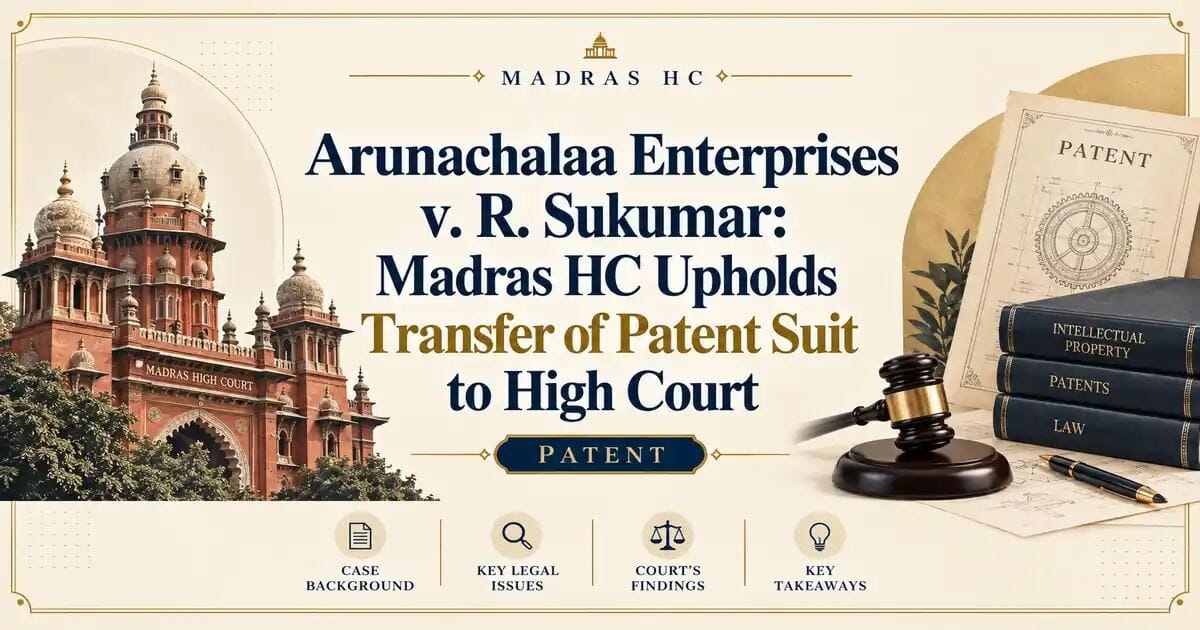
In M/s. Arunachalaa Enterprises vs. M/s. R. Sukumar, the Madras High Court dismissed a review petition seeking to recall an order that transferred a patent infringement suit from a District Court to the High Court. The Court affirmed that a defendant possesses a dual-track right under Section 64 of the Patents Act, 1970, which governs the power of the Controller or High Court to revoke patents, allowing them to seek revocation either by way of a counter-claim in an infringement suit or through an independent revocation petition, even if the latter is filed while an infringement suit is already pending. The litigation surfaced following an order dated 22.07.2026, where the Court had directed the transfer of an infringement suit pending before a District Court to be heard alongside a revocation petition filed before the High Court. The petitioner, the plaintiff in the original infringement suit, argued that the District Court’s jurisdiction remained intact because no counter-claim for revocation had been filed in that specific suit. The petitioner contended that Section 104 of the Patents Act, which restricts a District Court’s jurisdiction to try infringement suits if a counter-claim for revocation is made, was being misapplied. The Court rejected this, holding that the statutory right to seek revocation cannot be curtailed by forcing a defendant to choose only the counter-claim route.
Parties’ Submissions
The petitioner, represented by Mr. V. Natarajan, contended that the High Court committed a material error by transferring a suit that lacked an active counter-claim for revocation. He argued that under Section 104 of the Patents Act, the jurisdiction of a District Court is ousted only when a counter-claim is expressly filed. Relying on the decisions in Rajeev Indravadan Modi vs. Instance Laboratories Private Limited and Fabcon vs. Industrial Engineering Corpn, the petitioner submitted that absent a formal pleading for revocation within the suit, the High Court lacks the authority to withdraw the case from the District Court. Furthermore, the petitioner asserted that the court’s previous analysis on the maintainability of the revocation petition was an unsolicited exercise, as the issue had not been agitated by the parties. The respondent, represented by Mr. A.K. Rajaraman, countered that no error appeared on the face of the record. The respondent maintained that the Court correctly exercised its powers, supported by an analysis of Section 64 of the Patents Act. The respondent argued that the High Court possesses the inherent jurisdiction to consolidate the infringement suit and the revocation petition to avoid multiplicity of proceedings and conflicting outcomes, ensuring that the issue of patent validity is decided by the only forum competent to do so: the High Court.
Court’s Analysis
Justice K. Kumaresh Babu delivered a firm clarification on the interplay between infringement suits and revocation proceedings. The Court emphasized that Section 64 provides a litigant with an absolute statutory right to challenge a patent. This right is not subordinate to the filing of an infringement suit; rather, it exists alongside it. The Court distinguished the current matter from cases where the transfer was rejected due to the absence of a counter-claim. The Court clarified that the proviso to Section 104 is a mandate for transferring suits where a counter-claim is filed, but it does not act as a negative covenant preventing the High Court from transferring a suit in the interest of justice when an independent revocation petition is pending.
“The right of a defendant in a suit for revocation of patent had been given under Section 64 of the Act either to file an independent revocation petition or to file it by way of a counter claim in a suit filed for infringement of the said patent. This statutory right cannot be whittled down by forcing the litigant to choose a remedy by only filing a counter claim.”
Hon’ble Justice K. Kumaresh Babu
The Court further noted that allowing a District Court to proceed with an infringement suit while the validity of the underlying patent is being challenged before the High Court would lead to an anomalous situation. By transferring the suit to the High Court, the Court fulfilled the object of the Civil Procedure Code (CPC) to avoid driving litigants to different forums. The Court also cited Clause 13 of the Letters Patent Act, which provides the High Court with the power to remove and try cases from subordinate courts to ensure justice. On the issue of maintainability, the Court rebuked the petitioner’s claim that the topic was not raised, noting that the petitioner had, in fact, filed written submissions specifically addressing the maintainability of the original petition.
Outcome
The High Court dismissed the review petition (Rev.Pet(IPD) No. 2 of 2026) and effectively closed the connected application for stay ((PT) A. No. 7 of 2026). The Court found no material error or justification for recalling the order of transfer, affirming that the judicial consolidation of the infringement suit and the revocation petition remains a necessary measure to uphold the integrity of patent adjudication.
Also Read: Calcutta HC Revokes Letters Patent Leave in Maitra Servicenter Dispute
Implications for IP Practice
This judgment serves as a practical blueprint for how High Courts will likely handle the consolidation of patent disputes moving forward. For practitioners, the following takeaways are critical:
- Statutory Independence of Revocation: Litigants must recognize that the right to file a revocation petition under Section 64 is independent. A plaintiff cannot freeze a defendant’s path to challenging patent validity by simply filing an infringement suit in a District Court.
- Jurisdictional Consolidation: While Section 104 mandates transfer upon the filing of a counter-claim, this judgment confirms that the High Court will not be constrained by the lack of a counter-claim if it determines that consolidation is necessary for justice. The High Court will likely use its inherent powers, including those under the Letters Patent Act, to pull suits from District Courts if a parallel revocation challenge exists.
- Duty of Candour in Written Submissions: The Court’s rejection of the petitioner’s claim regarding the “non-issue” of maintainability highlights the weight judges place on written submissions. Counsel should be precise and consistent; the record of written submissions will be scrutinized, and any attempt to backtrack on issues argued in writing may be met with judicial reprimand.
- Procedural Strategy: Defense counsel in infringement suits should consider whether to file a counter-claim immediately or to approach the High Court with an independent revocation petition, keeping in mind that the end result, transfer to the High Court, will likely be the same. Filing a counter-claim remains the standard practice, but this ruling clarifies that the absence of one is not a fatal defect to the High Court’s jurisdiction to consolidate matters.
- Forum Shopping and Efficiency: The Madras High Court’s reliance on the principle of avoiding multiplicity of forums signals a judicial preference for centralized patent adjudication. Attorneys should be prepared to argue for or against consolidation based on the specific evidence of prejudice or procedural economy, rather than relying solely on the presence or absence of a formal counter-claim.
This ruling reinforces a judicial culture in India where technical procedural hurdles are secondary to the primary objective of ensuring that complex technical questions, such as the validity of a patent, are decided by the forum with the requisite jurisdiction. Litigators representing patent holders should prepare for the possibility that District Court proceedings may be interrupted by such transfers when validity is contested. Conversely, those challenging patents have secured a clear path to move their disputes to the High Court, bypassing the limitations of District Court proceedings.
Case Details: M/S. ARUNACHALAA ENTERPRISES Vs M/S. R. SUKUMAR, PROPRIETOR, | Case Number: REV.PET(IPD).2/2026 | Court: Madras High Court | Date: 26-09-09
Presiding Bench: Hon’ble THE HON’BLE MR.JUSTICE K.KUMARESH BABU