
Factual Matrix
New to Trademark Law? Start with our complete Trademark Law Guide.
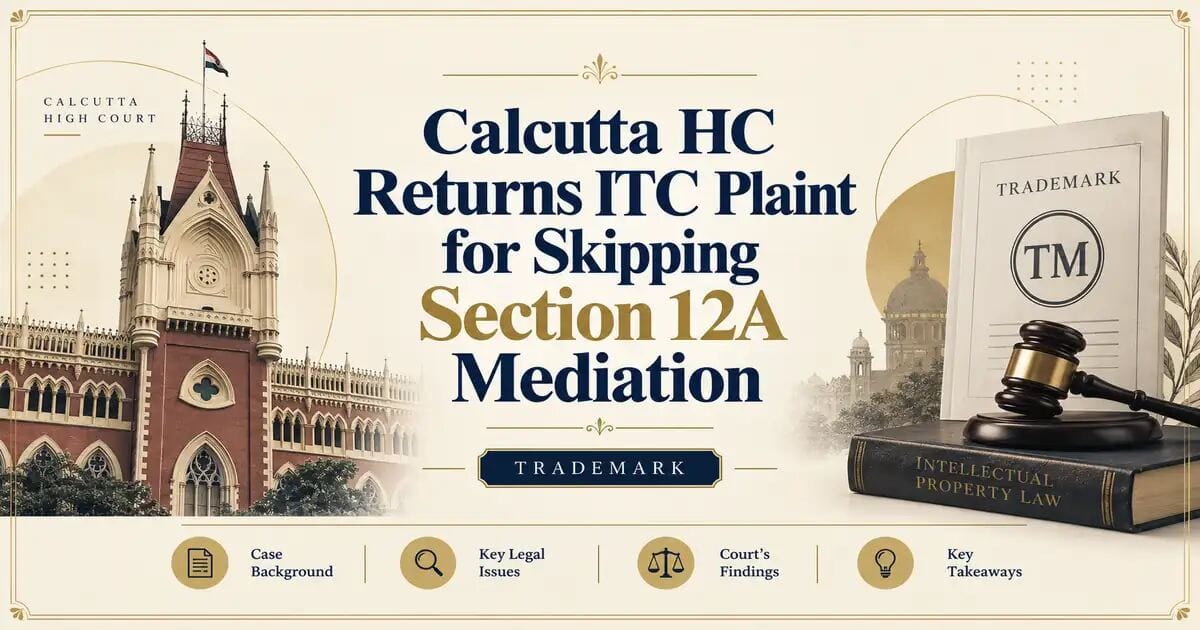
Can a brand owner execute a successful criminal raid against a counterfeiter and then skip civil pre-suit mediation on the grounds of emergency? The Calcutta High Court recently answered with a resounding negative. In the landmark matter of [ITC Limited v. SMM Tobacco Private Limited & Ors.], the court checked the aggressive litigation tactics of major IP proprietors. This ruling delivers a sharp reality check to corporate trademark owners across India.
Justice Arindam Mukherjee held that selecting a criminal remedy while keeping civil options in abeyance destroys the immediacy required to skip pre-suit mediation. Corporate legal departments must now re-evaluate their enforcement timelines. Any strategic gap between police action and civil filing will prevent a plaintiff from bypassing the mediation table.
The dispute began in mid-July 2026. Dedicated field investigators gathered specific, credible intelligence about unauthorized operations in Muzaffarpur, Bihar. SMM Tobacco Private Limited operated an illicit setup. The enterprise utilized mechanized cigarette-making, packing, and allied machinery to produce counterfeit tobacco products.
Acting on this intelligence, ITC Limited filed a First Information Report with local police. Law enforcement conducted extensive search and seizure operations on July 22, 2026. The raid yielded a significant haul of counterfeit goods and mechanized machinery. Having successfully disrupted the physical supply chain, ITC Limited paused.
Although the right to sue accrued immediately, the conglomerate chose not to file a civil suit right away. It waited until early September 2026 to approach the High Court. This tactical delay of approximately one month proved to be a fatal procedural error.
When ITC Limited finally presented its civil plaint, it sought an interim injunction. It also prayed for a dispensation of the mandatory pre-suit mediation under Section 12A of the Commercial Courts Act, 2015. The plaintiff relied on the argument that intellectual property counterfeiting creates an inherent, continuous emergency.
Justice Arindam Mukherjee refused to accept this plea of convenience. The court scrutinized the plaint’s averments under the strict rules of commercial civil procedure. It concluded that ITC Limited’s own actions disproved its claims of urgent necessity.
Applicable Law & Statutory Provisions
What legal framework governs this procedural tug-of-war? The statutory conflict centers primarily on Section 12A of the Commercial Courts Act, 2015. This provision governs mandatory pre-suit mediation, forcing parties to attempt settlement before litigation. A plaintiff can only bypass this step if they contemplate urgent interim relief.
In *Patil Automation Private Ltd. v. Rakheja Engineers Private Ltd.*, the Supreme Court declared Section 12A to be mandatory. Courts must reject or return any suit filed in violation of this requirement. Later, the Apex Court in *Yamini Manohar v. T.K.D. Keerthi* outlined the rules for examining such plaints. Judges must limit their scrutiny to the averments in the plaint and its accompanying documents to assess genuine urgency.
ITC Limited also invoked criminal enforcement mechanisms. Specifically, Sections 103 and 104 of the Trade Marks Act, 1999, govern criminal penalties for applying false trademarks. Additionally, Section 63 of the Copyright Act, 1957, governs criminal penalties for copyright infringement. These criminal remedies operate independently of civil remedies.
To justify bypassing mediation, ITC Limited relied heavily on *Novenco Building & Industry A/S v. Xero Energy Engg. Solutions (P) Ltd.* This Supreme Court decision explored whether continuing infringement of IP rights satisfies the urgency test. The Apex Court held that continuing infringement constitutes a fresh wrong every single day.
The *Novenco* ruling emphasized that intellectual property disputes involve public interest elements. When imitation masquerades as innovation, it sows confusion among consumers. Therefore, the public interest element imparts a color of immediacy to the civil reliefs.
Judicial Analysis
Did the *Novenco* doctrine grant an absolute exemption to ITC Limited? Justice Mukherjee rejected this broad interpretation. The court emphasized that every dispute must be analyzed on its unique facts. In the present matter, the plaintiff knew about the counterfeiting in July 2026.
Instead of filing a civil action immediately, the company chose to pursue only the criminal path. It secured a police raid, recovered the counterfeit stock, and then kept its civil remedies in abeyance. The court was not buying the plaintiff’s argument that an emergency existed in September. This strategic choice undermined the claim of immediate civil urgency.
Let us examine the court’s precise reasoning. The judge noted that dual remedies are indeed available to intellectual property owners. A plaintiff can pursue criminal and civil actions simultaneously. If a brand owner chooses to defer one remedy, it cannot later claim that the deferred remedy is suddenly too urgent to allow for mediation.
The court recorded this finding in clear terms:
“The plaintiff, therefore, was specifically aware about the illegal and wrongful acts of the defendant no. 1 in July, 2026. The plaintiff therefore at that point of time could have either gone to police authorities with a complaint invoking the provisions of 1999 Act or could have approached the competent Civil Court by filing a suit alleging infringement and passing off. The plaintiff also could have at the same time maintained the criminal and civil action since such remedy are independent of each other. The plaintiff, however, chose one of the remedies available to it by lodging an FIR with the police authorities which led to search and seizure by keeping the other remedy in abeyance though the same was available.”
Hon’ble Justice Arindam Mukherjee
Accepting ITC Limited’s logic would create an unacceptable loophole. If every intellectual property suit automatically bypassed mediation due to “inherent urgency,” Section 12A would become completely useless. The legislature specifically included intellectual property disputes within the Commercial Courts Act, 2015. Exempting them by default would violate clear legislative intent.
To support this view, the court relied on other recent High Court decisions. It cited *Goodfaith Holding (P) Ltd. v. Supreme Wood Products (P) Ltd.* of the Calcutta High Court. Additionally, the court pointed to the Bombay High Court’s judgment in *High Point Supply Co. LLC v. Agati Healthcare (P) Ltd.*
Consequently, the court refused to admit the plaint. It directed the department to return the plaint to ITC Limited. The company must now undergo pre-suit mediation before it can re-file the civil suit. However, the court granted leave to ITC Limited to use the same court fees for any future suit on this cause of action.
Also Read: Meridian v. Cascade: Bombay HC Restrains ‘NACOMIST’ Under Consent Terms
Practical and Commercial Implications
What does this ruling mean for brand protection strategies in India? For corporate legal counsel, the judgment demands a complete overhaul of enforcement timelines. Selecting the right forum is no longer just a question of choosing between civil and criminal courts. It is now a high-stakes timing calculation.
Many brand owners prefer criminal raids because they offer immediate physical deterrence. Police seizures dry up the counterfeiter’s stock in trade. Yet, this strategy now carries a heavy procedural price tag. If you choose a criminal raid first, you must expect the defendant to use Section 12A to delay any subsequent civil suit.
This delay can have massive financial consequences. A pre-suit mediation process typically takes three to five months. During this period, a sophisticated counterfeiter can rebuild its supply chain. They can relocate their mechanized machinery to another district or state.
While the brand owner is stuck in mediation, market share continues to erode. The loss of sales turnover during those months can dwarf the costs of litigation. Therefore, a serial approach to IP enforcement is highly risky. To preserve civil urgency, brand owners must file civil and criminal actions concurrently.
Launching both actions at the same time prevents the defendant from arguing that the plaintiff slept on its rights. It shows the court that the emergency remains active on both fronts. This approach requires greater upfront investment and tighter coordination among field investigators, local counsel, and police authorities.
Corporate legal departments must also reassess their budgets. Filing a civil suit in a High Court requires substantial court fees. Under this order, the court allowed ITC Limited to reuse its court fees, saving the company from a significant loss. However, other courts may not be as accommodating.
For law students and young practitioners, this judgment highlights the supremacy of procedural law over substantive IP rights. Substantive trademark and copyright protections mean very little if procedural barriers prevent you from entering the courtroom. Section 12A is not a mere formality that can be brushed aside with creative drafting. It is a mandatory gatekeeper.
Litigators representing plaintiffs must now craft their plaints with absolute precision. If there is a gap between discovery and filing, the plaint must explain every single day of delay. Vague assertions of “continuing wrong” will no longer suffice to secure dispensation.
The plaintiff’s legal team, led by senior advocate Mr. Rudraman Bhattacharya, along with Mr. Sarathi Dasgupta, Mr. K.K. Pandey, Mr. Manosij Mukherjee, Mr. Aayush Sinha, Mr. Naman Chowdhury, and Mr. Bhavesh Garodia, faced this reality firsthand. Their arguments failed to overcome the procedural barrier.
For defendants, this ruling provides a powerful tactical shield. If a plaintiff delays filing a civil suit after a raid, the defendant’s counsel should immediately demand a return of the plaint under Section 12A. This strategy buys valuable time and forces the parties to the negotiating table.
Ultimately, this decision strikes a balance between protecting intellectual property and respecting legislative mandates. It prevents wealthy brand owners from using the court system as a discretionary tool. The ruling ensures that the Commercial Courts Act, 2015, applies equally to all commercial litigants.
Case Details: ITC LIMITED vs. SMM TOBACOO PRIVATE LIMITED & ORS. | Neutral Citation: 2026:CHC-OS:388 | Case Number: IP-COM/10/2026 | Court: Calcutta High Court | Date: 08-09-2026
Presiding Bench: Hon’ble THE HON’BLE JUSTICE ARINDAM MUKHERJEE
Appearances: For the Plaintiff : Mr. Rudraman Bhattacharya, Sr. Adv.