
Factual Matrix
Looking to understand Trademark Law better? Read our complete Trademark Law Guide.
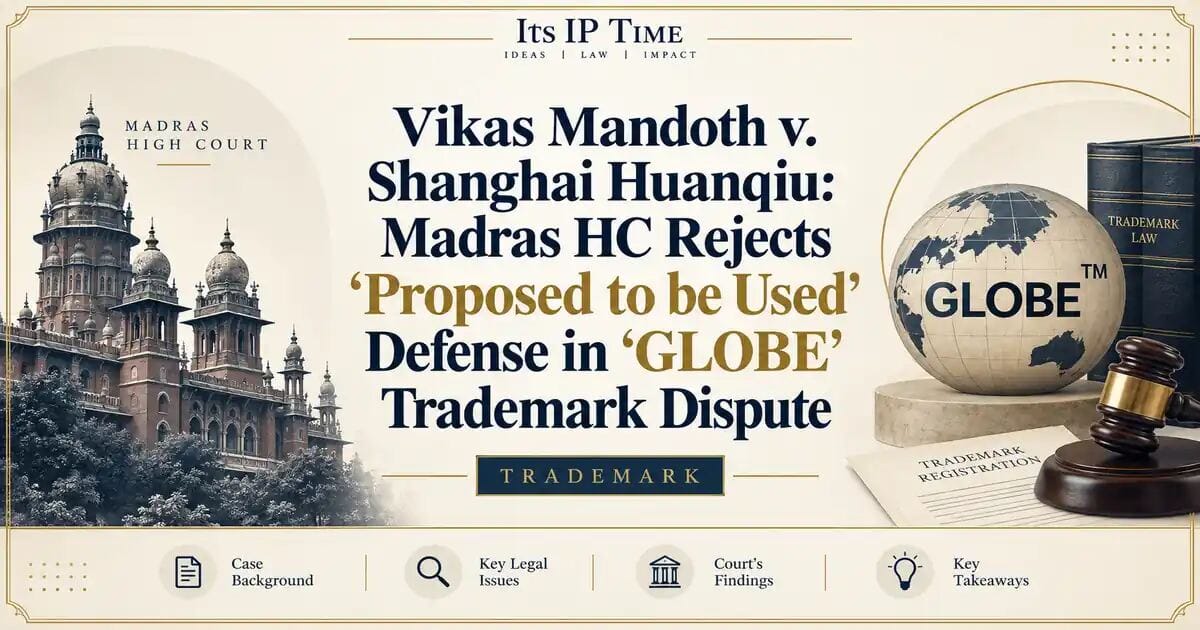
In the matter of Vikas Mandoth Vs Shanghai Huanqiu Lock Making Company Ltd And Anr, the Madras High Court dismissed the defendant’s applications to vacate an ex-parte interim injunction, thereby confirming the protection of the plaintiff’s “GLOBE” trademark and associated artistic works. The core legal dispute centered on whether the defendant’s adoption of a phonetically and visually similar mark, registered in the Tamil script, constituted infringement and passing off against the plaintiff’s established global brand presence in the hardware sector.
The plaintiff, M/s. Shanghai Huanqiu Lock Making Company Ltd, a Chinese entity, initiated the underlying suit (C.S.(COMM.DIV.)No.307 of 2025) alleging that the defendant, Vikas Mandoth, had infringed upon its registered “GLOBE” trademark and related trade dress used for padlocks and hardware equipment. The plaintiff asserted significant market reputation and prior usage, claiming that the defendant’s branding created consumer confusion. Conversely, the defendant argued that his adoption of the mark was an independent process, bolstered by a registration for the same device in the Tamil language. Furthermore, the defendant challenged the maintainability of the suit, alleging that the plaintiff failed to comply with the mandatory pre-institution mediation procedures under Section 12A of the Commercial Courts Act, 2015, a provision requiring parties to exhaust mediation before filing commercial suits, and contended that the plaintiff’s supporting documents were fabricated.
The proceedings were marked by vigorous arguments from both sides. Mr. Jayesh Kumar Daga represented the applicant (defendant), while Mr. Ramesh Ganapathy appeared for the respondents (plaintiffs). Following the initial ex-parte grant of injunction in November 2025, the defendant sought to vacate the order, relying heavily on assertions of prior use and procedural irregularities.
Applicable Law and Statutory Provisions
The dispute invoked fundamental principles of the Trade Marks Act, 1999, specifically regarding the rights conferred by registration and the common law remedy against passing off. The court examined the interplay between Section 27, which preserves the right of action for passing off despite the status of a registered trademark, and the broader protections afforded to registered proprietors under Section 29, which defines the acts constituting infringement of a registered trademark.
A critical statutory focal point was the defendant’s reliance on his own trademark registration. The court balanced this against the plaintiff’s claim of prior user, a principle codified in Indian trademark law where the rights of an established prior user generally supersede those of a subsequent registrant who may have obtained a registration for an identical or deceptively similar mark. Additionally, the court addressed the procedural bar under Section 12A of the Commercial Courts Act, which the defendant argued rendered the suit non-maintainable. By deferring complex evidentiary questions such as alleged document fabrication and procedural compliance to the stage of trial, the bench underscored the limitations of summary adjudication in interlocutory applications.
Judicial Analysis
The Hon’ble Mr. Justice K. Kumaresh Babu rejected the defendant’s plea to vacate the injunction, finding the plaintiff’s case for prior usage and reputation superior to the defendant’s claims. The bench observed that while registration grants certain proprietary rights, it does not provide an absolute shield against claims of infringement when the mark is proven to be deceptively similar to a prior existing mark. A pivotal moment in the court’s reasoning involved scrutinizing the defendant’s conduct during his own registration process.
“Even though the defendants claim to be a prior user, as rightly pointed out by the learned counsel for the plaintiff, in the application that had been filed by the defendant for registration of the Trademark they had indicated that they had proposed to use the trademark and the said application had been made in the year 2023.”
Hon’ble Justice K. Kumaresh Babu
The court emphasized that the defendant’s own trademark application, filed in 2023 under a “proposed to be used” basis, fundamentally contradicted his assertion of being a prior user in the current litigation. This inconsistency proved fatal to the defendant’s effort to vacate the injunction. The judge further held that the defendant’s attempt to register the identical name in a vernacular script (Tamil) did not negate the likelihood of confusion, as the phonetic and visual similarity remained high enough to deceive the average consumer of hardware and padlock products.
Regarding the defendant’s challenges to the suit’s maintainability and the authenticity of the plaintiff’s documentation, the court adopted a cautious approach. It determined that issues pertaining to the alleged fabrication of invoices or the standing of the parties involved in the partnership are matters of evidence that must be ventilated during the full course of a trial, rather than during the adjudication of an interim application. Consequently, the court maintained the status quo, preserving the injunction to prevent further market confusion.
Also Read: Calcutta HC Returns ITC Plaint for Skipping Section 12A Mediation
Practical and Commercial Implications
This judgment serves as a practical reminder for corporate counsel and IP practitioners regarding the weight of “proposed to be used” declarations in trademark applications. When a party files for registration under the “proposed to be used” category, they effectively preclude themselves from later asserting a prior common law usage that predates that application. This tactical error by the defendant highlights the need for rigorous due diligence during the pre-litigation phase of trademark disputes.
For businesses, the ruling underscores that the “vernacular shield”, the idea that transliterating a trademark into a regional language renders it distinct, is rarely effective if the overall visual and phonetic impression remains deceptively similar to an established brand. In the hardware and manufacturing sectors, where trade channels are often uniform and target consumers may not discern subtle script variations, courts are increasingly likely to protect the global brand equity of the senior user.
The dismissal of the defendant’s procedural challenges, specifically the assertion of non-compliance with Section 12A of the Commercial Courts Act, suggests that courts are disinclined to entertain such technical objections to vacate injunctions where a strong prima facie case of infringement is established. Defendants seeking to challenge the maintainability of a suit should prepare to anchor such arguments in clear, uncontroverted evidence that can survive initial scrutiny, rather than relying on procedural technicalities that may be deferred to trial.
Finally, for licensing and brand management teams, this case illustrates the high value of maintaining a consistent and accurate paper trail. The defendant’s focus on the interchangeability of “Chennai” and “Madras” in the plaintiff’s documents, while potentially a relevant point for cross-examination at trial, failed to outweigh the prima facie evidence of the plaintiff’s prior use and market reputation. Practitioners should advise clients that in the face of strong evidence of prior use and consumer confusion, tactical attacks on minor invoicing discrepancies are insufficient to overturn interim injunctive relief.
The confirmation of the injunction confirms that the courts continue to favor established market reputation over the late-comer’s registration, particularly when the latter’s registration claims contradict their factual history of usage. As the matter moves toward trial, the burden will remain on the defendant to prove that the plaintiff’s usage is not entitled to the protection sought, a high threshold given the current judicial stance on the deceptive nature of the defendant’s mark.
Case Details: VIKAS MANDOTH Vs SHANGHAI HUANQIU LOCK MAKING COMPANY LTD AND ANR | Case Number: A.446/2026 | Court: Madras High Court | Date: 26-09-07
Presiding Bench: Hon’ble THE HON’BLE MR.JUSTICE K.KUMARESH BABU
Read the Full Judgment/Order Here