
Skip to content
Subscribe

Browse the archive

Category: patent

patent

Delhi HC Directs Pro Tem Security in InterDigital vs Transsion

The Delhi High Court's recent pro tem security order in InterDigital v. Transsion underscores India's evolving role in Standard Essential Patent (SEP) enforcement. By clarifying that infringement need not be proven at the pro tem stage, the court has lowered the barrier for SEP holders to secure financial deposits. The ruling affirms that neither an implementer's robust financial health nor the absence of third-party licence data prevents the court from ordering security. This decision cements the 'one-fifth of counter-offer' formula as a standard, reinforcing India as a critical venue for global SEP litigation.

8 min read
patent

Delhi HC Sets Pharma Patent Standards on Section 3(d) and 3(i)

The Delhi High Court has clarified that a patent refusal must contain granular reasoning rather than generic objections. In Array Biopharma v. Deputy Controller, the court ruled that a rejection under Section 3(d) of the Patents Act, 1970 requires a specific, named prior art compound, while Section 3(i) exclusions cannot be invoked against product claims based on dosing descriptions in the specification. This decision provides pharmaceutical patent applicants with a vital legal standard to challenge arbitrary Controller orders, ensuring that the Patent Office adheres to established procedural rigour when evaluating inventive step and therapeutic exceptions.

8 min read
patent

Bombay HC: Patent Rejections Must Substantiate Common Knowledge

The Bombay High Court has mandated that patent refusals must be substantiated by specific references to common general knowledge, rejecting the practice of using it as a generic assertion. In Deepak Nitrite Limited v. Assistant Controller of Patents, the court held that a reasoned order under the Patents Act 1970 must identify the source, date, and relevance of evidence used to deny inventive steps. Controllers are required to assess claims as an integrated whole rather than dissecting individual steps, ensuring applicants receive a fair and transparent examination of their patent applications.

9 min read
patent

Delhi HC: Deuterated Compounds Fail Patent Efficacy Test

The Delhi High Court's decision in Intra-Cellular Therapies reaffirms that pharmaceutical patents for deuterated compounds must meet strict novelty and efficacy standards. Specifically, demonstrating improved pharmacokinetics, such as higher bioavailability, does not satisfy the 'enhanced therapeutic efficacy' threshold required by Section 3(d) of the Patents Act 1970. The court clarified that coverage in a broad genus patent anticipates species claims, limiting the ability of originators to 'serial parent' drug molecules. Patent applicants must provide clinical evidence of improved patient outcomes to overcome Section 3(d) rejections in the Indian Patent Office.

8 min read
patent

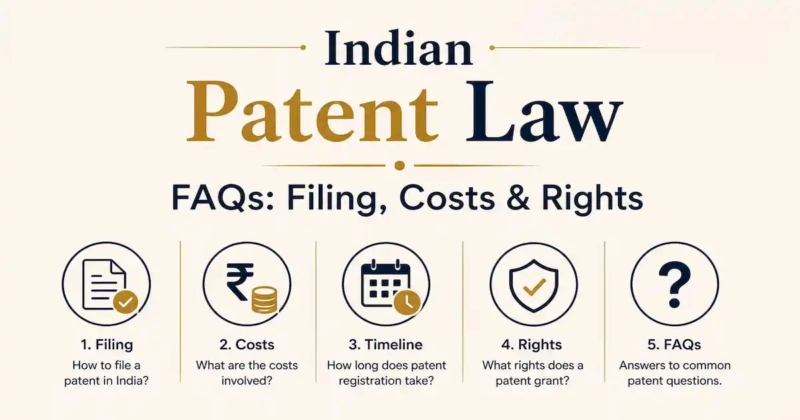
Indian Patent Law Guide: Filing and Rights Analysis 2026

Indian patent law under the Patents Act 1970 offers a rigorous framework for protecting functional innovation through novelty, inventive steps, and industrial application. Following the 2024 Amendments, inventors and startups must navigate updated filing, examination, and renewal procedures to secure 20-year exclusive rights. Whether you are filing an application or enforcing a patent through the Intellectual Property Division of the High Court, strategic compliance is mandatory. This guide clarifies the distinctions between patentability, provisional specifications, and the statutory obligations of patentees in India.

12 min read
patent

NBA Approval Does Not Guarantee Patentability: Delhi HC Ruling

National Biodiversity Authority (NBA) approval provides no legal nexus to patentability under the Patents Act, 1970. The Delhi High Court in Shaafi Naturcure LLP v. Assistant Controller of Patents and Designs confirmed that compliance with the Biological Diversity Act, 2002 does not satisfy the requirements for inventive step or Section 3(p) traditional knowledge exclusions. Patent applicants in the herbal medicine sector must establish synergy within the complete specification; post-filing affidavits cannot compensate for inherent disclosure gaps. Demonstrable technical efficacy remains the bedrock for valid patent protection in India.

14 min read
patent

Bombay HC: Patent Remand Cannot Authorise Fresh Re-examination

A court-ordered remand to the Indian Patent Office for a fresh hearing does not grant the Controller a license to conduct a de novo examination or introduce new prior art. The Bombay High Court has ruled that unless explicitly authorized, a remand triggered by natural justice violations restricts the Controller to clarifying existing objections on the record. This ensures procedural fairness under the Patents Act, preventing the Patent Office from using a limited remand as a mechanism to relitigate an application beyond its original scope.

7 min read
patent

Patent Rights vs Antitrust: Supreme Court Stays CCI Jurisdiction

The Supreme Court of India in CCI v. Swapan Dey is currently determining whether the Competition Commission of India (CCI) holds jurisdiction over anti-competitive practices tied to patent rights. While the NCLAT previously argued that the Patents Act 1970 operates as a self-contained code, the Supreme Court has stayed this exclusion, signaling that patent exclusivity cannot shield owners from antitrust scrutiny. This case is pivotal for clarifying how Section 3(5) of the Competition Act interacts with patent monopolies to prevent the abuse of a dominant position in Indian pharmaceutical markets.

8 min read
patent

CCA v. Rosenberger: Delhi HC Awards 152 Crore Patent Damages

In a landmark ruling, the Delhi High Court established the 'Dartboard Model' to penalize speculative prior art challenges in patent litigation. The case of Communication Components Antenna Inc. v. Rosenberger affirms that computational MATLAB simulations serve as legally sufficient proof of infringement when physical product access is denied. By applying a royalty-based damages framework with a bad-faith uplift, the court provided a clear roadmap for quantifying relief in oligopolistic markets. This judgment significantly strengthens the enforcement of technology patents in India, emphasizing objective evidence over scattershot defense strategies.

14 min read
patent

SEP Litigation in India: K.K. Bansal v. Philips Reversal

The Delhi High Court's ruling in K.K. Bansal v. Philips establishes a rigorous evidentiary standard for enforcing Standard Essential Patents (SEP) in India. Patent holders must prove essentiality through detailed claim charts mapping claims to technical specifications, comply with Section 45 of the Indian Evidence Act regarding expert testimony, and provide comparable licence agreements to establish FRAND rates. Furthermore, the court reinforced that international patent exhaustion under Section 107A(b) of the Patents Act prevents patentees from collecting royalties from downstream buyers once a licensed component enters the supply chain.

13 min read