
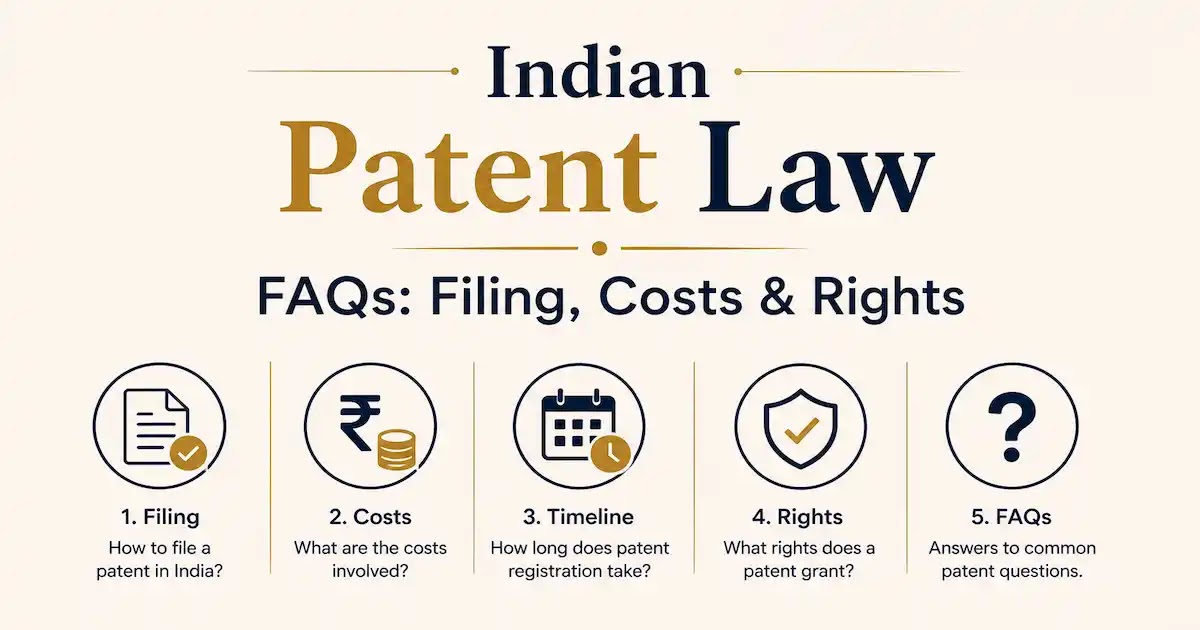

Indian patent law can appear technical at first, especially for inventors, startups, researchers, and businesses filing their first patent application. This guide answers the most frequently asked questions on the Patents Act, 1970, including patentability, filing, examination, costs, ownership, licensing, infringement, and the latest amendments introduced under the Patents (Amendment) Rules, 2024.
1. Patent Basics
New to Patent Law? Start with our complete Patent Law Guide.
Understand what patents protect, what inventions qualify, and how patents differ from other forms of intellectual property.
What exactly is a patent? Section 2(1)(m)
A patent is an exclusive statutory right granted by the Government that allows an inventor to prevent others from making, using, selling, offering for sale, or importing the patented invention in India without permission for a limited period. In return, the inventor must fully disclose the invention to the public through the patent specification.
What makes an invention patentable? Sections 2(1)(j), 2(1)(ja), 2(1)(ac)
An invention is patentable only if it satisfies three essential requirements:
- It must be novel, meaning it has never been disclosed anywhere in the world.
- It must involve an inventive step, meaning it is not obvious to a person skilled in the relevant field.
- It must be capable of industrial application, meaning it can be manufactured or used in an industry.
Failure to satisfy any one of these requirements will result in refusal of the application.
What cannot be patented in India? Section 3
Section 3 of the Patents Act excludes several categories from patent protection, irrespective of novelty.
- Scientific discoveries
- Mathematical methods
- Business methods
- Computer programs per se
- Methods of medical treatment
- Plants and animals (except microorganisms)
- Traditional knowledge
- Inventions contrary to public order or morality
A new form of a known substance is also not patentable unless it demonstrates enhanced efficacy under Section 3(d).
How is a patent different from a trademark, copyright and design registration?
| IP Right | Protects | Typical Duration |
|---|---|---|
| Patent | Functional inventions | 20 years |
| Trademark | Brand names, logos and slogans | Renewable indefinitely |
| Copyright | Original literary, artistic and software works | Life of author + 60 years |
| Design Registration | Visual appearance of products | 10 years + 5 year extension |
Many commercial products enjoy protection under more than one intellectual property regime simultaneously.
How long does a patent last? Section 53
An Indian patent remains valid for 20 years from the filing date (or the international filing date for PCT national phase applications).
Annual renewal fees become payable from the third year onwards. Under the Patents (Amendment) Rules, 2024, applicants receive a 10% discount when four or more renewal years are paid electronically in advance.
Who owns an invention created during employment?
The Patents Act does not automatically transfer ownership to an employer merely because an invention was created during employment.
Ownership generally remains with the inventor unless:
- there is a written assignment agreement;
- the employment contract specifically requires the employee to invent; or
- the inventor assigns the patent rights subsequently.
For this reason, employment and consultancy agreements commonly contain detailed intellectual property assignment clauses.
2. Filing the Patent Application
This section explains who may apply for a patent, the filing process, priority claims, provisional specifications, and publication of applications.
Can an inventor file a patent application without a patent agent?
Yes. Resident Indian applicants may file applications directly before the Indian Patent Office. However, patent drafting requires considerable technical and legal expertise, making professional assistance advisable for most inventions.
What is the difference between a provisional and complete specification? Section 9
A provisional specification secures an early filing date while allowing additional time to complete the invention.
A complete specification containing the full disclosure and claims must ordinarily be filed within 12 months. Failure to do so results in abandonment of the provisional application.
What is a priority date and why is it important? Section 135
The priority date determines the date against which novelty and inventive step are assessed. Applicants claiming convention priority generally have twelve months from their first filing to submit corresponding applications in other member countries.
Can patent applications be filed online?
Yes. The Indian Patent Office provides a comprehensive e-filing system, and most applications are now submitted electronically. Online filing also attracts lower government fees compared with physical filing.
What if I disclosed my invention before filing? Section 31 • Form 31
Public disclosure before filing generally destroys novelty. However, Section 31 provides a limited grace period in specified circumstances such as recognised exhibitions or learned societies.
Applicants relying on this exception must comply with the requirements introduced by the Patents (Amendment) Rules, 2024, including filing Form 31 where applicable.
When is a patent application published? Section 11A • Form 9
Applications are ordinarily published 18 months after the priority or filing date.
Applicants requiring earlier publication may file Form 9 requesting expedited publication.
Can one patent application protect my invention worldwide?
No. Patent rights are territorial.
The Patent Cooperation Treaty (PCT) simplifies international filing by allowing applicants to file a single international application before entering national phases in the countries where protection is sought.
3. Examination, Opposition & Grant
After filing a patent application, it undergoes examination by the Indian Patent Office. This stage determines whether the invention satisfies the statutory requirements for grant and also allows third parties to challenge the application.
How long does it take to obtain a patent in India?
There is no fixed timeline. The duration depends on factors such as the technical field, examination backlog, and whether expedited examination is available.
Most applications are granted within approximately 2 to 5 years, while eligible applicants using expedited examination may receive a decision considerably earlier.
What is expedited examination? Form 18A
Expedited examination places an application ahead of the normal examination queue.
It is available to eligible applicants including startups, small entities, educational institutions, women applicants, certain government organisations, and applicants qualifying under applicable Patent Prosecution Highway arrangements.
When must the Request for Examination be filed? Rule 24B
Applications filed before 15 March 2024 generally allow 48 months for filing the Request for Examination.
Applications filed on or after that date must ordinarily submit Form 18 within 31 months from the priority or filing date.
Failure to file the request within the prescribed period results in the application being treated as withdrawn.
What happens after examination is requested? Sections 12–15
An examiner reviews the application for novelty, inventive step, industrial applicability, clarity of claims, and statutory compliance.
If objections exist, the Patent Office issues a First Examination Report (FER). The applicant must respond within the prescribed time. After considering the reply and any hearing, the Controller may grant, refuse, or require amendment of the application.
What is pre-grant opposition? Section 25(1)
Any person may oppose a published patent application before grant on grounds such as lack of novelty, obviousness, wrongful obtaining, or non-patentable subject matter.
The Patents (Amendment) Rules, 2024 introduced procedural changes including preliminary scrutiny and prescribed fees.
What is post-grant opposition? Section 25(2)
Only an interested person may file post-grant opposition.
The opposition must generally be filed within one year from publication of the grant and may rely upon statutory grounds similar to those available for revocation.
Can a refusal by the Controller be appealed?
Yes.
Following the abolition of the Intellectual Property Appellate Board (IPAB), appeals are now heard by the Intellectual Property Division (IPD) of the jurisdictional High Court.
4. Costs, Fees & Discounts
Government fees vary depending upon the applicant category and the type of filing. Recent amendments have also introduced additional fee concessions.
What are the government filing fees for patents in India?
Government fees depend upon whether the applicant is a natural person, startup, small entity, educational institution or large entity.
Electronic filing generally attracts lower fees than physical filing. Applicants should always verify the latest fee schedule published by the Indian Patent Office before filing.
Are there fee concessions available?
Yes.
- Natural persons, startups and small entities enjoy substantially lower filing fees.
- Patent of Addition filings receive a 50% concession under the 2024 Rules.
- Electronic advance payment of multiple renewal years qualifies for a 10% renewal fee discount.
Can missed deadlines be extended? Rule 138 • Form 4
Many procedural deadlines may be extended or delays condoned upon filing Form 4 together with the prescribed fee.
However, certain statutory deadlines—including national phase entry and requests for examination—cannot ordinarily be extended under Rule 138.
5. After Grant: Working, Renewals & Patents of Addition
Obtaining a patent is only the beginning. Patentees must comply with renewal obligations, working statement requirements, and other statutory duties throughout the life of the patent.
What is Form 27 and why is it important? Section 146
Form 27 is the statutory working statement submitted to the Indian Patent Office indicating whether the patented invention has been commercially worked in India.
Following the 2024 amendments, it is generally filed once every three financial years instead of annually.
What happens if Form 27 is not filed?
Failure to comply may attract statutory penalties under the Patents Act.
Persistent non-working may also strengthen an application seeking a compulsory licence.
What is a compulsory licence? Section 84
After the prescribed period following grant, an interested person may apply for a compulsory licence where:
- public requirements are not being satisfied;
- the patented invention is not reasonably affordable; or
- the invention is not being adequately worked in India.
If granted, the Controller authorises another person to use the invention subject to payment of appropriate royalties.
What is a Patent of Addition? Section 54
A Patent of Addition protects improvements or modifications to an existing patented invention owned by the same patentee.
It expires along with the principal patent and ordinarily does not require separate renewal fees while linked to the parent patent.
Following the 2024 amendments, filing fees for Patents of Addition have been reduced by 50%.
6. Rights, Ownership & Licensing
A granted patent gives its owner exclusive commercial rights over the invention. However, ownership and licensing are governed by statutory requirements that every inventor and business should understand.
What rights does a patent owner receive? Section 48
A patentee has the exclusive right to prevent others from:
- making the patented invention;
- using the invention;
- selling or offering it for sale;
- importing it into India without permission.
These rights continue throughout the life of the patent, subject to the provisions of the Patents Act.
What is the difference between assignment and licensing? Sections 68 & 69
| Assignment | Licence |
|---|---|
| Transfers ownership of the patent. | Ownership remains with the patentee. |
| The assignee becomes the new owner. | The licensee only receives permission to use the invention. |
| Usually permanent. | May be exclusive or non-exclusive. |
Both assignments and licences should be executed in writing and recorded before the Controller in accordance with the Act.
What is the difference between an exclusive and non-exclusive licence?
An exclusive licence gives one licensee the exclusive right to exploit the invention within the agreed territory or field.
A non-exclusive licence allows the patentee to grant similar rights to multiple licensees simultaneously.
Can the Government or third parties use my patented invention without permission?
Yes, but only in limited statutory situations.
The Controller may grant compulsory licences under Sections 84–92, while the Central Government may authorise governmental use of patented inventions in specific public interest situations, subject to payment of appropriate compensation wherever applicable.
7. Patent Infringement & Enforcement
Patent rights become commercially valuable only when they can be enforced. This section explains infringement, available remedies, and common legal defences.
What constitutes patent infringement?
Patent infringement generally occurs when a person, without the patentee’s consent, makes, uses, offers for sale, sells, or imports a patented invention while the patent remains in force.
Whether infringement has actually occurred depends upon the scope of the granted claims rather than the overall similarity between two products.
What remedies are available for patent infringement? Section 108
The court may grant one or more of the following remedies:
- temporary injunction;
- permanent injunction;
- damages;
- account of profits;
- delivery up or destruction of infringing goods where appropriate.
Where are patent disputes heard in India?
Patent infringement suits are generally heard by courts having appropriate jurisdiction.
Several High Courts, including the Delhi High Court, now operate specialised Intellectual Property Divisions (IPDs) to hear patent litigation and appeals arising from decisions of the Patent Office.
What happened to the Intellectual Property Appellate Board (IPAB)?
The IPAB was abolished by the Tribunals Reforms Act, 2021.
Its jurisdiction has largely been transferred to the respective High Courts exercising intellectual property jurisdiction.
What defences are available in a patent infringement suit? Sections 107 & 64
The most common defence is to challenge the validity of the patent itself.
A defendant may argue that:
- the invention lacks novelty;
- it is obvious;
- the specification is insufficient;
- the patent was wrongly obtained;
- the invention falls within Section 3 exclusions.
What is the Bolar Exception? Section 107A(a)
The Bolar Exception permits use of a patented invention solely for obtaining regulatory approval before patent expiry.
This enables generic manufacturers to enter the market immediately after the patent expires without waiting to complete regulatory testing.
What is parallel importation? Section 107A(b)
Importing genuine patented products from authorised foreign sources may not amount to infringement under Section 107A(b).
This statutory exception prevents patentees from using patent rights to restrict legitimate imports in specified circumstances.
8. Special & Emerging Topics
Patent law continues to evolve with technological developments such as artificial intelligence, software inventions, biotechnology, and digital innovation.
Can software be patented in India? Section 3(k)
Computer programs per se are excluded from patentability.
However, software producing a demonstrable technical effect or solving a technical problem may qualify for patent protection depending upon the facts and the claims drafted.
Can Artificial Intelligence be named as an inventor?
No.
Under the present legal framework, only a natural person can be recognised as an inventor. AI systems may assist inventors but cannot themselves be recorded as inventors.
Can methods of medical treatment be patented? Section 3(i)
No.
Methods of surgery, therapy, diagnosis and medical treatment are specifically excluded from patentability under the Patents Act, although medical devices and pharmaceutical products themselves may be patentable.
Does traditional knowledge affect patentability?
Yes.
An invention that merely reproduces or slightly modifies existing traditional knowledge generally cannot receive patent protection. Biological resources may also require compliance with biodiversity legislation.
How can I search existing Indian patents?
The Indian Patent Advanced Search System (InPASS) enables applicants to search published patent applications and granted patents free of charge.
Applicants often supplement InPASS searches with international databases such as Espacenet or Google Patents before filing.
Which Patent Office will examine my application?
The Indian Patent Office has branches in Kolkata, Delhi, Mumbai and Chennai.
Jurisdiction is generally determined by the applicant’s residence, place of business, or the address of the authorised patent agent.
Also Read: Calcutta HC Revokes Letters Patent Leave in Maitra Servicenter Dispute
Conclusion
Indian patent law has undergone significant changes in recent years through judicial decisions and the Patents (Amendment) Rules, 2024. Understanding the filing process, statutory timelines, ownership rules, licensing mechanisms, and enforcement remedies helps inventors, startups, researchers, and businesses make informed decisions while protecting innovation.
Whether you are filing your first patent application or managing an existing patent portfolio, staying updated with legislative developments and Patent Office practice remains essential for securing and enforcing valuable intellectual property rights.