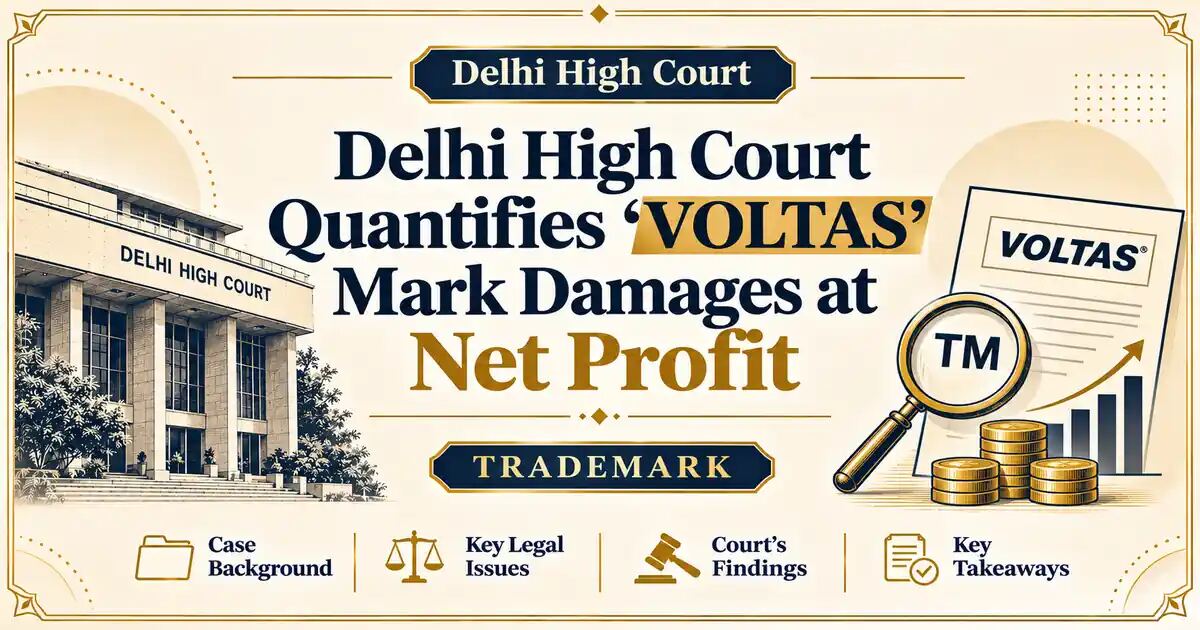
In VOLTAS LIMITED Vs M/S SHIV SHAKTI ENTERPRISES & ORS. [CS(COMM)-632/2019 2026:DHC:10010], the Delhi High Court granted summary judgment under Order XIII-A of the Code of Civil Procedure, 1908, awarding INR 5,00,000 in compensatory damages and INR 5,07,500 in legal costs to Voltas Limited against former authorized service center operators who engaged in unauthorized post-termination commercial use of the registered trademark ‘VOLTAS’. Adjudicated by Hon’ble Mr. Justice Tejas Karia, the Single Bench established a vital evidentiary standard for intellectual property accounting: while post-termination use of a registered mark by an ex-channel partner constitutes deliberate infringement, gross turnover reflected in seized invoices cannot automatically be equated to net profit for disgorgement without accounting for procurement, repair, and operational overheads. Furthermore, the Court exercised judicial restraint by denying punitive exemplary damages, drawing a strict line of demarcation between the reconditioning of secondary electronic scrap and high-hazard counterfeit medical devices.
| Disputed Subject Matter | Registered Trademark ‘VOLTAS’ (Class 11 covering Air Conditioners, Ventilating Plants, Refrigerating Apparatus) |
|---|---|
| Plaintiff / Petitioner’s Case | Voltas Limited sought permanent injunction, disgorgement of profits, damages, and full legal costs against former authorized service center operators who continued assembling, renting, repairing, and selling air conditioners using the ‘VOLTAS’ mark, letterheads, and visiting cards post-2012 agreement termination. |
| Defendant / Respondent’s Defense | Defendants 3 and 5 submitted they dealt exclusively in scrapped, damaged, and refurbished electronic goods procured from distributors, that letterheads were leftover stock from their pre-2012 authorized service center status, and that no counterfeit products were manufactured or seized. |
| Governing Law & Authorities | Order XIII-A CPC (Summary Judgment); Rule 20, Delhi High Court IPD Rules, 2022; Order XXVI Rule 10(2) CPC; Section 35 CPC (Legal Costs); Aero Club v. Sahara Belts (2023); Koninklijke Philips N.V. v. Amazestore (2019); Johnson & Johnson v. Pritamdas Arora (2025). |
| Decisive Holding & Relief | Summary judgment granted under Order XIII-A CPC. Permanent injunction having been decreed previously on September 8, 2025, Defendants 3 and 5 were held jointly and severally liable to pay INR 5,00,000 in damages and INR 5,07,500 in costs. Exemplary punitive damages denied. |
Post-Termination Channel Infringement and Procedural Evolution Under Order XIII-A CPC
Struggling with Indian Trademark Law principles? Explore our complete Trademark Law Guide.
The factual foundation of this suit addresses an enduring vulnerability for corporate brand owners: persistent mark exploitation by legacy channel partners following contractual severance. Voltas Limited instituted commercial proceedings against Defendants 1 through 5, alleging systematic trademark infringement, passing off, and unauthorized commercial representation. Defendants 3 and 5 operated as an authorized service center for Voltas until their underlying service agreement was formally terminated in 2012. Subsequent investigation by the Plaintiff revealed that despite contract termination, Defendants 3 and 5 continued executing commercial transactions, issuing repair quotations, renting air conditioning apparatus, and supplying assembled units to downstream vendors (Defendants 1 and 2) while utilizing letterheads, quotations, and visiting cards bearing the registered mark ‘VOLTAS’.
The procedural history reflects a strategic deployment of interlocutory remedies. On November 18, 2019, the High Court issued an ex-parte ad-interim injunction restraining Defendants 3 and 5 from exploiting the Plaintiff’s mark and appointed a Local Commissioner to inspect their premises. Executed on November 23, 2019, the commission yielded physical inventory including two outdoor units, three outdoor unit cartons, eleven remote controls, motor components, visiting cards, legacy letterheads, commercial quotations (including an offer to supply 500 LED TVs valued at INR 35,00,000), and transaction invoices. Following the deletion of Defendant 4 and the entry of a permanent injunction decree against Defendants 1 and 2, Defendants 3 and 5 suffered a decree of permanent injunction on September 8, 2025, after tendering a statement of no contest. Consequently, the sole triable issue left before the Court under Application I.A. 24279/2023 was the assessment of compensatory damages, legal costs, and punitive relief under Order XIII-A of the CPC.
Doctrinal Interplay: Section 28 Exclusive Rights Versus Section 34 Savings for Vested Use
From an intellectual property jurisprudence perspective, the unauthorized post-termination use of a mark by a former licensee brings into direct conflict Section 28 and Section 34 of the Trade Marks Act, 1999. Section 28(1) confers upon the registered proprietor the exclusive statutory right to use the trademark in relation to the goods for which it is registered and to obtain relief in respect of infringement. Defendants in post-termination disputes frequently attempt to shield their commercial actions by alleging continuous market presence or asserting that their handling of second-hand, secondary, or refurbished goods falls outside the statutory definition of infringement.
Governs judicial determination of damages and accounts of profits in IP disputes, requiring courts to assess lost profits of the proprietor, actual profits earned by the infringer, hypothetical royalty values, duration of infringement, degree of intent or negligence, and conduct mitigating damages.
However, statutory savings under Section 34 of the Trade Marks Act, 1999, which protect continuous prior use, are legally unavailable to an ex-franchisee or former authorized service provider. As affirmed by the Supreme Court of India in S. Syed Mohideen v. P. Sulochana Bai (2016 2 SCC 683) and Neon Laboratories Ltd. v. Medical Technologies Ltd. (2016 2 SCC 672), prior use rights require continuous, bona fide, independent commercial use preceding the proprietor’s registration or use. Under agency and licensing doctrine (codified under Sections 48 and 56 of the Act), all use of a mark by an authorized service provider or licensee inures exclusively to the benefit of the registered proprietor. Upon formal termination of the underlying agreement in 2012, any subsequent commercial deployment of the ‘VOLTAS’ mark by Defendants 3 and 5 converted their status from permissive users to bad-faith infringers under Section 29. Retaining legacy stationery, issuing transaction documents on proprietary letterheads, and holding out as an active service provider destroys any defense of innocent or continuous prior use.
Evidentiary Forensics: Distinguishing Gross Invoice Revenue from Net Disgorgement Profits
The core analytical issue addressed by Justice Tejas Karia concerned the evidentiary methodology required to quantify monetary damages when an infringer fails to produce financial ledgers or tax filings. The Plaintiff urged the Court to adopt the gross transaction value derived from seized invoices as the absolute measure of disgorgable profits. Relying on Order XXVI Rule 10(2) of the CPC and Aero Club v. Sahara Belts (2023 SCC OnLine Del 7466), the Plaintiff submitted that because the Local Commissioner’s report remained un-challenged, its contents constituted conclusive proof of gross infringing revenue totaling INR 7,84,656.25 (comprising INR 4,59,375 for unit sales, INR 2,38,281.25 for inverter AC sales, and INR 87,000 for equipment rentals).
The Court rejected the legal proposition that gross invoice turnover can be directly converted into recoverable net profits or compensatory damages. Under Rule 20 of the Delhi High Court Intellectual Property Division Rules, 2022 (“IPD Rules”), while an injured proprietor may seek damages based on an infringer’s unjust enrichment, the burden remains on establishing actual net financial gain. The Bench emphasized that Defendants 3 and 5 operated within the secondary electronic scrap and refurbishment market, acquiring old, damaged, or discarded original units from distributors and original equipment manufacturers. Examining the documentary evidence gathered during the commission and the evidentiary gap in proving net unjust enrichment, Justice Tejas Karia observed:
The Plaintiff has quantified its claim for damages at ₹7,84,656.25/- on the basis of the Invoices recovered by the LC. However, the aggregate value of the transactions reflected in the Invoices cannot, by itself, be equated with the profits earned by Defendant Nos. 3 and 5. Defendant Nos. 3 and 5 have contended that they dealt in old, defective and scrapped ACs. The Plaintiff has not placed on record any computation of the profits earned by Defendant Nos. 3 and 5 after accounting for the costs of procurement, repair or refurbishment of such ACs, including their scrap value, nor any computation of the loss suffered by the Plaintiff on account of the aforesaid transactions.
Hon’ble Mr. Justice Tejas Karia, Delhi High Court
The procedural failure of Defendants 3 and 5 to produce their VAT and GST returns for the period spanning November 1, 2016, to November 30, 2019 (asserting that their portal access was blocked due to a GST suspension show-cause notice dated December 31, 2025) did not automatically relieve the Plaintiff of submitting market-indexed net profit estimates. Synthesizing the Rule 20 parameters, including the deliberate post-2012 mark usage, the duration of unauthorized representation, and the unexecuted high-value quotations, the Single Bench exercised judicial discretion to award a consolidated sum of INR 5,00,000 in compensatory damages.
Judicial Restraint in Aggravated Damages: Distinguishing Commercial Misuse from Public Health Risks
A crucial legal aspect of the judgment is the Court’s strict enforcement of the standard required to trigger punitive or exemplary damages under Indian IP law. The Plaintiff argued that the sale of reconditioned or unapproved air conditioning units posed severe consumer safety hazards, including risks of electrical fires, short circuits, refrigerant gas leaks, and compressor explosions, relying on Johnson & Johnson v. Pritamdas Arora (2025 1 HCC (Del) 489) where INR 1 Crore in exemplary damages was awarded for counterfeit medical devices.
Justice Karia distinguished the strict liability standard governing healthcare, pharmaceuticals, and medical devices from commercial disputes involving reconditioned industrial or household electronics. The Court highlighted that the physical evidence seized by the Local Commissioner did not consist of counterfeit units fabricated with fake components, but rather genuine original equipment units that had been discarded, scrapped, or repaired. Addressing the strict legal threshold governing the award of exemplary punitive damages, the High Court distinguished public health hazards from commercial scrap handling, holding:
Insofar as the Plaintiff’s reliance on Johnson & Johnson (supra) in support of its claim for exemplary damages is concerned, the said judgment pertained to the sale of counterfeit surgical devices found to be non-sterile and contaminated, as well as expired surgical devices repackaged with falsified expiry dates. In the present case, Defendant Nos. 3 and 5 have contended that the documents filed by the Plaintiff do not establish that they sold Counterfeit Products and no Counterfeit Products were found at their premises as all the products found there were original since they deal in scrapped and damaged electronic goods, and the return of old and defective ACs bearing the Plaintiff’s Mark does not establish that they dealt in Counterfeit Products.
Hon’ble Mr. Justice Tejas Karia, Delhi High Court
This ruling reinforces the principle established in Koninklijke Philips N.V. v. Amazestore (2019 SCC OnLine Del 8198): while deliberate, non-innocent commercial infringement justifies compensatory damages, punitive damages require proof of malicious, predatory conduct or high-risk threats to public safety, such as non-sterile surgical equipment or falsified pharmaceuticals.
Key Precedents & Statutory Guidance
- Search recent High Court judgments in our Latest Indian IP Law Cases Directory.
- Examine core statutory doctrines in our Indian Trademark Law Guide.
- Procedural Breakdown: Customs IP Recordal in India & ICER Portal Procedures.
- Review nationwide litigation trends in our Monthly IP Law Roundup.
Strategic Guidance and Corporate Risk Mitigation for IP Counsel
The decision in Voltas v. Shiv Shakti Enterprises offers critical operational and tactical takeaways for in-house corporate counsel, brand protection managers, and commercial IP litigators handling distribution networks.
1. Execution of Franchise Exit Protocols and Decommissioning Audits
Brand proprietors must establish mandatory contractual off-boarding protocols when terminating dealership, agency, or service center agreements. Franchise contracts must contain explicit surrender clauses requiring the physical destruction or verified return of all branded letterheads, visiting cards, promotional literature, service logs, and physical signage within fourteen days of termination. Conducting an independent physical audit immediately upon termination prevents legacy partners from converting residual goodwill into unauthorized commercial repair or sales operations.
2. Financial Evidentiary Modeling under IPD Rule 20
When seeking disgorgement of profits under Rule 20 of the IPD Rules, litigators must submit an expert financial report or industry-standard margin analysis rather than relying solely on gross invoice numbers. Submitting standard profit margin data for the relevant secondary sector (e.g., establishing a 15% to 25% average net margin on commercial reconditioning) provides the court with a concrete mathematical foundation to award full net profit disgorgement without risking judicial reduction.
3. Managing Tax Record Non-Compliance and Summary Proceedings
Where infringing defendants conceal financial records or claim GST/VAT portal suspensions, plaintiffs should leverage Order XIII-A CPC summary judgment procedures alongside deemed admissions under Order XI CPC. Demonstrating that the defendant failed to participate in admission and denial proceedings allows rights holders to secure early monetary decrees without enduring prolonged, expensive trial cross-examinations.
4. Full Legal Cost Allocations Under Section 35 CPC
The Court’s cost allocation reflects a clear trend toward making successful brand owners whole on actual enforcement expenditures under Section 35 of the CPC. The Bench awarded INR 5,07,500 in total costs specifically against Defendants 3 and 5, comprising:
- INR 2,07,500 towards court fees paid on the plaint;
- INR 1,00,000 towards Local Commissioner execution fees (attributable directly to the inspection of Defendants 3 and 5);
- INR 2,00,000 towards reasonable advocate professional fees.
This cost breakdown confirms that where an ex-franchisee forces a trademark owner to undertake multi-year litigation to enforce market compliance, the Delhi High Court will utilize summary judgment mechanisms under Order XIII-A to deliver prompt injunctions, tailored compensatory relief, and recovery of actual litigation costs.
Case Details: VOLTAS LIMITED Vs M/S SHIV SHAKTI ENTERPRISES & ORS. | Neutral Citation: 2026:DHC:10010 | Case Number: CS(COMM)-632/2019 2026:DHC:10010 | Court: Delhi High Court | Date: 06-11-2026 (pdf) 06-11-2026 (txt)
Presiding Bench: HON’BLE MR. JUSTICE TEJAS KARIA
Appearances: For the Plaintiff : Mr. Jaskaran Singh, Mr. Shivansh Tiwari, Ms. Kruttika Vijay and Ms. Geetanjali Visvanathan, Advocates. For Defendant Nos. 3 and 5: None.