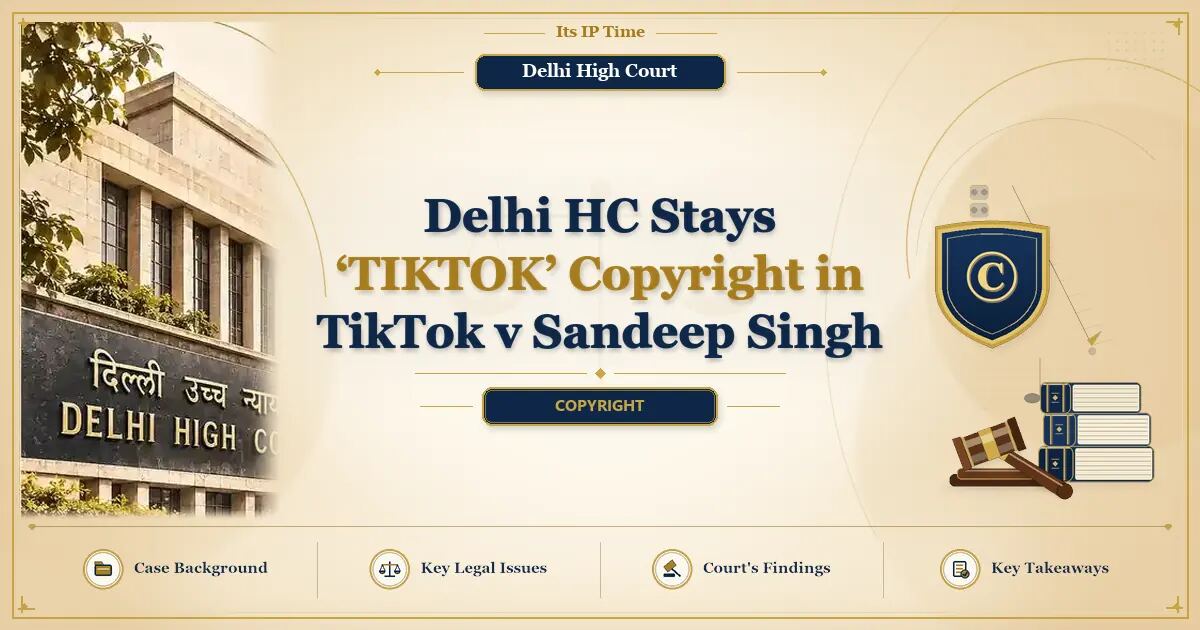
In TIKTOK LTD, Vs SANDEEP SINGH & ORS. [C.O.(COMM.IPD-CR)-23/2024 2026:DHC:10530], the Delhi High Court granted an interim stay against the operation of Copyright Registration No. A-154060/2024 titled “TIKTOK” and its corresponding search certificate issued under the proviso to Section 45(1) of the Copyright Act, 1957. The single-judge Bench of Hon’ble Mr. Justice Purushaindra Kumar Kaurav ruled that executive ban orders restricting public access to a software application under Section 69A of the Information Technology Act, 2000 do not extinguish a global brand owner’s statutory trademark registrations, residual goodwill, or legal locus standi as a “person aggrieved” under Section 50 of the Copyright Act, 1957.
| Disputed Subject Matter | Copyright Registration No. A-154060/2024 for an artistic packaging label titled “TIKTOK” and Trade Marks Registry Search Certificate TMR-CC No. 119624 issued for sewing machines and parts in Class 7. |
|---|---|
| Plaintiff / Petitioner’s Case | TikTok Ltd. (ByteDance group), registered proprietor of word marks TIK TOK and TIKTOK across Classes 9, 38, and 42 since 2017, asserted prior global and Indian adoption, massive residual brand equity, and dishonest appropriation of its mark by Respondent No. 1. |
| Defendant / Respondent’s Defense | Respondent No. 1 pleaded honest adoption for industrial sewing machines in Class 7 since 2018, absence of market confusion due to disparate goods, and argued that the Indian Government’s 2020 executive ban under Section 69A IT Act stripped Petitioner of commercial goodwill and legal locus standi. |
| Governing Law & Authorities | Sections 45(1) Proviso & 50, Copyright Act, 1957; Rule 70(9), Copyright Rules, 2013; Sections 28, 34, 47(3) & 48, Trade Marks Act, 1999; Section 69A, Information Technology Act, 2000; Order XXXIX Rules 1 & 2, CPC, 1908; S. Syed Mohideen v. P. Sulochana Bai; Neon Laboratories Ltd. v. Medical Technologies Ltd. |
| Decisive Holding & Relief | Interim stay granted under I.A. 42683/2024 against Copyright Registration A-154060/2024 and NOC TMR-CC No. 119624. The Court established that executive regulatory bans do not amount to trademark abandonment or destroy standing under Section 50. |
Anatomy of the Dispute: Strategic Intersection of Copyright Cancellation and Statutory Trademark Monopolies
Looking to master Indian Trademark Law jurisprudence? Read our full Trademark Law Guide.
The proceedings stem from a petition filed under Section 50 of the Copyright Act, 1957, by TikTok Ltd., a entity incorporated in the Cayman Islands belonging to the ByteDance corporate group. The Petitioner sought the expunction of Copyright Registration No. A-154060/2024 titled “TIKTOK”, registered in favor of Respondent No. 1, Sandeep Singh trading as Ralco International in Ludhiana, Punjab. Concurrently, the Petitioner sought revocation of the Search Certificate (No Objection Certificate) bearing TMR-CC No. 119624 issued by the Registrar of Trade Marks under the proviso to Section 45(1) of the Copyright Act. In the High Court, Advocate Mr. Ajay Amitabh Suman represented Petitioner TikTok Ltd., Advocate Mr. Rahul Rajput appeared for Respondent No. 1, and Central Government Standing Counsel Ms. Nidhi Raman alongside Ms. Nikita Singh appeared for statutory Respondents No. 2 and 3.
Respondent No. 1 manufactures industrial sewing machines, overlock machines, and bag closers. On December 26, 2019, Respondent No. 1 filed Trade Mark Application No. 4390454 in Class 7 for the word mark TIKTOK, asserting user from April 3, 2018. ByteDance Ltd., the Petitioner’s predecessor-in-interest, formally opposed this application on March 13, 2020. While this trademark opposition remained pending, Respondent No. 1 applied for copyright registration on May 9, 2024, securing registration on June 13, 2024, for an artistic label work dominated by the stylized word TIKTOK alongside Urdu script and decorative border elements. Respondent No. 1 defended his registration by pointing to an extraordinary regulatory development: in June 2020, the Ministry of Electronics and Information Technology banned public access to the TikTok mobile application under Section 69A of the Information Technology Act, 2000 on grounds of national security and public order. Respondent No. 1 contended that this regulatory prohibition destroyed the Petitioner’s Indian goodwill, rendered its marks unused, and deprived it of standing as a “person aggrieved” under Section 50 of the Copyright Act.
Regulatory Banning under Section 69A IT Act versus Proprietary Trademark Persistence: The Interplay of Section 28 and Section 34
The single-judge Bench rejected the proposition that an executive block imposed under public safety legislation automatically strips a property owner of intellectual property rights or legal standing. Under trademark jurisprudence, statutory ownership under Section 28 of the Trade Marks Act, 1999 confers an exclusive right to use and protect a mark, which remains valid unless cancelled through formal statutory mechanisms under Section 57. The Bench emphasized that executive access restrictions under Section 69A of the IT Act target computer resource routing and public data access, leaving underlying statutory property titles intact.
The doctrinal clash between statutory registration rights under Section 28 and common law prior adoption under Section 34, as analyzed by the Supreme Court in S. Syed Mohideen v. P. Sulochana Bai (2016) 2 SCC 683 and Neon Laboratories Ltd. v. Medical Technologies Ltd. (2016) 2 SCC 672, demonstrates that priority of adoption and continuous statutory registration create rights that withstand temporary market disruptions. The Court noted that even if commercial operations face external suspension, non-use enforced by statutory prohibition falls under the protective doctrine of special circumstances, codified in Section 47(3) of the Trade Marks Act, 1999. Involuntary non-user caused by sovereign intervention does not evidence an intent to abandon a trademark.
Articulating the core ratio decidendi regarding executive bans and statutory trademark persistence, the High Court observed:
The directions operate upon the access to the TikTok application in India. They do not purport to cancel the registrations of the petitioner under the TM Act, or to divest it of its proprietorship in the marks, or to make the marks available for appropriation by others.
Hon’ble Mr. Justice Purushaindra Kumar Kaurav, Delhi High Court
Relying on established authorities such as Hardie Trading Ltd. v. Addisons Paint & Chemicals Ltd. and R.R. Oomerbhoy Pvt. Ltd. v. Court Receiver, High Court of Bombay, the Court affirmed that goodwill built through massive historical user (where India generated 44% of global TikTok application downloads in late 2019) does not disappear upon a regulatory suspension. Because the Petitioner actively defended its brand by filing trademark oppositions, executing international assignments with goodwill in July 2023, and prosecuting rectification petitions, its legal standing as a “person aggrieved” under Section 50 of the Copyright Act remains legally unassailable.
Evidentiary Forensics and Bad-Faith Adoption: Testing the Limits of Product Class Dissimilarity
Respondent No. 1 argued that industrial sewing machines in Class 7 operate in a market segment distinct from social media software in Class 9 or transmission services in Class 38, precluding any likelihood of consumer confusion. The Delhi High Court bypassed this class division defense by focusing on the subjective intent and evidentiary proof surrounding the adoption of the mark.
Under the proviso to Section 45(1) of the Copyright Act, 1957, an application for copyright registration of an artistic work used or capable of being used in relation to goods must be accompanied by a search certificate from the Trade Marks Registry certifying that no identical or deceptively similar trademark has been registered or applied for. Under Rule 70(9) of the Copyright Rules, 2013, an applicant bears an explicit obligation to serve notice of the application on every person claiming an interest in or disputing rights to the work.
In evaluating the visual features of the disputed work, the Court found that the word TIKTOK formed the single dominant feature of the artistic label. Respondent No. 1 claimed adoption as of April 3, 2018, a period when the TikTok mark was experiencing viral global and domestic expansion. When a party adopts a coined mark without a reasonable, independent origin story, courts draw an adverse inference of bad faith.
Evaluating the evidentiary explanation offered by Respondent No. 1 regarding his choice of the mark, the Court held:
Respondent no. 1 has not offered any explanation for choosing the word TIKTOK for sewing machines, except to state that he never saw the goods and services of the petitioner in the market. Considering the popularity of the TikTok application in India during the said period, this explanation does not inspire confidence.
Hon’ble Mr. Justice Purushaindra Kumar Kaurav, Delhi High Court
Applying the principle settled in Tata SIA Airlines Ltd. v. Vistara Home Appliances Pvt. Ltd., the Court reaffirmed that where the initial adoption of a distinctive mark is dishonest, differences in product classes offer no protection. Furthermore, the Court noted procedural non-compliance: despite participating in trade mark opposition proceedings against ByteDance since March 2020, Respondent No. 1 failed to issue statutory notice under Rule 70(9) of the Copyright Rules, 2013 when filing his copyright application in 2024. The Trade Marks Registry’s issuance of the clearance NOC under Section 45(1) proviso was held to be prima facie erroneous given the pre-existing registrations on the Trade Marks Register.
Dissecting the Order XXXIX Triple Test in Copyright Rectification Proceedings
The grant of interim stay orders in copyright rectification proceedings under Section 50 is governed by the traditional triple test under Order XXXIX Rules 1 and 2 of the Code of Civil Procedure, 1908, combined with equitable principles of clean hands and fair conduct:
- Prima Facie Case: The Petitioner established a strong prima facie case by showing prior statutory registrations dating to 2017, prior adoption, and ongoing opposition proceedings. The entry on the Copyright Register was made without fulfilling the notice requirements under Rule 70(9) and relied upon a flawed search certificate issued under Section 45(1) proviso.
- Balance of Convenience: The balance of convenience strongly favored the senior user. Allowing a junior adopter to maintain an illegal copyright registration for a globally recognized mark creates market distortion, whereas staying the copyright entry pending final trial preserves the status quo of the official register.
- Irreparable Injury: The dilution of an inherently distinctive mark through uncorrected copyright entries causes intangible, irreparable damage to corporate brand equity that cannot be quantified or compensated purely by monetary damages.
- Equitable Conduct & Clean Hands: The Court rejected allegations of suppression raised by Respondent No. 1 regarding the 2020 app ban. The Petitioner’s failure to explicitly reference the Section 69A IT Act executive order was deemed non-fatal because regulatory app blocking does not alter statutory trademark ownership or negate legal locus standi.
Litigation Strategy & Tactical Playbook under Section 50 of the Copyright Act
This judgment provides actionable tactical insights for intellectual property litigators handling parallel trademark and copyright cancellation disputes:
- Enforcing Mandatory Compliance under Rule 70(9): Litigators challenging artistic work copyright registrations should audit whether the applicant issued formal written notice to opposing trademark claimants. Demonstrating non-compliance with Rule 70(9) provides immediate grounds to establish that the entry was wrongly made or wrongly remaining on the Register under Section 50.
- Neutralizing Disparate Product Class Defenses: When representing senior brand owners against squatters in non-competing classes, litigators must shift judicial focus from product overlap to initial adoption intent. Establishing that the mark is arbitrary or coined eliminates defenses rooted in Class separation.
- Dismantling Third-Party Registration Pleadings: Defendants routinely cite third-party register entries to argue that a mark is common to the trade. Litigators must invoke the doctrine applied in Indian Hotels Co. Ltd. v. Jiva Institute and Under Armour Inc. v. Aditya Birla Fashion: a party that has applied to register a mark cannot assert that the mark is generic or unprotectable.
- Constructing Section 47(3) Evidentiary Dossiers: For corporate clients facing market bans or trade suspensions, counsel must compile systematic proof of brand preservation, including active trademark renewals, international portfolio assignments, enforcement oppositions, and worldwide revenue records to defeat abandonment claims.
Also Read: Amitabh Bachchan v. Rajat Nagi: Delhi HC Restrains Persona Misuse
Key Precedents & Statutory Guidance
- Search recent High Court judgments in our Latest Indian IP Law Cases Directory.
- Examine core statutory doctrines in our Indian Trademark Law Guide.
- Identify NICE & Locarno filing classes with our Indian IP Class Finder or estimate fees via our IP Fee & Deadline Calculator.
- In-Depth Guide: Customs IP Recordal in India & ICER Portal Procedures.
- In-Depth Guide: Section 57 Trademark Rectification: Grounds, Jurisdiction & Procedure.
- Catch up in 2 minutes with our latest Weekly Indian IP Law Digest: November 15 to 21, 2026 | Its IP Time (or browse the Weekly IP Digest Archive).
- Review nationwide litigation trends in our Latest Monthly IP Law Roundup.
Corporate Risk Mitigation and Due Diligence Standards for In-House Counsel
For corporate GCs and brand managers navigating complex regulatory environments and cross-registry risks, the decision highlights critical operational imperatives:
- Auditing Search Certificate (NOC) Reliability: In-house legal teams cannot treat Copyright Search Certificates issued under the Section 45(1) proviso as absolute clearances. Administrative searches frequently miss conflicting word marks across unrelated classes. Companies must implement automated monitoring services across both Trademark and Copyright registries.
- Safeguarding IP Assets During Market Suspension: Regulatory bans under public safety laws do not extinguish corporate intellectual property assets. In-house counsel must maintain active portfolio maintenance, prosecute infringement actions, and record corporate assignments during operational downtime to preserve asset valuation.
- Rigorous Clearance Audits for Brand Creation: Product management teams introducing traditional goods (such as Class 7 machinery) must undergo strict trademark origin clearance. Borrowing famous digital or consumer marks under the assumption that non-competing categories offer immunity creates severe legal exposure and capital risk in packaging and tooling.
Case Details: TIKTOK LTD, Vs SANDEEP SINGH & ORS. | Neutral Citation: 2026:DHC:10530 | Case Number: C.O.(COMM.IPD-CR)-23/2024 2026:DHC:10530 | Court: Delhi High Court | Date: 26-11-2026 (pdf) 26-11-2026 (txt)
Presiding Bench: HON’BLE MR. JUSTICE PURUSHAINDRA KUMAR KAURAV