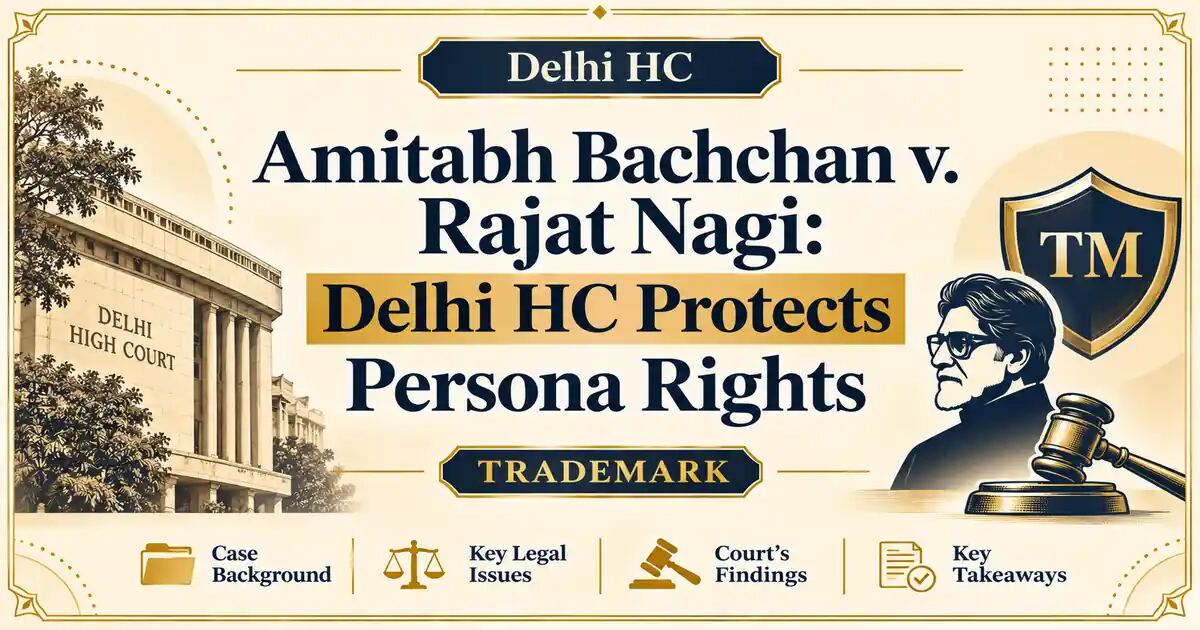
In AMITABH BACHCHAN Vs RAJAT NAGI & ORS. [CS(COMM)-819/2022 2026:DHC:10033], the Delhi High Court granted a comprehensive permanent injunction and issued a final decree safeguarding the personality rights, publicity rights, name, image, voice, and commercial likeness of legendary actor Amitabh Bachchan across physical merchandise and digital ecosystems. Presiding over the Commercial Division, Hon’ble Mr. Justice Purushaindra Kumar Kaurav adjudicated two concurrent interlocutory applications, passing a compromise decree under Order XXIII Rule 3 of the Code of Civil Procedure, 1908 (CPC) against settling defendants, while simultaneously issuing a default decree under Order VIII Rule 10 CPC read with Rule 27 of the Delhi High Court Intellectual Property Rights Division Rules, 2022 against defaulting infringers and anonymous John Doe entities. This decision establishes a critical procedural precedent for personality rights litigation in India, demonstrating how commercial courts can harmonize consensual settlements with statutory default decrees to deliver complete, expedited enforcement against both identified and anonymous infringers without subjecting rights holders to redundant ex-parte trials.
| Disputed Subject Matter | Commercial personality rights, publicity rights, name, photograph, voice, commercial likeness, domain names ( |
|---|---|
| Plaintiff / Petitioner’s Case | Exclusive common law and property rights to control commercial identity and persona. Alleged unauthorized exploitation by mobile app developers, lottery scammers, book publishers, merchandise manufacturers, and domain registrants, causing passing off, privacy violations, and commercial goodwill dilution. |
| Defendant / Respondent’s Defense | Defendants 1, 3, 5, and 8 entered into a formal written settlement acknowledging plaintiff’s rights. Defendants 2, 4, 6, 9, and 10 (John Doe) defaulted by failing to file written statements within the mandatory statutory period under the proviso to Order VIII Rule 1 CPC. |
| Governing Law & Authorities | Order XXIII Rule 3 CPC; Order VIII Rule 10 CPC; Proviso to Order VIII Rule 1 CPC; Rule 27 of the Delhi High Court Intellectual Property Rights Division Rules, 2022; Section 168 of the Bharatiya Sakshya Adhiniyam, 2023; Gurpreet Singh v. Chatur Bhuj Goel (1988); Asma Lateef v. Shabbir Ahmad (2024); Titan Industries Ltd. v. M/s Ramkumar Jewellers (2012). |
| Decisive Holding & Relief | Suit decreed in terms of Paragraph 76(a) to (c) of the plaint against all defendants including John Doe. Defendants permanently restrained from unauthorized use of name, image, voice, and persona attributes. Impugned domain names surrendered or deleted, and mobile apps permanently withdrawn. |
Judicial Architecture of Commercial Identity: Protection of Celebrity Persona in Modern Indian Jurisprudence
Struggling with Indian Trademark Law principles? Explore our complete Trademark Law Guide.
The legal protection of celebrity identity in India has evolved through a synthesis of common law passing off, tortious commercial misappropriation, property rights in goodwill, and the fundamental right to privacy under Article 21 of the Constitution. Unlike traditional trademark infringement, which requires registration across specific statutory classes under the Trade Marks Act, 1999, publicity rights protect the broader commercial persona of an individual against unauthorized exploitation. The plaintiff, represented by Senior Advocate Mr. Sandeep Sethi alongside Advocates Mr. Pravin Anand, Mr. Ameet Naik, Ms. Madhu Gadodia, and Mr. Dhruv Anand, instituted the commercial suit to combat an array of unauthorized commercial uses targeting his identity across diverse market sectors.
The judicial foundation for protecting personality rights rests on preventing unjust enrichment and consumer deception. When an unauthorized entity employs a celebrity’s name, photograph, or voice to market goods or services, it creates a false impression of commercial association or endorsement. This unauthorized appropriation causes dual harm: it deceives consumers into purchasing products under a false pretense of quality guarantee, and it impairs the celebrity’s exclusive right to license their commercial identity. The Delhi High Court applied established principles of commercial torts, affirming that an individual whose persona commands significant public recognition possesses an exclusive property right to control how, where, and by whom their commercial identity is commercialized.
Procedural Synthesis Under Order XXIII Rule 3 CPC: Judicial Review of Severable Compromise Agreements
A significant procedural aspect of the judgment lies in the application of Order XXIII Rule 3 CPC to grant partial compromise decrees in multi-defendant commercial suits. Litigation involving widespread digital infringement frequently presents mixed scenarios where certain defendants seek amicable resolution while others default. Defendants 1, 3, 5, and 8 entered into formal written settlement agreements with the plaintiff. Defendant No. 1 deleted the mobile application titled ‘Amitabh Bachchan Video Call’; Defendant No. 3 stopped publishing its ‘General Knowledge Quizbook’ bearing the actor’s photograph; Defendant No. 5 ceased selling wall posters displaying his image and likeness; and Defendant No. 8 deleted the domain name
Evaluating the joint settlement application (I.A. 30837/2026), the court examined the statutory conditions governing valid compromises. Under Order XXIII Rule 3 CPC, a court is empowered to pass a decree adjusting a suit wholly or in part, provided the agreement is lawful, reduced to writing, and executed voluntarily by the parties. Citing the Supreme Court benchmark in Gurpreet Singh v. Chatur Bhuj Goel, Justice Kaurav confirmed that a compromise must constitute a completed, lawful agreement capable of being embodied directly in a decree. The High Court established that a settlement with willing defendants can be severed and executed independently without prejudicing claims against defaulting co-defendants, provided the compromise meets the standards of the Indian Contract Act, 1872.
Default Judgments in Commercial IP Suits: Dissecting Order VIII Rule 10 CPC and the Rule 27 Summary Mechanism
Addressing the non-settling parties, the High Court considered the plaintiff’s application (I.A. 30836/2026) under Order VIII Rule 10 CPC against Defendants 2, 4, 6, 9, and 10 (John Doe). Under the Commercial Courts Act, 2015, read with the proviso to Order VIII Rule 1 CPC, the statutory period for filing a written statement expires after 120 days from service of summons. The right of Defendants 2, 4, 6, and 9 to submit their defense had been formally closed by the court on September 25, 2023. However, the court reiterated that default decrees under Order VIII Rule 10 CPC must not be passed automatically without judicial scrutiny.
The High Court scrutinized the threshold required to pass a default decree under Order VIII Rule 10 CPC, emphasizing that default powers cannot be exercised mechanically where factual disputes exist, citing the Supreme Court:
What emerges from a reading of Balraj Taneja, with which we wholeheartedly concur, is that only on being satisfied that there is no fact which needs to be proved on account of deemed admission, could the court pass a judgment against the defendant who has not filed the written statement; but if the plaint itself suggests involvement of disputed questions of fact, it would not be safe for the court to pass a judgment without requiring the plaintiff to prove the facts.
Hon’ble Mr. Justice Purushaindra Kumar Kaurav, Delhi High Court
Applying this standard, the court held that because none of the defaulting defendants appeared to contest the suit, no triable issues of fact remained. Furthermore, the settling defendants had formally recognized the plaintiff’s exclusive rights, removing any risk of conflicting decrees. The court synthesized Order VIII Rule 10 CPC with Rule 27 of the Delhi High Court Intellectual Property Rights Division Rules, 2022, which authorizes summary judgments in IP cases where a defense has no real prospect of success. Relegating the plaintiff to lead formal ex-parte evidence would create unnecessary procedural delay without altering the material facts.
Liability for infringement of celebrity publicity rights turns on two mandatory judicial prongs: (1) Validity: The plaintiff owns an enforceable right in the commercial identity or persona of a human being; and (2) Identifiability: The celebrity must be clearly identifiable from the defendant’s unauthorized commercial use.
In evaluating the legal standard for personality rights enforcement, the Court affirmed the two-pronged test governing liability for identity infringement:
the right to control commercial use of human identity is the right to publicity”, and held that liability for its infringement turns on “Validity: The plaintiff owns an enforceable right in the identity or persona of a human being” and “Identifiability: The Celebrity must be identifiable from defendant’s unauthorized use.” Both elements are satisfied. The impugned uses employ the plaintiff’s very name and photographs, for commercial gain and without his consent, and falsely suggest his endorsement.
Hon’ble Mr. Justice Purushaindra Kumar Kaurav, Delhi High Court
Evidentiary Forensics and Dynamic Relief: Combatting Cybersquatting, App Misappropriation, and Anonymous Infringers
The judgment addresses diverse modes of modern digital and physical identity theft. The infringing activities encompassed mobile application software (‘Amitabh Bachchan Video Call’ by Defendant 1), messaging-based lottery fraud exploiting the actor’s image for fake ‘Kaun Banega Crorepati’ promotions (Defendant 2), unauthorized print publications (Defendant 3), commercial apparel and posters (Defendants 4 and 5), and domain name cybersquatting (
The ex-parte ad-interim injunction granted on November 25, 2022, incorporated omnibus directions against unknown John Doe entities (Defendant 10), while directing statutory communications authorities and Telecom Service Providers to block infringing online access. By merging the interim injunction into the final decree, the court ensured that permanent injunctive relief extends to anonymous digital entities operating on messaging platforms and online marketplaces. Notably, during earlier proceedings, the court indicated that should settlement negotiations fail, it would require the personal attendance of parties under Order X Rule 2 CPC, Order V Rule 3 CPC, and Section 168 of the Bharatiya Sakshya Adhiniyam, 2023 (BSA), demonstrating the court’s willingness to exercise rigorous procedural powers to enforce judicial compliance.
Strategic Litigator Playbook: Structuring Multi-Tiered IP Enforcement in Identity Suits
For IP litigators managing personality rights protection for high-profile clients, this judgment outlines several critical tactical considerations:
- Formulate Comprehensive Multi-Party Joinder: Structure plaints to implead specific commercial operators, merchandise sellers, app developers, and domain registrants alongside domain registrars and Telecom Service Providers as functional parties, anchored by a John Doe (Ashok Kumar) impleadment to capture decentralized online infringers.
- Pair Order VIII Rule 10 CPC with DHC IPRD Rules: When defaulting defendants fail to submit written statements within the 120-day outer limit mandated by the Commercial Courts Act, litigators should move for summary judgment under Order VIII Rule 10 CPC read with Rule 27 of the DHC IPRD Rules, avoiding protracted ex-parte trial procedures.
- Structure Binding Compromise Terms: Compromise applications under Order XXIII Rule 3 CPC must explicitly bind legal heirs, representatives, and business assigns. Terms should mandate the complete deletion of domain names, removal of mobile applications from third-party app stores, and physical destruction of infringing merchandise.
- Secure Dynamic Permanent Injunctions: Ensure that final decree prayers mirror interim John Doe protections, allowing rights holders to enforce permanent court orders against newly discovered online domain registrants and messaging channels without filing fresh substantive suits.
Also Read: Bombay High Court Protects Ananya Panday Persona Against AI Deepfakes
Key Precedents & Statutory Guidance
- Search recent High Court judgments in our Latest Indian IP Law Cases Directory.
- Examine core statutory doctrines in our Indian Trademark Law Guide.
- In-Depth Guide: Customs IP Recordal in India & ICER Portal Procedures.
- In-Depth Guide: Confidentiality Clubs in Indian IP Litigation (Delhi HC IPD Rule 19).
- Catch up in 2 minutes with our latest Weekly Indian IP Law Digest: November 15 to 21, 2026 | Its IP Time (or browse the Weekly IP Digest Archive).
- Review nationwide litigation trends in our Latest Monthly IP Law Roundup.
Corporate Governance and Rights Management: Licensing Standards and Digital Risk Mitigation
For corporate brand managers, marketing executives, e-commerce platforms, and digital publishers, the ruling underscores strict legal boundaries surrounding commercial content creation:
- Conduct Strict Personality Rights Clearance Audits: In-house counsel must audit all commercial campaigns, mobile applications, quiz publications, and promotional merchandise to ensure that no individual’s name, image, voice, or likeness is utilized without prior written authorization.
- Deploy Proactive E-Commerce and Content Monitoring: Online marketplaces and digital app stores must implement automated detection protocols to identify unauthorized listings that exploit celebrity attributes. Continued hosting of infringing material after formal notice creates direct legal exposure to passing off claims and statutory damages.
- Enforce Rigorous Domain Name Registration Protocols: Registering domain names incorporating recognizable personal names without authorization constitutes commercial bad faith. Corporations must clear domain portfolios to prevent compulsory administrative transfers under UDRP/INDRP rules or court-ordered domain deletions.
Case Details: AMITABH BACHCHAN Vs RAJAT NAGI & ORS. | Neutral Citation: 2026:DHC:10033 | Case Number: CS(COMM)-819/2022 2026:DHC:10033 | Court: Delhi High Court | Date: 05-11-2026 (pdf) 05-11-2026 (txt)
Presiding Bench: HON’BLE MR. JUSTICE PURUSHAINDRA KUMAR KAURAV