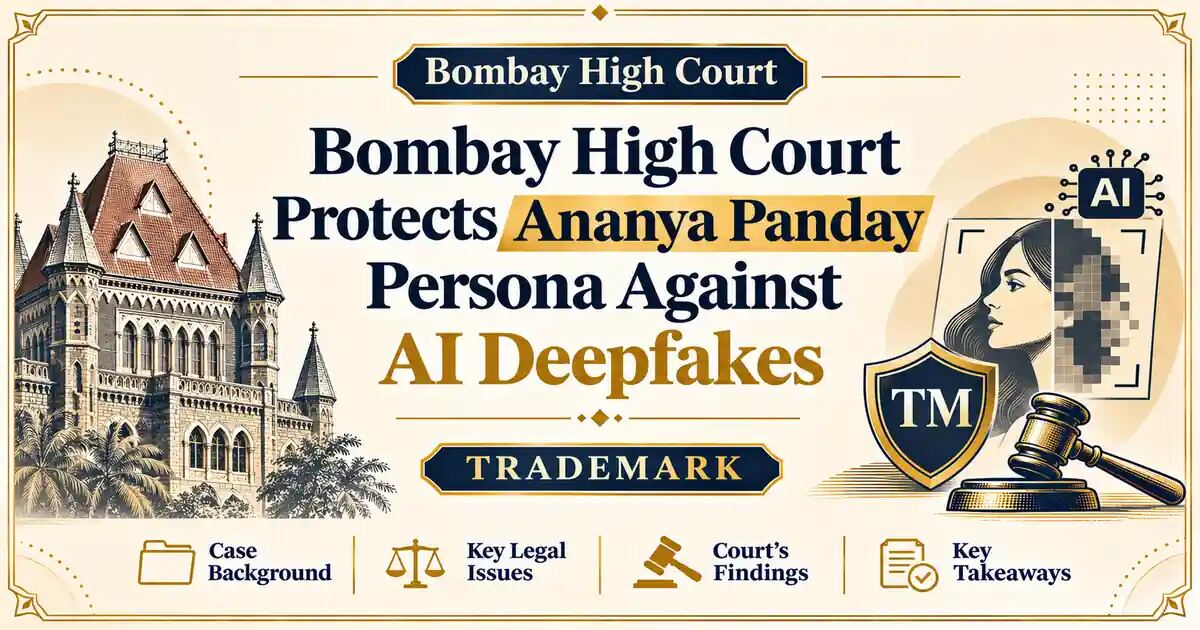
In Ananya Suyash Panday Vs Fankaar Live Experiences Pvt Ltd [IAL/38621/2026], the Bombay High Court granted comprehensive ad-interim injunctive protection to film actor Ananya Panday, restraining 25 named commercial vendors, digital platforms, domain registrars, and unidentified John Doe entities from unauthorizedly commercializing her personality attributes, voice, visual likeness, performance rights, and digital identity. Presiding over the Commercial Division, Justice Madhav J. Jamdar held that the unlicenced commercial exploitation of celebrity attributes through generative artificial intelligence deepfakes, interactive conversational chatbots, fraudulent event booking portals, and bootleg merchandise violates the fundamental right to privacy under Article 21 of the Constitution of India, performer rights under Sections 38, 38A, and 38B of the Copyright Act, 1957, and common law principles prohibiting passing off and personality dilution.
| Disputed Subject Matter | Personality rights, publicity rights, right to privacy under Article 21, performer rights under Sections 38, 38A, and 38B of the Copyright Act, 1957, AI-generated conversational chatbots, morphed pornographic deepfakes, unauthorized booking portals, and bootleg merchandise. |
|---|---|
| Plaintiff / Petitioner’s Case | The Plaintiff asserted exclusive commercial rights over her personality attributes and dramatic film performances, demonstrating widespread unauthorized commercial exploitation across 25 Defendants engaged in fake talent booking, unauthorized apparel sales, interactive AI voice cloning, and pornographic image synthesis. |
| Defendant / Respondent’s Defense | Pro forma Defendants (domain registrars 20 to 22 and social media intermediaries 16 to 19) appeared through counsel to facilitate compliance; primary commercial infringers and John Doe entities (Defendants 1 to 15 and 25) failed to establish any defense of consent, authorization, or fair use. |
| Governing Law & Authorities | Article 21, Constitution of India; Sections 38, 38A, 38B, Copyright Act, 1957; Rule 3(1)(b), IT (Intermediary Guidelines and Digital Media Ethics Code) Rules, 2021; Order XXXIX Rules 1 & 2 CPC; S. Syed Mohideen v. P. Sulochana Bai (2016) 2 SCC 683; Neon Laboratories Ltd. v. Medical Technologies Ltd. (2016) 2 SCC 672. |
| Decisive Holding & Relief | Ad-interim injunction granted under Order XXXIX Rules 1 & 2 CPC. Defendants restrained from using Plaintiff’s persona; social media platforms ordered to remove deepfake content; domain registrars ordered to suspend AI chatbot domains; MeitY and DoT directed to issue blocking orders under IT Act. |
Anatomy of the Infringement Matrix: Booking Fraud, Bootleg E-Commerce, and Generative AI Chatbots
For foundational statutory analysis, consult our in-depth Trademark Law Guide.
The factual matrix submitted to the Bombay High Court showcases the multifaceted digital enforcement challenges facing public figures in contemporary commercial litigation. The Plaintiff, an established Indian actor with an active filmography spanning from 2019 to 2026 and a combined social media following exceeding 36 million individuals, instituted a commercial IP suit seeking emergency protection against widespread, unlicenced commercial monetization of her persona. The legal representation featured Mr. Astad Randeria alongside Ms. Priyanka Khimani and team from Khimani and Associates appearing for the Plaintiff, Mr. Hrishikesh Shukla with Shardul Amarchand Mangaldas & Co. appearing for Defendant No. 20, and Ms. Shivani Choudhary appearing for Defendant No. 21.
To demonstrate the systematic scale of misappropriation, the Plaintiff categorized the 25 arrayed Defendants into distinct operational tiers within a comprehensive evidentiary grid. The first tier consists of talent management websites and event agencies (Defendants 1 to 6, operating portals such as fankaar.co, tkctalent.com, exchange4artist.com, skyevents.in, blackhattalent.com, and starclinch.com) that falsely held themselves out to the public as authorized managers capable of booking the Plaintiff for professional live appearances. This deceptive representation exposed the Plaintiff’s professional goodwill to substantial commercial injury by falsely linking her name with engagements over which she exercised zero creative or contractual oversight.
The second tier comprises standalone e-commerce platforms and online retailers (Defendants 7, 11, 12, 14, and 15 operating iceposter.com, desertcart.in, pvt-ltd.in, fashionrazor.com, and nuvansh.com) alongside major e-commerce marketplaces (Defendants 8 to 10 and 13, including Amazon, Flipkart, Etsy, and copn.in). These entities manufactured, advertised, or facilitated third-party sales of unauthorized merchandise, including apparel, posters, drinkware, phone cases, and customized home accessories displaying the Plaintiff’s name, photograph, and likeness. Certain vendors generated synthetic imagery using artificial intelligence to depict the Plaintiff wearing their custom clothing lines, falsely implying official brand endorsement.
The third tier involved social media intermediaries (Defendants 16 to 19, including Instagram, Facebook, X, Reddit, and YouTube), domain name registrars (Defendants 20 to 22 hosting interactive AI chatbot domains such as botify.ai, character.ai, and janitorai.com), central governmental ministries (Defendants 23 and 24), and unidentified John Doe operators (Defendant 25). These actors facilitated the hosting and propagation of AI-generated conversational avatars, morphed pornographic content, and fake news alleging elective cosmetic surgeries. The interactive AI chatbots allowed users to engage in automated conversations with a synthetic avatar mimicking the Plaintiff’s voice and mannerisms, generating vulgar and sexually explicit responses attributed directly to her persona.
Doctrinal Foundations: Unpacking Common Law Passing Off, Section 34 Prior Use, and Constitutional Autonomy
Commercial protection for celebrity persona stems from fundamental privacy under Article 21 of the Constitution of India, fortified by performer statutory rights under Sections 38, 38A, and 38B of the Copyright Act, 1957, and common law priority rights under Section 34 of the Trade Marks Act, 1999.
The legal framework governing personality rights in India rests at the confluence of statutory intellectual property entitlements, common law torts, and constitutional privacy guarantees. In trademark law, registration under Section 28 of the Trade Marks Act, 1999 confers exclusive rights to the registered proprietor. However, statutory jurisprudence established by the Supreme Court of India in S. Syed Mohideen v. P. Sulochana Bai (2016) 2 SCC 683 clarifies that registration under Section 28 is expressly subject to the common law rights of prior users protected under Section 27(2) and Section 34. The Supreme Court affirmed that rights in passing off are rooted in common law equity and remain superior to statutory registration when a prior user establishes goodwill and reputation in a commercial mark or identity.
This principle was reinforced in Neon Laboratories Ltd. v. Medical Technologies Ltd. (2016) 2 SCC 672, where the Supreme Court ruled that a registered trademark owner cannot restrain a prior user of a mark, as prior commercial adoption creates an unassailable priority right. In the context of celebrity personality rights, an actor’s identity, voice, visual image, and signature function as an unregistered, proprietary mark of persona. When unauthorized entities attempt to register or commercialize celebrity names or avatars, the individual’s prior continuous commercial usage and public identification defeat third-party claims under the Section 34 prior use doctrine and common law passing off actions.
Beyond common law passing off, personality rights in India draw direct authority from Article 21 of the Constitution of India, as interpreted by the Supreme Court in K.S. Puttaswamy v. Union of India (2017) 10 SCC 1. The right to privacy encompasses individual autonomy, bodily privacy, personal dignity, and the sole prerogative to control how one’s identity is presented to the public. Unauthorized exploitation of persona for commercial gain or synthetic image synthesis directly violates this constitutional guarantee.
Furthermore, Sections 38, 38A, and 38B of the Copyright Act, 1957 provide a statutory foundation for actors. Section 38A grants performers exclusive economic rights to control the visual reproduction, sound recording, and public communication of their dramatic performances. Section 38B establishes the performer’s moral right to restrain any distortion, mutilation, or modification of their performance that is prejudicial to their reputation. The unauthorized extraction of performance clips to train AI models or construct synthetic deepfakes violates both economic and moral rights under the copyright framework.
Evidentiary Forensics and the Order XXXIX Injunction Assessment
To secure interlocutory orders under Order XXXIX Rules 1 & 2 of the Code of Civil Procedure, 1908, a plaintiff must satisfy a rigorous three-pronged test: demonstrating a strong prima facie case, proving that the balance of convenience lies in their favor, and establishing that unmitigated infringement will cause irreparable injury that cannot be compensated by monetary damages.
In analyzing the evidentiary record, Justice Madhav J. Jamdar evaluated commercial transaction records, platform listings, screenshot captures of AI chatbot interactions, and domain registry data. The Court arrived at an unequivocal factual finding regarding the unauthorized commercialization of the Plaintiff’s persona. Reviewing the submitted evidentiary documents, the High Court observed:
Perusal of the plaint and documents annexed to the plaint clearly show that the Plaintiff’s right to control and determine whether, and the manner in which, the Plaintiffs Personality Attributes may be used, depicted, reproduced, communicated to the public or otherwise exploited by any third party is violated.
Hon’ble Mr. Justice Madhav J. Jamdar, Bombay High Court
Elevating the legal analysis from factual findings of commercial misuse to core constitutional guarantees, the High Court articulated the primary ratio decidendi of the judgment, establishing that persona misappropriation breaches Article 21 protections:
Various averments raised in the plaint and documents annexed to the plaint clearly show that the Plaintiff’s right to privacy including her rights of personal autonomy, bodily privacy and dignity and her right to control the use, representation and depiction of the Plaintiff’s identity and persona are affected. Her right to privacy is a fundamental right guaranteed under Article 21 of the Constitution of India.
Hon’ble Mr. Justice Madhav J. Jamdar, Bombay High Court
From an evidentiary perspective, litigators navigating digital IP disputes must satisfy electronic evidence authentication standards under Section 65B of the Indian Evidence Act, 1872 (now Section 63 of the Bharatiya Sakshya Adhiniyam, 2023). Litigators must submit verified GST invoices from bootleg vendors, cryptographic hashes of web pages, WHOIS registration certificates, and verified metadata of AI-generated content. Demonstrating financial transactions through GST numbers or payment gateway records provides undeniable proof of commercial exploitation, satisfying the prima facie standard.
Applying the triple test, the balance of convenience weighs heavily in favor of public figures seeking to protect personal autonomy and brand exclusivity. While commercial vendors suffer no legitimate prejudice by being restrained from selling unlicenced products, celebrities suffer irreparable harm to goodwill, endorsement value, and personal dignity when deepfakes and fake agency listings circulate unchecked. Additionally, where third parties attempt to register marks incorporating celebrity attributes, aggrieved parties can initiate cancellation proceedings under Section 57 of the Trade Marks Act, 1999 to rectify the register based on prior continuous adoption.
Consequently, the High Court issued comprehensive dynamic ad-interim injunctions. Defendants 1 to 7, 11, 12, 14, 15, and 25 were restrained from using, reproducing, or altering the Plaintiff’s personality attributes across physical merchandise, digital media, and AI tools. Social media platforms (Defendants 16 to 19) were directed to disable access to reported infringing URLs within strict timelines under Rule 3(1)(b) of the Information Technology (Intermediary Guidelines and Digital Media Ethics Code) Rules, 2021. Domain Name Registrars (Defendants 20 to 22) were ordered to suspend domain names hosting interactive AI chatbots. Central government agencies (Defendants 23 and 24) were instructed to issue internet service provider blocking orders under Section 69A of the IT Act to ensure complete enforcement across Indian network infrastructure.
Also Read: Amitabh Bachchan v. Rajat Nagi: Delhi HC Protects Persona Rights
Key Precedents & Statutory Guidance
- Search recent High Court judgments in our Latest Indian IP Law Cases Directory.
- Examine core statutory doctrines in our Indian Trademark Law Guide.
- In-Depth Guide: Customs IP Recordal in India & ICER Portal Procedures.
- In-Depth Guide: Section 57 Trademark Rectification: Grounds, Jurisdiction & Procedure.
- Catch up in 2 minutes with our latest Weekly Indian IP Law Digest: November 15 to 21, 2026 | Its IP Time (or browse the Weekly IP Digest Archive).
- Review nationwide litigation trends in our Latest Monthly IP Law Roundup.
Strategic Roadmap for Litigation Practice and In-House IP Governance
The decision provides actionable operational guidelines for IP litigators and corporate in-house counsel managing identity assets, AI deployment, and brand protection in modern digital markets.
Litigation Playbook for IP Practitioners
- Structured Multi-Tiered Impleadment: Counsel should structure commercial suits by segregating infringers into functional categories: commercial vendors, fake agencies, platform intermediaries, domain name registrars, and John Doe operators under an omnibus prayer clause.
- Forensic Electronic Evidence Dossiers: Litigators must compile electronic evidence packages certified under Section 63 of the Bharatiya Sakshya Adhiniyam, 2023, incorporating GST invoices, WHOIS data, payment gateway receipts, and timestamped transcripts of AI chatbot sessions.
- Pre-Suit Statutory Intermediary Notices: Litigators should serve targeted legal notices referencing Rule 3(1)(b) of the IT Rules, 2021 directly to platform grievance officers to displace statutory safe harbor defenses under Section 79 of the IT Act prior to seeking interlocutory relief.
- Dynamic Injunction and Section 69A IT Act Synergy: Applications must include prayers directing MeitY and DoT to issue network-level blocking orders against mirror domains, sub-domains, and emerging digital channels hosting synthetic content.
Corporate Strategy & In-House Risk Governance
- AI Model and Dataset Compliance Audits: In-house legal teams at technology companies developing generative AI, voice synthesis models, or interactive chatbots must conduct rigorous IP audits to ensure training datasets do not ingest proprietary performance media or personality attributes without written licenses.
- Endorsement Non-Compete and Brand Protection Protocols: Corporate brand owners contracting celebrity ambassadors must establish active monitoring programs across major e-commerce marketplaces to identify and remove counterfeit merchandise that dilutes brand exclusivity.
- Proactive Domain Registrar Watch Services: Enterprise legal departments should deploy automated domain watch tools to identify lookalike or impersonating domain registrations incorporating celebrity names or brand assets prior to commercial launch.
- Trademark Register Rectification Audits: Corporations must conduct periodic registry audits to detect unauthorized third-party trademark applications incorporating celebrity attributes, filing timely oppositions or cancellation petitions under Section 57 of the Trade Marks Act.
By harmonizing constitutional privacy guarantees under Article 21, performer rights under the Copyright Act, and common law passing off doctrines, the Bombay High Court has affirmed that personal identity, voice, and visual persona remain strictly protected proprietary rights in Indian law.
Case Details: Ananya Suyash Panday Vs Fankaar Live Experiences Pvt Ltd | Neutral Citation: 2026:BHC-OS:24306 | Case Number: IAL/38621/2026 | Court: Bombay High Court | Date: 05/11/2026
Presiding Bench: Hon’ble MADHAV J. JAMDAR, J.