Judicial Threshold for Mandatory Interlocutory Relief in Digital IP and Platform Disputes
Looking to master Indian Trademark Law jurisprudence? Read our full Trademark Law Guide.
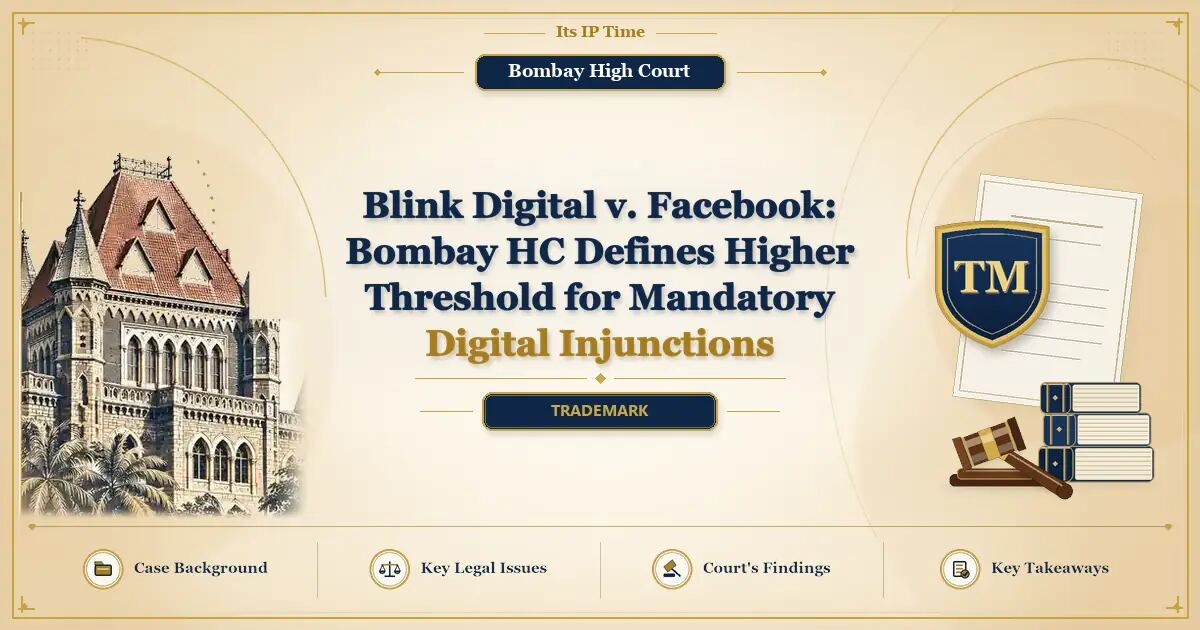
Whether an interlocutory mandatory injunction compelling an online intermediary to restore blocked corporate digital assets and proprietary brand channels requires a standard of proof significantly higher than the traditional prima facie test governs the central inquiry in modern digital IP litigation. In Interim Application No. IAL/31469/2026, the Bombay High Court addressed this contentious threshold in Blink Digital India Private Limited v. Facebook India Online Services Private Limited. The dispute brings into sharp focus the procedural conflict between platform enforcement actions under intermediary due diligence rules and the commercial necessity of preserving corporate digital identity. When platform operators suspend business pages or digital infrastructure citing third-party proprietary claims, affected entities face immediate operational paralysis. Litigators must navigate the strict evidentiary requirements for mandatory interim relief, where courts resist granting orders that alter the status quo prior to full trial. This decision highlights the friction between summary platform governance and judicial standards for interlocutory mandatory relief under Specific Relief principles.
Interlocutory mandatory injunctions occupy an exceptional category within Indian equity jurisprudence. Unlike prohibitory injunctions designed to maintain existing status quo, mandatory orders at the interlocutory stage require the defendant to take affirmative positive steps before trial. Courts approach such applications with extreme caution, demanding that the applicant establish a clear case of higher standard than a prima facie case required for negative covenants. The Bombay High Court examined whether the disruption of commercial operations, loss of client goodwill, and employee turnover resulting from digital account suspension justify departing from this conservative judicial approach.
Factual Matrix and Commercial Exposure
Blink Digital India Private Limited, an active digital agency operating within the interactive advertising sector, established extensive trade channels and brand presence across social media infrastructure managed by Facebook India Online Services Private Limited. Over years of commercial operation, Blink Digital India built substantial corporate goodwill, maintaining client accounts, proprietary campaign materials, and digital communication channels vital to its core business activities. The enterprise relied upon uninterrupted access to these platform services to fulfill client contracts, execute digital ad campaigns, and manage staff operations.
The operational crisis emerged when Facebook India Online Services Private Limited restricted, suspended, or deactivated access to Blink Digital India’s digital assets and administrative accounts. The platform’s enforcement mechanism was triggered under the framework governing intermediary due diligence, specifically targeting alleged violations of third-party proprietary rights, trademark infringement, copyright claims, or misleading commercial content. The immediate administrative blocking severed Blink Digital India from its client management interfaces, active advertising campaigns, and enterprise communications.
Confronted with systemic business interruption, Blink Digital India filed Interim Application No. IAL/31469/2026 seeking mandatory interlocutory directions to compel Facebook India Online Services Private Limited to immediately restore complete account access, operational privileges, and digital assets. Blink Digital India pleaded that the sudden disruption caused catastrophic commercial injury, demonstrating that the firm was actively losing valued clients and key professional employees. The applicant asserted that the balance of convenience leaned overwhelmingly in its favor, as platform inaction threatened irreversible structural collapse of its commercial business.
Facebook India Online Services Private Limited countered by invoking its regulatory duties and statutory immunity under intermediary guidelines. The intermediary contended that platform enforcement actions are mandated when potential violations of trademark, copyright, or child safety standards are flagged. The defense emphasized that granting a mandatory direction at the interim stage would effectively decide the suit, granting full final relief without permitting complete trial discovery on the underlying IP disputes.
Applicable Law and Statutory Provisions
The statutory framework governing this dispute intersects substantive intellectual property statutes, intermediary regulatory regimes, and equity principles governing discretionary relief. Section 29 of the Trade Marks Act, 1999 (governing trademark infringement through unauthorized commercial use of identical or deceptively similar marks) forms the substantive backdrop when platforms act against alleged infringing commercial handles. Simultaneously, Section 51 of the Copyright Act, 1957 (governing copyright infringement through unauthorized reproduction, public performance, or digital distribution) dictates when digital platforms must remove alleged infringing work to avoid indirect liability.
The regulatory obligation of online platforms is rooted in Rule 3(1)(b) of the Information Technology (Intermediary Guidelines and Digital Media Ethics Code) Rules, 2021. Under Rule 3(1)(b)(iv), an intermediary must publish rules and regulations informing users not to host, display, upload, modify, publish, transmit, store, update, or share any information that infringes any patent, trademark, copyright, or other proprietary rights, or deceives or misleads users, or is harmful to children. Compliance with these due diligence obligations is mandatory for intermediaries seeking statutory safe harbor immunity under Section 79 of the Information Technology Act, 2000 (exempting intermediaries from third-party content liability subject to compliance).
The procedural parameters for injunctive remedies are dictated by the Specific Relief Act, 1963, alongside Order XXXIX Rules 1 and 2 of the Code of Civil Procedure, 1908 (governing temporary injunctions and interlocutory orders). Where an applicant seeks positive mandatory directions prior to judgment, the settled common law standard requires establishing an exceptionally strong prima facie case, high degree of probability of success at trial, and grave irreparable injury that cannot be compensated by monetary damages.
Judicial Analysis and Mandatory Injunction Standards
In evaluating the interim application, the High Court focused on the rigorous standard governing mandatory interlocutory injunctions. The court emphasized that mandatory injunctions at an interlocutory stage are extraordinary remedies granted only under rare and exceptional circumstances. Drawing from established equity principles, the bench reaffirmed that the primary purpose of interlocutory mandatory relief is limited to restoring the status quo ante, rather than establishing a novel state of affairs or granting final substantive relief prematurely.
The court analyzed the evidentiary threshold required to grant affirmative relief against an intermediary platform during pending suit proceedings. The bench highlighted that a party seeking a mandatory order must establish a case for trial of a significantly higher standard than the standard prima facie case sufficient for prohibitory relief. The court observed:
“…if the mandatory injunction is granted at all on an interlocutory application it is granted only to restore the status quo and not granted to…”
Hon’ble Bombay High Court
Evaluating the balance of convenience, the court weighed the severe commercial disruption claimed by Blink Digital India against the operational and regulatory duties imposed on platform intermediaries. While Blink Digital India presented compelling evidence of client attrition and employee turnover resulting from digital account suspension, the court scrutinised whether such financial and operational losses could be adequately remedied through monetary damages upon final trial adjudication.
The judicial analysis examined whether the account suspension was a unilateral administrative action or a statutory mandate triggered by third-party IP infringement notices. Intermediaries operating under Section 79 of the Information Technology Act, 2000, are bound to act upon receiving notice of proprietary rights violations. The court observed that forcing an intermediary to restore content or accounts without resolving underlying trademark or copyright claims places the platform in direct conflict with its statutory due diligence duties under Rule 3(1)(b) of the IT Rules, 2021.
The bench concluded that where contested questions of proprietary infringement exist, granting an interim mandatory injunction to restore platform handles without complete trial evidence exceeds the limited equitable jurisdiction of interlocutory proceedings. The court reaffirmed that mandatory directions to restore access will be denied if the applicant fails to meet the heightened burden of demonstrating an unimpeachable legal right and clear balance of convenience.
Key Precedents & Statutory Guidance
- Search recent High Court judgments in our Latest Indian IP Law Cases Directory.
- Examine core statutory doctrines in our Indian Trademark Law Guide.
- In-Depth Guide: Customs IP Recordal in India & ICER Portal Procedures.
- In-Depth Guide: Allied and Cognate Goods in Indian Trademark Infringement Law.
- Catch up in 2 minutes with our latest Weekly Indian IP Law Digest: November 15 to 21, 2026 | Its IP Time (or browse the Weekly IP Digest Archive).
- Review nationwide litigation trends in our Latest Monthly IP Law Roundup.
Practical and Commercial Implications
This decision offers practical guidance for IP litigators, corporate counsel, and brand owners navigating digital asset enforcement and platform account suspensions. For corporate enterprises dependent on social media infrastructure, the ruling underscores the extreme difficulty of obtaining urgent mandatory interlocutory relief against tech intermediaries. Litigators representing commercial entities cannot rely solely on showing commercial loss, client departure, or operational disruption to secure affirmative court orders.
From a strategy perspective, corporate counsel must build an exhaustive evidentiary record before filing interlocutory applications for mandatory restoration. Applicants must prove that the platform’s enforcement action was entirely arbitrary, devoid of statutory justification under Rule 3(1)(b) of the IT Rules, 2021, and outside the scope of third-party IP disputes. Demonstrating a heightened prima facie case requires submitting clear proof of registered trademark rights under Section 28 of the Trade Marks Act, 1999 (granting exclusive rights to registered proprietors), clean copyright title under Section 17 of the Copyright Act, 1957 (defining initial ownership of copyright work), and full compliance with platform terms.
For platform intermediaries, the judgment solidifies judicial recognition of regulatory compliance obligations. Intermediaries acting in good faith to curb potential trademark infringement, copyright violations, or misleading commercial content remain protected against mandatory judicial intervention at the preliminary stage, provided their actions align with statutory due diligence mandates.
Furthermore, corporate risk management strategies must account for digital asset redundancy. Relying exclusively on single-platform digital channels creates severe single-point-of-failure exposure. When platform accounts are suspended, litigators must pursue concurrent administrative dispute resolution remedies alongside judicial proceedings, ensuring that interim prayers clearly distinguish between restoring status quo ante and seeking final mandatory relief.
Case Details: Blink Digital India Private Limited Vs Facebook India Online Services Private Limited | Case Number: IAL/31469/2026 | Court: Bombay High Court | Date: 20/11/2026