
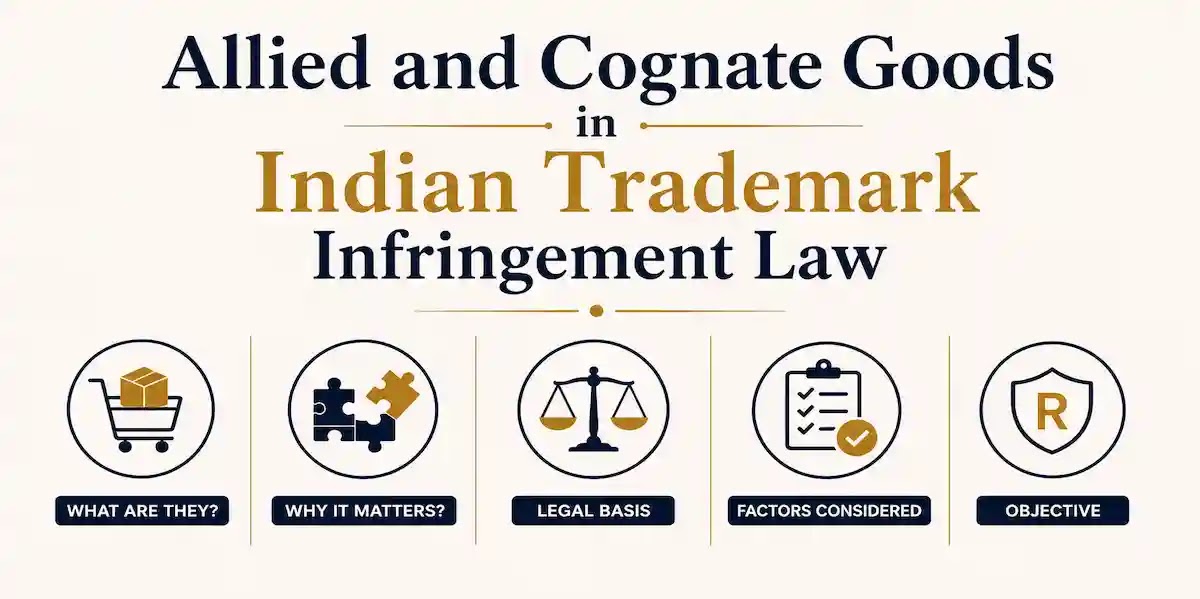
Here is a question that comes up in trademark disputes more often than practitioners expect: can a brand registered for beer stop someone from using the same name on whisky? The two products sit in different trademark classes under the Nice Classification. The average consumer clearly knows the difference between a cold pint and a glass of single malt. And yet, courts have repeatedly said that class boundaries do not settle the question of infringement. What matters is whether the goods are allied or cognate, and that determination has nothing to do with where the Registrar files the paperwork. This article covers: how courts define allied and cognate goods, the tests that determine whether goods across classes are legally close enough to create infringement risk, what the beer versus whisky question actually produces in litigation, and how the anti-dissection rule operates when composite marks are involved.
Introduction
New to Trademark Law? Start with our complete Trademark Law Guide.
The concept of allied and cognate goods is one of those areas of Indian trademark law where the statutory text gives you almost nothing and the case law gives you everything. Section 29 of the Trade Marks Act, 1999 sets out when a registered mark is infringed, and it brings in the similarity or identity of goods as part of that analysis. But neither “allied” nor “cognate” appears in the statute. The courts built the entire framework themselves, starting from a 1960 Supreme Court judgment and continuing to add to it right through the present year.
What Allied and Cognate Goods Actually Mean in Trademark Law
Before anything else: these two words are not interchangeable, though they are almost always used together. The Delhi High Court in a 2023 judgment pulled the dictionary distinction forward to make the point explicit. The Oxford Advanced Learner’s Dictionary defines “allied” as “relating in subject or kind.” “Cognate” means having a common source or root, being naturally grouped together. Cognate goods are goods with a trade connection, or goods intended for the same class of customers, or goods that are complementary to each other.
A court does not ask whether two products are identical or sold in the same aisle of a supermarket. It asks whether a connection in trade exists between them, whether the same customers buy both, and whether those customers would, on seeing the same mark on both, assume a common source. That is a much wider test than class identity, and it is why trademark disputes frequently cross class lines in India.
The Supreme Court built the foundational logic in Corn Products Refining Co. v. Shangrila Food Products Ltd., AIR 1960 SC 142. Corn Products held a registration in Class 30 for its glucose powder mixed with vitamins under the mark GLUCOVITA. Shangrila applied to register GLUVITA for biscuits, also in Class 30. The Deputy Registrar and the Bombay High Court appellate bench both found the goods not to be “of the same description.” The Supreme Court disagreed. It held that the question of deceptive similarity is one of first impression, to be approached from the standpoint of a man of average intelligence and imperfect recollection. And it introduced the trade connection test: it is not just the absolute identity of marks but also the trade connection between different goods that can make confusion likely. Glucose and biscuits were different products in different parts of Class 30. But biscuits are made with glucose, and a consumer familiar with GLUCOVITA glucose powder might assume that GLUVITA biscuits came from the same manufacturer. The Supreme Court held that sufficient trade connection existed to bar registration.
The test was elaborated through a series of High Court decisions that mapped specific pairs of products. The Delhi High Court in Preetendra Singh Aulakh v. Green Light Foods Pvt. Ltd. (2023 DHC) synthesised the position: cognate goods include goods with a trade connection (as in glucose and biscuits), goods intended for the same class of customers (as in television picture tubes and televisions), and goods complementary to each other (as in toothbrushes and toothpaste). None of these categories requires the goods to be in the same Nice Classification class. They require the goods to be naturally grouped together in the minds of the relevant public.
The Bombay High Court’s observation in H.M. Saraiya & Ors. v. Ajanta India Ltd. gave us a working question: are the two sets of goods so commonly dealt in by the same trader that customers, knowing that trader’s mark in connection with one set and seeing it used in relation to the other, would be likely to suppose it was used to indicate that those too were the trader’s goods?
The Deceptive Similarity Test for Overlapping Product Classes
Classification of goods into Nice Classes is an administrative convenience. The Supreme Court has said so plainly and consistently. Class boundaries determine where an application is examined and where registrations are noted in the register. They do not determine the scope of infringement liability. A registration in Class 33 for whisky can give rise to a claim against someone using a confusingly similar mark on goods in Class 32, and vice versa, if the goods are allied or cognate and a likelihood of confusion exists.
The core infringement provision is Section 29(2) of the Trade Marks Act, 1999. It covers three configurations: identity of mark combined with similarity of goods, similarity of mark combined with identity or similarity of goods, and identity of both mark and goods. In all three situations, the test is whether there is a likelihood of confusion, including a likelihood of association. Section 29(1) separately covers use of an identical or deceptively similar mark on the goods for which the mark is actually registered.
When goods fall outside the registered class but are alleged to be allied or cognate, the court applies a multi-factor analysis. The factors are drawn from the accumulated case law and include the nature and composition of the goods, their intended use, their trade channels and distribution, the class of consumers who buy them, the price range in which they are sold, and whether it is realistic to expect the same trader to deal in both. No single factor is decisive. The inquiry is holistic.
The Bombay High Court in Indchemie Health Specialities (P) Ltd v. Intas Pharmaceuticals Ltd., 2017 SCC OnLine Bom 10127, confirmed that nature, uses, and trade channels need not match exactly but should be examined together. This prevents a defendant from winning simply by pointing to one distinguishing factor, such as a price gap or a slight difference in composition, when the overall picture shows commercial closeness.
A recent example of this analysis in agriculture is the Bombay High Court’s 2025 interim order in the matter involving SML Limited v. Safex Chemicals (India) Ltd., concerning the mark TRACKON for fertilizers and pesticides respectively. The court found that fertilizers and pesticides are complementary agrochemical products: one supplies nutrients while the other controls pests, both are purchased by the same farmers from the same retailers, and there is substantial overlap in trade channels. On that basis, the goods were treated as related enough to attract protection under Section 29(2).
The case demonstrates something practitioners often overlook: the allied goods analysis is not just about consumer-facing products in glamorous sectors. It applies across industries wherever goods share customers, trade channels, or end uses.
Class 32 vs Class 33: Can Beer and Whisky Share Similar Brand Names?
Under the Nice Classification system adopted in India, beer and malt beverages fall in Class 32 along with non-alcoholic beverages. Whisky, wine, rum, gin, vodka, and other spirits fall in Class 33. The separation is not arbitrary: historically beer was fermented rather than distilled, its alcohol content is substantially lower, and its production and distribution operated through different commercial channels. So the question of whether a mark registered in Class 32 for beer can restrain its use in Class 33 for whisky is a real one, and Indian courts have not answered it consistently.
For years, the leading authority on this was the Delhi High Court’s 2011 interim order in Radico Khaitan Ltd. v. Carlsberg India Pvt. Ltd., CS(OS) 1216/2011. Radico held registrations for its mark 8PM in Class 32 (mineral water) and Class 33 (whisky). Carlsberg launched a strong beer under the mark PALONE 8. Radico argued that the prominent numeral 8 in Carlsberg’s branding infringed its 8PM mark. The court applied the test of identity of composition, identity of consumers, and price range. It found beer and whisky to be dissimilar goods. The whisky was priced at approximately Rs. 300 per bottle, the beer at Rs. 65. The consumer profiles, the court held, did not overlap sufficiently. Section 29(1), (2), and (3) were held inapplicable. The court went on to examine Section 29(4), which covers dissimilar goods where the mark has a reputation, but found that the numeral 8 was not sufficiently distinctive to attract that protection either. Carlsberg won.
That position held as the dominant judicial view for over a decade. Brand owners seeking to extend beer marks into spirits territory, or vice versa, faced a difficult road in court.
The Delhi High Court’s order in Devans Modern Breweries Limited v. Cartel Bros Private Limited (2026:DHC:5156), decided on 22 June 2026, moved the dial. Devans has manufactured beer under the GODFATHER mark since 1984, holding Class 32 registrations since the 1980s and Class 33 registrations since 2005. In early 2026, Cartel Bros, incorporated in 2022, filed trademark applications for a whisky product featuring the word GODFATHER prominently, later revising the proposed mark to THE GLENWALK GODFATHER’S BY SANJAY DUTT. Devans filed for interim relief.
Justice Tushar Rao Gedela granted the ad-interim injunction. The court held that beer and whisky are allied and cognate goods. The determining metric was the kind, nature, and intended use of the goods rather than price variation or consumer profile. The court expressly rejected the Carlsberg case as distinguishable: crucially, Devans held a Class 33 registration and had placed invoices before the court demonstrating actual whisky sales, even if the volumes were relatively modest. The defendant had also, in its own reply to the Trade Marks Registry’s examination report, acknowledged awareness of Devans’ prior registrations, which went against any claim of innocent adoption.
The GODFATHER ruling does not overrule Radico v. Carlsberg as a matter of precedent. The two cases turned on different facts. Radico held no beer registration, and 8PM was found insufficiently distinctive as a mark. Devans held both Class 32 and Class 33 registrations, and GODFATHER is an inherently distinctive word with four decades of goodwill behind it. But the reasoning in GODFATHER, which anchors the allied goods determination in kind, nature, and intended use rather than price or consumer demographics, is broader than Radico’s reasoning. It represents a more plaintiff-friendly analytical frame, and future courts will have to decide which test to apply when the facts sit between the two cases.
For brand owners in the alcohol industry, the practical lesson from these two cases taken together is clear: register in both Class 32 and Class 33 if you have any commercial reason to operate in either segment. The cost of a multi-class filing is a fraction of the cost of litigation over allied goods when you discover a gap in your class coverage.
How Indian Courts Apply the Anti-Dissection Rule to Composite Marks
The anti-dissection rule arises in trademark law from Section 17 of the Trade Marks Act, 1999, which specifies that registration of a composite mark does not confer exclusive rights in any component of the mark taken in isolation, unless that component is itself separately registered. The rule requires courts, when comparing two marks, to look at the mark as a whole rather than dissecting it into its parts and comparing the parts. The rationale is straightforward: consumers encounter marks as complete units, not as decomposed elements, and their impressions are formed by the overall impact of the mark rather than by analytical scrutiny of its components.
The Supreme Court applied the rule in Corn Products and again in Amritdhara Pharmacy v. Satya Deo Gupta, (1963) 2 SCR 484, where it held that an unwary purchaser of average intelligence and imperfect recollection would not split a mark into its constituent parts to work out its etymology. The consumer takes the mark as she encounters it.
The rule has a significant tension with another doctrine that courts apply in parallel: the dominant feature rule. The dominant feature rule says that where one element of a mark is particularly prominent or distinctive, it has greater weight in the consumer’s impression, and copying that element can amount to infringement even if the defendant’s mark is a composite that includes additional elements. If the two rules were applied absolutely, they would contradict each other. Anti-dissection says you cannot isolate parts of a composite mark. Dominant feature says you can, where one part is especially prominent.
The Delhi High Court resolved this apparent contradiction in South India Beverages Pvt. Ltd. v. General Mills Marketing Inc., 2015 (61) PTC 231 (Del.) (DB). The Division Bench held that the anti-dissection rule does not impose an absolute embargo on considering the constituent elements of a composite mark. Those elements can be examined as a preliminary step on the way to determining the probable customer reaction to the composite mark as a whole. The two rules are not antithetical but complementary. A court can identify the dominant feature of a mark without violating the anti-dissection rule, as long as the ultimate assessment remains the overall impression of the mark.
The Delhi High Court applied this framework again in Bennett, Coleman and Company v. Fashion One Television LLC (December 2023), finding that the word NOW was the dominant feature across a family of TIMES NOW, ET NOW, MOVIES NOW, MIRROR NOW, and ROMEDY NOW marks, even though it was not separately registered. The court relied on South India Beverages to justify examining NOW as a component, while maintaining that the mark as a whole still drove the likelihood of confusion analysis.
The Devans GODFATHER case (2026:DHC:5156) applied this interplay in a fact pattern that makes the principle easier to see. Cartel Bros argued that its mark THE GLENWALK GODFATHER’S BY SANJAY DUTT was a composite mark, that the court was required to assess it as a whole, and that the dominant source identifier in the composite was Sanjay Dutt’s celebrity rather than the word GODFATHER. The court rejected this. Justice Gedela held that the plaintiff’s registration was a word mark for GODFATHER, and where the essential element, characteristics, and feature of that word mark appears within a composite mark, the anti-dissection rule does not insulate the composite from infringement. The word GODFATHER remained visually prominent in the revised label despite the addition of surrounding elements. Even with “By Sanjay Dutt” added, the court found, the average consumer would still identify and respond to the GODFATHER element as the primary source indicator.
This is the correct reading of the doctrine, and it has significant practical implications. A defendant cannot defeat a word mark infringement claim simply by adding surrounding words, images, or a celebrity’s name to create a “composite” that the anti-dissection rule then protects as an indivisible whole. If the infringing word remains the dominant feature of the composite, the composite receives no more shelter from the rule than a standalone use of the word would.
The cases that sit at the difficult end of this analysis are those where no single element of a composite mark is obviously dominant. PhonePe Pvt. Ltd. v. Ezy Services & Anr., CS(COMM) 292/2019 illustrates the opposite result. The Delhi High Court found that “Pe” was a generic phonetic equivalent of “Pay” and lacked distinctiveness. The plaintiff could not claim exclusivity over it, and the anti-dissection rule applied more conventionally to prevent dissection of the composite marks into their “Pe” components. The contrast with GODFATHER could not be sharper: GODFATHER is an inherently distinctive coined phrase. “Pe” is a misspelling of a common word in commerce.
Common Allied Goods Recognised by Indian Courts
Courts have, over decades, recognised certain pairs and groups of goods as allied or cognate. These are not exhaustive, but they reflect the analytical patterns courts use.
In food and beverages, glucose and biscuits have been treated as connected since Corn Products. More broadly, courts have found food products sharing common ingredients, common manufacturing origins, or common retail channels to be allied. Pharmaceutical goods have consistently been treated as a near-uniform class in litigation because the stakes of confusion are higher: a consumer who confuses one drug brand for another does not just experience disappointment. Courts in pharmaceutical disputes tend to be stringent, finding allied goods across a wide range, as was the basis for the analysis in Cadila Laboratories v. Dabur India (1997) DLT 741.
In consumer goods, toothbrushes and toothpaste are treated as complementary. Footwear and apparel are routinely found allied because brand extension within these categories is standard trade practice and consumers expect it.
In alcoholic beverages, the position is contested at the beer-spirits boundary, as shown above. Within spirits themselves (whisky, rum, vodka, gin), courts have consistently treated the goods as allied and the same brand name appearing across multiple spirit categories would raise infringement concerns.
In agrochemicals, the SML Limited TRACKON case treated fertilizers and pesticides as allied because of their shared customer base and trade channels.
One principle that runs through all these groupings is that trade practice matters as much as product composition. If it is common for the same manufacturer to make both products, for the same retailer to sell both, and for the same consumer to buy both, the goods are likely allied. If those three factors diverge significantly, the goods are less likely to be treated as allied, and price differentiation becomes a more relevant consideration.
Practical Implications for Brand Owners and Practitioners
The allied goods framework has several practical consequences that do not always receive enough attention at the registration stage.
First, a brand owner should think about registration across classes with the question “where might this brand plausibly expand?” rather than “what are we selling right now?” A food company launching a sauce should ask whether they might license the brand to a range of condiments, snacks, or beverages. If yes, registering only in the class of the primary product leaves gaps that a competitor can use.
Second, a registration in a class does not create a defensive perimeter only around that class. It creates a zone of protection that extends to allied and cognate goods on one side, and potentially to dissimilar goods where the mark has a reputation, under Section 29(4), on the other. But that extended zone depends on the mark’s distinctiveness and reputation. A generic or descriptive mark in a crowded field gets very little extension. An inherently distinctive mark with decades of use and commercial reputation, like GODFATHER, gets a great deal.
Third, when encountering a potential infringement scenario involving goods in different classes, practitioners need to run the allied goods test before advising the client on whether an infringement claim is viable. The starting point is not the class of the plaintiff’s registration but the nature, use, trade channels, and customer overlap between the two products. If those factors point to commercial closeness, the different class is not a defence.
Fourth, the anti-dissection rule is not the automatic shield defendants sometimes hope it will be. Adding a famous person’s name to a composite mark that includes a plaintiff’s registered word mark does not cause the word mark element to disappear from the analysis. Where the word mark remains visually and commercially prominent in the composite, courts will look through the composite to identify the dominant feature, and the infringement analysis will proceed accordingly. For related reading on how deceptive similarity is assessed in different product contexts, read trademark infringement and brand protection under Indian law and on the Alkem Laboratories v. Numen Pharma pharmaceutical trademark dispute.
Also Read: Calcutta HC Returns ITC Plaint for Skipping Section 12A Mediation
Conclusion
The allied and cognate goods doctrine is where Indian trademark law gets genuinely interesting, and genuinely difficult. The statute gives you Section 29 and a likelihood of confusion standard. Everything else comes from a body of case law built on trade connection, consumer perception, and commercial reality, starting with Corn Products in 1960 and still being refined in June 2026.
The beer and whisky question captures the difficulty neatly. There is no single answer. Radico v. Carlsberg gave a fact-specific result that turned on the non-distinctiveness of a numeral, the absence of a beer registration, and price differentiation. Devans GODFATHER turned on a distinctive word mark, dual class registration, documented sales, and demonstrated bad faith adoption. The two rulings do not contradict each other. They show that the allied goods determination responds to the total picture of the dispute, not to any mechanical rule.
The anti-dissection rule adds another layer. A composite mark is assessed as a whole, but identifying the dominant feature of a composite is a permissible and often necessary step in that assessment. A defendant who takes a plaintiff’s word mark and surrounds it with additional elements does not get the benefit of the anti-dissection rule if the word mark remains the thing consumers actually notice and remember.
My view on where this leaves practitioners: allied goods arguments are underused in trademark infringement claims and overused as defensive shields. Plaintiffs with registrations in one class frequently abandon claims too early when goods in another class are involved, without running the allied goods test properly. Defendants lean too heavily on class difference as a standalone answer, when the actual question is whether consumers would draw a commercial connection. The courts, from the Supreme Court downwards, have consistently made clear that class boundaries are administrative tools, not limits on liability. Treat them accordingly.
For related reading, see our analysis of the GLASS SKIN trademark cancellation in Renee Cosmetics v. Rupali Sharma on how descriptiveness shapes the scope of a mark’s protection, and the Hindware v. Google intermediary liability case for how trademark rights are asserted across digital channels.