
Introduction
Struggling to understand Trademark Law? Read our complete Trademark Law Guide.
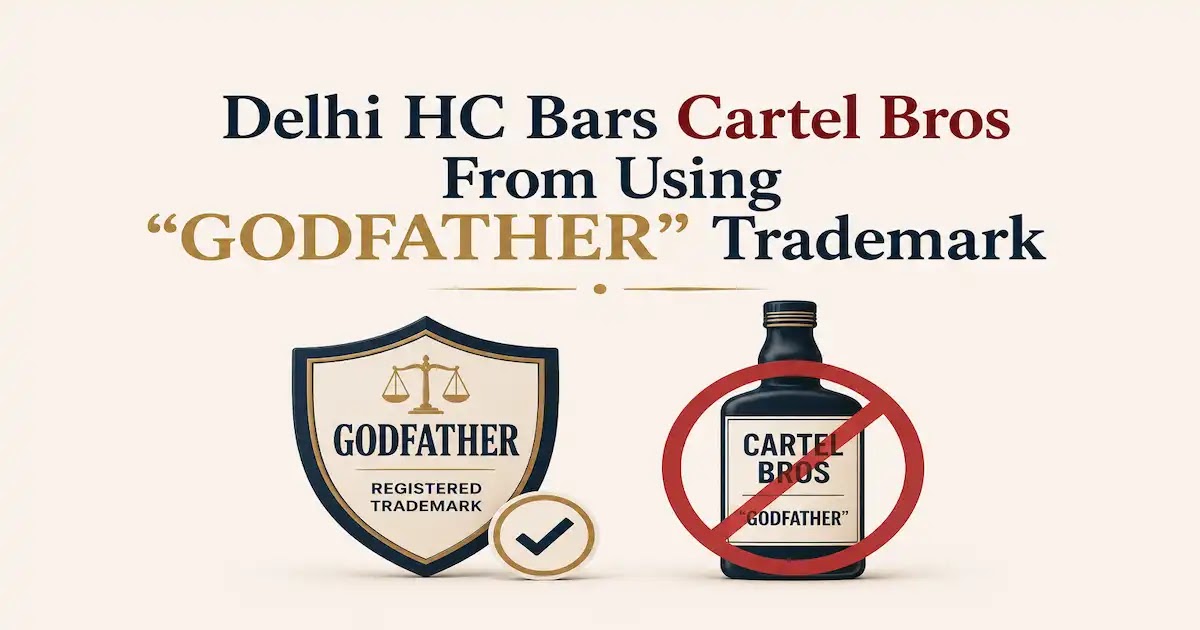
Some trademark disputes are won on novelty of law. Others are won on the sheer weight of forty years of goodwill. The Delhi High Court’s interim order in Devans Modern Breweries Limited v. Cartel Bros Private Limited case falls in the latter camp, but it answers three questions that come up again and again in Indian trademark practice. Does a registered proprietor lose its right to sue merely because it has not actively traded in one product line for some years? Are beer and whisky close enough cousins to count as “allied and cognate” goods? Can a defendant escape an infringement finding by burying a rival’s word mark inside a larger composite label? Hon’ble Justice Tushar Rao Gedela answered all three against the defendant, Cartel Bros Private Limited, the company backed by actor Sanjay Dutt that had proposed to sell a Scotch whisky styled “THE GLENWALK GODFATHER’S BY SANJAY DUTT.” The order restrains Cartel Bros from using “GODFATHER” or “GODFATHER’S” in any form for whisky for the duration of the suit, and directs the takedown of all related listings and advertising.
Background of the Dispute
Devans Modern Breweries Limited, incorporated in 1961, is among India’s older players in malt, spirits, and beer. It adopted “GODFATHER” as a trademark for beer in 1984 and has held a Class 32 registration for the mark since the 1980s. In 2005, it extended the registration to Class 33, covering alcoholic beverages other than beer, including rum and whisky. The mark is also registered abroad, including New Zealand, Canada, Malaysia, Singapore, and the UAE. By FY 2024-25, Devans’ beer business under the GODFATHER name was generating roughly Rs. 746 crore in annual sales, a figure supported with a Chartered Accountant’s certificate. Its case on the whisky and rum side was thinner. Invoices and accounting material on record showed sales under the GODFATHER mark running from around 2005/2007 to 2013, with a cumulative IMFL (Indian Made Foreign Liquor) turnover of roughly Rs. 18 crore over two decades.
Cartel Bros Private Limited was incorporated in 2022. In January and February 2026, it filed “proposed-to-be-used” trademark applications for a composite mark originally styled “THE GLENWALK BLENDED SCOTCH WHISKY,” prominently featuring the word “GODFATHER,” and separately applied to register the standalone word mark “THE GODFATHER” in Class 33. During the course of the present proceedings, Cartel Bros revised its proposed label to “THE GLENWALK GODFATHER’S BY SANJAY DUTT,” enlarging “THE GLENWALK” and shrinking “GODFATHER’S,” while adding the actor’s name as a subscript-style endorsement. Devans discovered both the registry filings and contemporaneous social media promotion of the impending launch, and moved the Delhi High Court for a permanent injunction restraining infringement and passing off, along with an application for ad-interim relief.
Issues Before the Court
- Whether non-use of a registered mark in one product sub-category (whisky, within Class 33) since 2013 extinguishes the registered proprietor’s statutory right under Section 28 to sue for infringement?
- Whether beer (Class 32) and whisky (Class 33) are “allied and cognate” goods for the purposes of Section 29 of the Trade Marks Act, 1999?
- Whether the anti-dissection rule shields a composite mark from an infringement finding where a registered word mark is embedded in it, even after the defendant subordinates that word to a smaller font and adds a celebrity-name subscript?
- Whether, taking the above together, Devans had made out a prima facie case warranting an ad-interim injunction with the balance of convenience and irreparable harm favouring such relief?
Devans’ Case
Devans built its case for an injunction on five limbs. First, it argued that “GODFATHER” is an arbitrary mark with no inherent connection to alcoholic beverages, which under Indian trademark jurisprudence earns a higher degree of protection than a descriptive or suggestive mark. Second, it pointed to its Class 32 and Class 33 registrations, contending that registration by itself confers an exclusive statutory right under Sections 18 and 28 of the Trade Marks Act, regardless of whether the proprietor is currently trading under the mark in every registered category. Non-use, it argued, is a ground for rectification, not a self-executing defence available to an infringer. Third, and to pre-empt the obvious rebuttal, Devans placed invoices and a CA certificate on record to show actual past sales of rum and whisky under the GODFATHER mark, arguing that even on the facts it was not a case of total non-use. Fourth, it argued that beer and whisky are allied and cognate goods. Both are intoxicating alcoholic beverages, sold through the same bars, restaurants, and retail liquor outlets, and regulated under the same state excise frameworks, so that a consumer encountering “GODFATHER” whisky on a shelf next to “GODFATHER” beer would reasonably assume a common origin. Fifth, Devans invoked Section 29(4) independently, arguing that even if the goods were treated as dissimilar, the use of an identical mark by a new entrant would still take unfair advantage of, and cause detriment to, the distinctive character and four-decade reputation of the GODFATHER mark. Devans also highlighted that Cartel Bros’ own reply to an examination report from the Trade Marks Registry showed awareness of Devans’ prior registrations, undercutting any claim of innocent adoption.
Cartel Bros’ Defence
Cartel Bros argued that its mark had to be read as a composite whole under the anti-dissection rule, and that the true source identifier in its branding was the celebrity persona of Sanjay Dutt rather than the word “GODFATHER.” It contended that “GODFATHER” is a common dictionary word and that Devans could not claim exclusivity over it for whisky without separately proving secondary meaning specific to that category. On non-use, it argued that Devans had not held an excise licence or sold whisky in any meaningful volume since around 2013, that the invoices on record had irregularities, and that Devans’ entire two-decade IMFL turnover of about Rs. 18 crore was dwarfed by Cartel Bros’ own reported turnover of roughly Rs. 212 crore over three years.
On the question of allied goods, Cartel Bros stressed the practical differences between beer and whisky, citing a price gap running from roughly Rs. 100 to Rs. 1,750 per unit, alcohol content of around 8 percent against 48 percent, different storage and consumption patterns, and a more discerning, price-insensitive whisky consumer base. It argued these differences ruled out any real likelihood of confusion. It relied on the UK Caledonian line of authority for the proposition that beer and whisky should not automatically be treated as cognate goods, and on the Supreme Court’s decision in Pernod Ricard India Private Limited v. Karamveer Singh Chhabra, 2025 SCC OnLine SC 1701, for the proposition that courts must compare rival marks holistically rather than fixate on one dominant element in isolation. Finally, it offered a partial concession. It said it had no intention of using “THE GODFATHER” as a standalone mark, was willing to withdraw that specific application, and asked to be permitted to continue with the revised composite label naming Sanjay Dutt.
Court’s Analysis
Non-use does not defeat the statutory right to sue
The Court held that Sections 18 and 28 of the Trade Marks Act, 1999 confer exclusive rights on a registered proprietor by virtue of registration itself, and that neither provision makes those rights contingent on continuous, contemporaneous use in trade. Where a mark is registered, the remedy for a third party who believes it is no longer genuinely in use is to seek rectification or cancellation. Until that process runs its course and succeeds, the registration stands and the statutory right to sue for infringement survives.
The Court added that the mere filing of a rectification petition by Cartel Bros, without any adjudication on it, could not by itself cast doubt on the validity of Devans’ registration. On the facts, the Court also found that this was not, in any event, a case of total non-use. The invoices and CA certificate placed on record by Devans were sufficient, at the prima facie stage, to show actual past dealings in rum and whisky under the GODFATHER mark, leaving the ultimate evidentiary weight of those documents to be tested at trial.
Beer and whisky are allied and cognate goods
This finding is among the most commercially significant in the order. The Court held that the test for “allied and cognate” goods turns on the nature, kind, and intended use of the products in question, not on the price point or sophistication of the likely purchaser. Both beer and whisky are intoxicating alcoholic beverages consumed for broadly the same purpose, sold through the same retail and hospitality channels, including bars, restaurants, and liquor stores, and regulated by a common state excise framework.
The Court was also unmoved by Cartel Bros’ price and alcohol-content arguments, holding that these go to market positioning rather than to the legal question of whether the goods belong to the same commercial family for trademark purposes. It distinguished the Caledonian authority relied on by Cartel Bros on the footing that the party resisting cognate-goods treatment in that case did not hold a registration covering the relevant class, whereas Devans held a subsisting Class 33 registration backed by evidence of historical use.
The anti-dissection rule cannot rescue a dominant, recognisable element
The Court accepted the anti-dissection principle as good law, in the sense that a plaintiff cannot ordinarily isolate one fragment of a defendant’s composite mark and ignore the rest when assessing similarity. But it held that the principle has no application where the very element the plaintiff complains of is the dominant, essential, and eye-catching feature of the composite mark, even after cosmetic rearrangement.
Examining Cartel Bros’ original label, the Court found “GODFATHER” to be the visually prominent element, with “THE GLENWALK” receding into the background. Turning to the revised version, “THE GLENWALK GODFATHER’S BY SANJAY DUTT,” with “THE GLENWALK” enlarged, “GODFATHER’S” shrunk, and the actor’s name added as a subscript, the Court found that the resizing and the celebrity attribution did not dislodge “GODFATHER’S” from its position as the bold, attention-catching part of the mark when viewed by an average consumer with imperfect recollection. Because Devans’ GODFATHER mark is a registered word mark, the Court held that its essential character survives embedding inside a larger composite label. Reading the rival marks holistically, in line with the Supreme Court’s guidance in Pernod Ricard v. Karamveer Singh Chhabra that dominant-feature analysis is an aid to overall comparison and not a substitute for it, the Court still arrived at the same conclusion. “GODFATHER” remained the dominant and essential feature, making the composite mark deceptively similar to Devans’ registered mark both visually and phonetically.
The Court also noted that Cartel Bros’ own correspondence with the Trade Marks Registry showed it was aware of Devans’ prior Class 33 registration before adopting the name, a fact that weighed against the bona fides of the adoption.
Section 29(4), passing off, and the balance of convenience
Having found the marks identical/similar and the goods allied and cognate, the Court held the ingredients of Section 29(1) and (2) infringement were prima facie satisfied. It went on to hold that Section 29(4) was independently attracted. Given the GODFATHER mark’s reputation built over roughly four decades, a newcomer’s use of an identical name for a related alcoholic beverage was likely to cause unfair advantage to the defendant and dilution of the plaintiff’s distinctive character and repute, irrespective of any formal finding on similarity of goods.
On passing off, the Court found Devans’ goodwill in the mark to be established, misrepresentation through use of an identical name to be self-evident, and a real risk of consumer diversion and association. It held that the balance of convenience lay with Devans, since dilution of a long-standing mark’s distinctiveness is a species of harm that money damages cannot fully repair, and that allowing the launch to proceed pending trial risked irreversible market confusion at the very moment of the defendant’s entry.
Decision
The Court’s ratio runs across three points. Registration alone, under Section 28, confers an exclusive and enforceable right on a trademark proprietor. Non-use of that mark in respect of a particular class or sub-category does not by itself extinguish the right to sue for infringement, and is relevant only through a properly adjudicated rectification or cancellation proceeding. Beer and whisky, despite their commercial and pricing differences, are allied and cognate goods because they share the same nature, purpose, trade channels, and regulatory regime. Where a registered word mark forms the dominant, recognisable element of a defendant’s composite mark, neither a reduction in font size nor the addition of a celebrity-name subscript is enough to escape infringement under the anti-dissection rule. The rule protects genuinely composite, undivided marks, not a rival’s attempt to dress up a borrowed dominant feature.
On this basis, the Court granted an ad-interim injunction restraining Cartel Bros Private Limited, along with its successors, assigns, partners, directors, and anyone acting on its behalf, from manufacturing, bottling, marketing, selling, offering for sale, advertising, exporting, or otherwise dealing in whisky under the marks “GODFATHER,” “GODFATHER’S,” or any deceptively similar mark, label, or trade dress, for the duration of the suit. Cartel Bros was further directed to immediately take down all listings, advertisements, social media posts, and other digital content bearing the GODFATHER mark in connection with whisky across all platforms, and to issue takedown requests to third-party platforms carrying such content. The suit, CS(COMM) 346/2026, along with the connected applications, will now proceed to trial on the merits, including on the rectification questions raised by Cartel Bros.
Why This Order Matters
A mark does not have to be in continuous, vigorous use across every registered category to retain its teeth against an infringer. A registration is a standing right, not a perishable one that quietly lapses the moment commercial activity in a sub-category slows down. The only route to strip that right is a formal rectification proceeding that succeeds, not the mere filing of one as a defensive shield in infringement proceedings. The order does not give registered proprietors a free pass. Devans still had to come forward with invoices and accounting evidence of past use, and the Court was careful to note that the ultimate weight of that evidence remains open for trial.
For new entrants, especially those building a brand around a celebrity endorsement, the order is a caution against treating “allied and cognate” too narrowly. Drawing the line at the same Nice Classification class, or even at gross differences in price and alcohol content, is not enough. Courts look at the commercial reality of shared trade channels, shared regulatory regimes, and shared purpose. Cosmetic rebranding, such as shrinking a borrowed word, growing a coined house mark, or bolting on a celebrity’s name, will not defeat an infringement claim if the borrowed word remains the part of the label that catches a consumer’s eye. The anti-dissection rule is a tool for fair comparison of genuinely original composite marks, not a workaround for diluting someone else’s dominant mark by surrounding it with other elements.
Also Read: Calcutta HC Returns ITC Plaint for Skipping Section 12A Mediation
Conclusion
Devans Modern Breweries v. Cartel Bros case is, at this stage, only an ad-interim order, and the underlying suit, including Cartel Bros’ rectification challenge to Devans’ Class 33 registration, remains to be tried on the merits. But the interim findings are unambiguous on all three contested questions. Registration trumps non-use absent rectification. Beer and whisky sit close enough together in the market to be treated as cognate goods. A dominant registered word mark cannot be diluted out of legal relevance by clever composite design. For a celebrity-backed challenger entering a crowded liquor market under a name that a forty-year-old brand already owns, the message from the Delhi High Court is blunt. Changing the font does not change the analysis.
Case: Devans Modern Breweries Limited v. Cartel Bros Private Limited & Anr., CS(COMM) 346/2026, I.A. 9898/2026, I.A. 9911/2026 & I.A. 10797/2026, Coram: Hon’ble Justice Tushar Rao Gedela, Date of Order: June 22, 2026