
Dispute Before the Court
Want to learn the fundamentals of Trademark Law? Read our complete Trademark Law Guide.
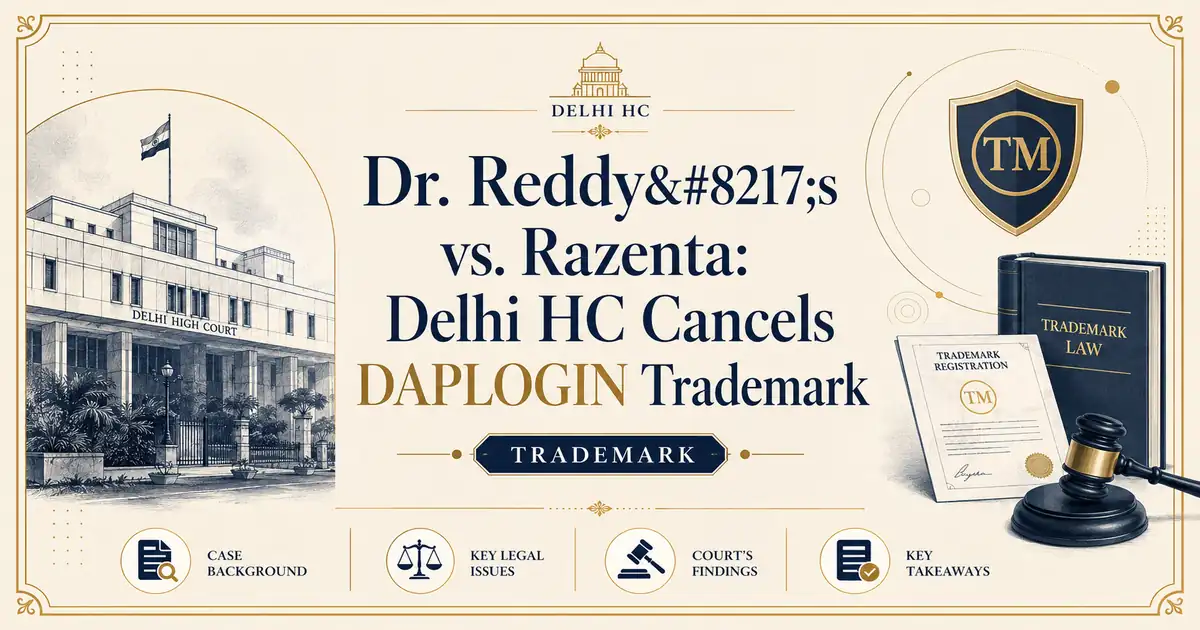
The Delhi High Court, presided over by Justice Sanjeev Narula, adjudicated a significant cancellation petition filed by Dr. Reddy’s Laboratories Limited against M/s Razenta Pharmaceuticals Private Limited. The dispute centered on the trademark registration of the mark DAPLOGIN (Registration No. 5208898 in Class 05). Dr. Reddy’s Laboratories (the Petitioner) initiated these proceedings under Section 57 of the Trade Marks Act, 1999, which provides a legal mechanism for aggrieved parties to apply for the cancellation or variation of a registered trademark entry on the Register of Trade Marks. The Petitioner sought the removal of the Respondent’s mark, contending that it infringed upon their own established trade mark rights and caused confusion in the pharmaceutical sector.
Relief Sought
The Petitioner requested the Court to exercise its powers to order the cancellation of the trademark DAPLOGIN from the Trade Marks Register. The primary objective was to protect their proprietary rights in the mark DAPLO. The Petitioner argued that the Respondent’s adoption and registration of a deceptively similar mark for pharmaceutical products was legally unsustainable and undermined the integrity of the market. Furthermore, the Petitioner sought costs and any other relief the Court deemed appropriate, emphasizing the necessity of maintaining clear distinctions between medicinal products to ensure consumer safety and prevent brand dilution.
Parties’ Contentions
Dr. Reddy’s Laboratories contended that they possessed superior common law and statutory rights in the mark DAPLO. They asserted that the mark DAPLO had achieved the status of a well-known mark, thereby fulfilling the parameters stipulated under Section 11(6) and Section 2(1)(zg) of the Trade Marks Act, 1999, provisions that define and protect trademarks that have become widely known to the relevant public. The Petitioner argued that the Respondent’s mark was identical or, at the very least, deceptively similar, leading to inevitable confusion among medical professionals and patients. They further submitted that the prior use of the mark DAPLO by the Petitioner entitled them to exclusive rights over the name, particularly within the pharmaceutical industry where identical or similar naming could lead to fatal medication errors.
Conversely, the Respondent maintained their right to the registration. They argued that their product was distinct and that their trademark adoption was bona fide. The Respondent claimed that the existence of their registration was valid and that the petition for cancellation lacked sufficient grounds to warrant a total removal from the Register. They urged the Court to consider the commercial viability and the specific context of their operations, asserting that the cancellation petition should be dismissed in its entirety.
Court’s Approach
The Court conducted a thorough examination of the competing claims, focusing on the principles of trademark law and the specific realities of the pharmaceutical market. Justice Narula highlighted that when two trademarks are used in a normal way for the same category of goods, the potential for confusion must be evaluated strictly. The Court revisited established judicial precedents regarding prior user rights, emphasizing that a prior user maintains superior rights that the Court is bound to recognize and protect.
A significant portion of the Court’s analysis focused on the potential for public harm. In the context of drugs and medicinal preparations, the standard for confusion is higher. The Court observed that even minor similarities between pharmaceutical marks can result in dangerous consequences if a patient or practitioner inadvertently uses the wrong product. By evaluating the parameters for a well-known mark, the Court acknowledged the Petitioner’s extensive reach and the reputation they had built around the DAPLO brand. The Court also assessed the balance of convenience, noting that the Petitioner’s long-standing presence in the market outweighed the Respondent’s relatively recent adoption of the contested mark.
Order
Upon hearing the arguments and examining the evidence provided by both sides, the Court ruled in favor of the Petitioner. The Court ordered the cancellation of the trademark registration of DAPLOGIN (Registration No. 5208898) in Class 05. Additionally, the Court issued a direct mandate to the Respondent No. 2, the Registrar of Trade Marks, to rectify the Register of Trade Marks within six weeks of the order. This directive ensures the official removal of the offending mark from the public record.
Also Read: Calcutta HC Returns ITC Plaint for Skipping Section 12A Mediation
What the Order Means
This decision serves as a significant affirmation of the protection afforded to well-known marks in the pharmaceutical sector. For legal practitioners, the key takeaway is the Court’s rigid adherence to the principle that prior usage and brand reputation form the bedrock of trademark protection. By granting the cancellation of the DAPLOGIN registration, the Court has signaled that it will not tolerate the registration of marks that mirror or closely resemble established brands, especially when such marks operate in the sensitive domain of healthcare.
The judgment reinforces the application of Section 57 of the Trade Marks Act, illustrating that the Court is prepared to invoke its rectification powers when evidence demonstrates that a registration was improperly granted or continues to infringe upon the rights of a prior user. Furthermore, the case serves as a warning to entities in the pharmaceutical space: the adoption of trademarks must be performed with extreme care to avoid infringing on established, well-known, or prior-used marks. The Court’s reliance on the potential for consumer confusion in the pharmaceutical industry underscores the intersection between trademark law and public welfare. For students of law, the case highlights how statutory provisions like Section 11(6), which details the criteria for well-known marks, provide the necessary framework for brands to defend their identity against encroachment.
Ultimately, the judgment solidifies the Petitioner’s exclusive control over the DAPLO brand and provides a clear mechanism for companies to remove conflicting marks from the Register. It clarifies the role of the Registrar of Trade Marks in post-judgment compliance, as the Court explicitly mandated a timeline for the rectification. The order emphasizes that trademark registration is not an absolute shield and that superior prior rights can effectively challenge and overturn existing registrations that are deemed deceptive or confusingly similar.
Case Details: DR. REDDYS LABORATORIES LIMITED Vs M/S RAZENTA PHARMACEUTICALS PRIVATE LIMITED AND ANR, C.O. (COMM.IPD-TM)-122/2025 2026:DHC:6769, Delhi High Court, 17-08-2026