
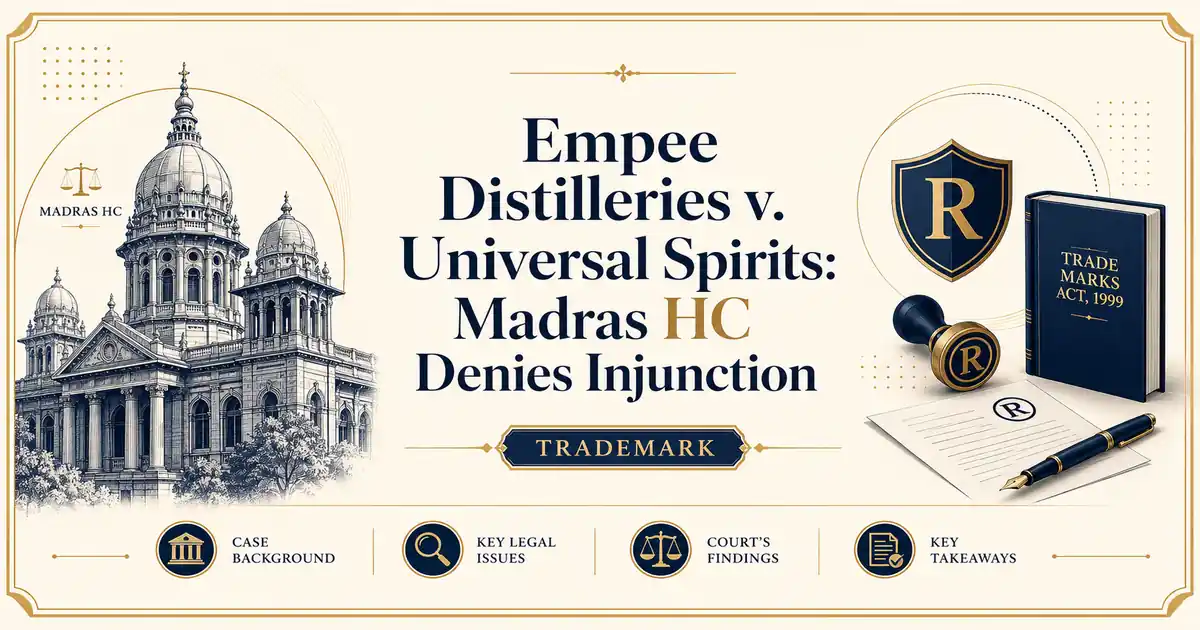
Case Snapshot: Empee Distilleries Limited v. Universal Spirits Pvt Ltd
Want to learn the fundamentals of Trademark Law? Read our complete Trademark Law Guide.
The Madras High Court recently adjudicated on the matter of Empee Distilleries Limited v. Universal Spirits Pvt Ltd (OA. 492/2026), a commercial dispute centered on allegations of trademark infringement and passing off. The core of the dispute involves the registered word mark ‘MARCO POLO’ owned by the Applicant, Empee Distilleries Limited. The Applicant sought an ad interim injunction against the Respondent, Universal Spirits Pvt Ltd, to restrain the manufacture, sale, and distribution of spirits under labels that allegedly incorporate the ‘MARCO POLO’ mark or utilize deceptively similar trade dress.
The proceeding, filed under the framework of the Trade Marks Act, 1999, tests the boundaries of trademark protection for brand names within the Indian liquor industry. The Applicant requested the Court to prevent the Respondent from using the mark ‘MARCO POLO’ as a prefix or suffix, or in any configuration deemed deceptively similar to their established brand. The Court examined the request through the traditional trinity of interim relief: the existence of a prima facie case, the balance of convenience, and the potential for irreparable injury.
Submissions and Legal Framework
The Applicant, Empee Distilleries Limited, contended that its registered brand name ‘MARCO POLO’ occupies a distinct position in the market. Counsel for the Applicant argued that the Respondent’s use of a similar name or trade dress constitutes an infringement of their statutory rights under Section 29 of the Trade Marks Act, 1999, which defines the conditions under which a registered trademark is infringed by unauthorized use of identical or deceptively similar marks. The Applicant further asserted that such use amounts to the tort of passing off, as it misrepresents the Respondent’s goods as those of the Applicant, thereby causing potential confusion among consumers.
The legal framework applied during the hearing focused on the following specific criteria for assessing trademark infringement:
- Similarity and Distinctiveness: A comparative analysis of the name, colour scheme, and overall trade dress of the competing products.
- Rule of Anti-Dissection: The principle that a trademark must be considered as a whole, rather than breaking it into constituent parts to find minor differences.
- Dominant Feature Test: The identification of the primary component of a trademark that captures the consumer’s attention and creates the impression of the brand.
The Applicant emphasized that the balance of convenience heavily favored the grant of an injunction. They argued that the damage caused by allowing the Respondent to continue operations under the disputed mark would be immeasurable, as it erodes the brand equity of the ‘MARCO POLO’ trademark and confuses the public regarding the source of the liquor.
Court’s Analysis of Deceptive Similarity
The Madras High Court performed an intensive review of the evidence to determine whether the Respondent’s activities led to deceptive similarity. In trademark law, deceptive similarity refers to a situation where the average consumer, with average intelligence and imperfect recollection, is likely to be confused into believing that the goods of one manufacturer originated from another. This assessment is guided by the potential for confusion in the minds of the target demographic.
The Court scrutinized whether the inclusion of ‘MARCO POLO’ as a prefix or suffix in the Respondent’s product labels, specifically instances like ‘MARCO POLO DELUXE XXX RUM’, crossed the line into infringement. The judicial inquiry focused on whether the overall commercial impression created by the product was intended to ride upon the reputation of the Applicant’s established trademark.
However, the Court noted that a finding of infringement is not automatic. The analysis requires the Court to weigh multiple interrelated factors, including the strength of the Applicant’s trademark, the similarity of the products, and the actual consumer base. The Court highlighted that where the likelihood of confusion is considered weak or speculative, the threshold for granting interim relief is not met. If the visual, phonetic, or structural differences between the products are sufficient to prevent a consumer of average intelligence from being misled, the Court will generally decline to grant an injunction at the interlocutory stage.
In this specific instance, the Court evaluated the Respondent’s branding against the Applicant’s registered mark. The analysis revolved around whether the specific layout, font, and word usage created an association that would deceive a reasonable purchaser. The Court cautioned against an overly broad interpretation of trademark rights that could lead to monopolistic behavior, unless a clear case of potential deception was established on the record.
Outcome and Judicial Findings
The Madras High Court, after evaluating the arguments on the prima facie case, found that the criteria for an ad interim injunction had not been satisfied to the extent required for immediate judicial intervention. The Court observed that the mere similarity of a word does not always translate into legal deception if the overall trade dress is sufficiently distinct to prevent confusion. The application for an ad interim injunction was evaluated against the necessity of preventing irreparable harm, which the Court found was not sufficiently demonstrated by the Applicant at this preliminary stage of the commercial suit.
The Court concluded that the allegations of deceptive similarity were not strong enough to warrant an immediate stop to the Respondent’s business activities. By denying the interim relief, the Court essentially preserved the status quo for the Respondent while the litigation proceeds to the discovery and trial phases. The Applicant, Empee Distilleries Limited, remains entitled to pursue the matter through a full trial, where they will carry the burden of proving that the Respondent’s product labeling is intentionally designed to deceive the public.
Also Read: Calcutta HC Returns ITC Plaint for Skipping Section 12A Mediation
Implications for IP Practice
This decision provides several takeaways for legal practitioners navigating trademark litigation in India. First, the ruling underscores the importance of the “overall impression” test. Practitioners should note that courts are increasingly sensitive to the difference between a dominant feature and descriptive or generic terms that might appear in a brand name.
Second, the judgment reinforces the high burden of proof required to secure interim relief in trademark cases. A plaintiff must do more than allege similarity; they must provide evidence that the similarity is of a nature that would genuinely mislead the intended market segment. Speculative or weak claims regarding the likelihood of confusion are likely to be dismissed at the threshold.
Third, the case highlights the necessity of robust evidentiary support regarding market presence and consumer confusion. Evidence such as survey results, sales figures, and records of actual consumer complaints often serve as the deciding factor in whether a prima facie case is established. Law students and practitioners should recognize that in the absence of tangible proof of confusion, courts tend to exercise caution before granting injunctions that restrict a business entity’s trade activities.
Finally, the Madras High Court’s reliance on the balance of convenience test demonstrates that judges are mindful of the economic impact of litigation. The court will consider not just the rights of the intellectual property owner, but also the potential for harm to a respondent who may be operating in good faith. This dual focus is a recurring theme in contemporary Indian IP jurisprudence, where the balance between protecting innovation and fostering fair market competition is constantly recalibrated.
As this case proceeds, the focus will shift to whether the Applicant can establish that the specific utilization of the ‘MARCO POLO’ mark by the Respondent constitutes a breach of Section 29 of the Trade Marks Act. The case serves as a reminder to IP practitioners that an initial setback in an application for interim relief does not equate to a loss on the merits of the suit. Instead, it invites the Applicant to build a more comprehensive record, likely involving expert evidence on consumer psychology and market behavior, to satisfy the court of the necessity for a permanent injunction during the final determination of the suit.
For those involved in the spirits and consumer goods sector, this judgment acts as a guide on the standard of similarity courts expect before intervening in the operations of a competitor. It signals that companies must ensure their product labeling provides clear differentiation if they choose to utilize terms that bear even a tangential relationship to an existing registered mark. Legal counsel should advise clients to document the design process and branding choices early, as these records often become the critical evidence needed to defend against claims of deceptive similarity in future litigation.
In summary, the Empee Distilleries decision does not diminish the rights of trademark owners but rather reinforces the evidentiary threshold required for early-stage relief. It remains a case to monitor as it progresses toward a final decree, as the application of the ‘dominant feature’ and ‘anti-dissection’ rules will likely be tested again in the trial phase. Practitioners should continue to frame their pleadings with a focus on specific, actionable evidence of consumer confusion rather than relying solely on the registration of a mark or the similarity of a single word.
Case Details: Empee Distilleries Limited Rep by its Authorised S Vs Universal Spirits Pvt Ltd Rep by its Managing Dire, OA.492/2026, Madras High Court, 11-08-26