
Dispute Before the Court
New to Patent Law? Start with our complete Patent Law Guide.
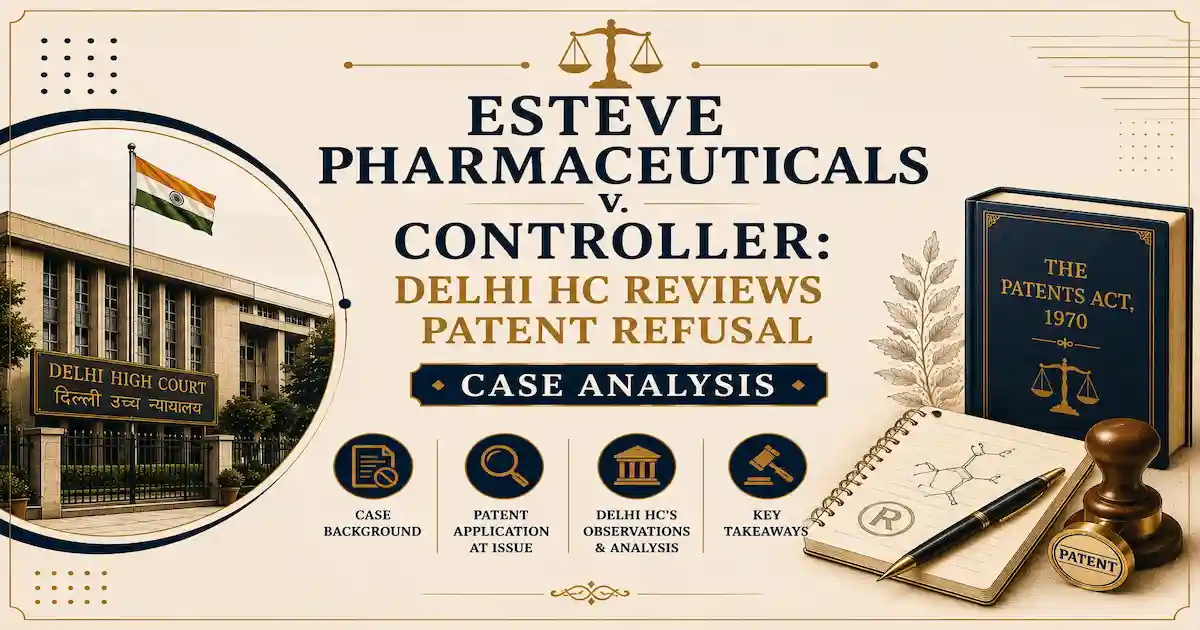
The matter of Esteve Pharmaceuticals S.A. Vs. Controller of Patents and Designs (C.A.(COMM.IPD-PAT)-118/2022, 2026:DHC:6408) represents a challenge to an order issued by the Indian Patent Office. The appellant, Esteve Pharmaceuticals S.A., sought to protect a pharmaceutical invention through a national phase patent application filed at the Delhi Patent Office, bearing number 1435/DELNP/2012. This application originated from an international PCT filing. During the examination process, the Controller of Patents raised significant objections, ultimately leading to the refusal of the application. The appellant invoked Section 117A of the Patents Act, 1970, the statutory provision allowing an applicant to appeal decisions of the Controller before the High Court, to challenge this refusal.
Relief Sought
The appellant requested that the High Court of Delhi set aside the order issued by the Controller of Patents and Designs. The objective was to secure the grant of a patent for the subject application (1435/DELNP/2012). The core of the appeal was that the Controller erred in finding the application ineligible for patent protection, arguing that the technical advancements described in the patent specification were sufficient to overcome the objections regarding novelty, inventive step, and patentability.
Parties’ Contentions
The controversy centered on the grounds of refusal cited by the Patent Office. The Controller’s primary objections were rooted in the following statutory provisions:
- Section 2(1)(ja): This provision defines an “inventive step” as a feature of an invention that involves technical advance as compared to existing knowledge or having economic significance, or both, which makes the invention not obvious to a person skilled in the art. The Controller argued the application lacked this necessary advancement.
- Section 3(d): This section denies patentability to the mere discovery of a new form of a known substance which does not result in the enhancement of the known efficacy of that substance, or the mere discovery of any new property or new use for a known substance. The Controller contended the appellant’s invention failed to demonstrate a significant increase in therapeutic efficacy.
- Section 3(e): This section precludes patents for substances obtained by a mere admixture resulting only in the aggregation of the properties of the components thereof or a process for producing such a substance. The Controller viewed the claims as mere aggregations of known ingredients rather than a synergistic invention.
The Controller cited prior art documents (referred to as D1 and D2) to argue that the subject application was anticipated by existing research and lacked the requisite novelty and inventive step.
Court’s Approach
The Delhi High Court applied a rigorous legal analysis to the refusal order. Relying on established jurisprudence, including the principle articulated in Biomoneta Research Pvt. Ltd. vs. Controller General of Patents, Designs & Anr. (2023/DHC/001816), the Court examined whether the Controller had adequately addressed the specific technical submissions made by the applicant during the examination phase.
The Court’s review focused on the following:
- Assessment of Prior Art: The Court scrutinized whether the cited documents D1 and D2 truly anticipated the claims in the appellant’s application. A key issue was whether the Controller correctly applied the test of “obviousness to a person skilled in the art” as required by Section 2(1)(ja).
- Evaluation of Objections under Section 3: The Court evaluated if the Controller’s application of Section 3(d) and 3(e) was legally sound or if the rejection was based on a flawed interpretation of the evidence regarding efficacy and synergy.
- Procedural Fairness: The Court looked into whether the Controller had afforded the appellant sufficient opportunity to address the specific objections and whether the final order reflected a reasoned response to the applicant’s counter-arguments.
Order
Upon reviewing the records of the Patent Office and the arguments presented, the Court adjudicated on the merits of the refusal. While the specific operative instructions reflect a detailed procedural history, the Court’s intervention signifies a re-evaluation of the Patent Office’s refusal based on the legal standards for inventive step and patentability under the Act. The High Court, having considered the submissions, provided a final determination that necessitates either the re-examination of the application or the direct grant, contingent on the Court’s specific findings regarding the technical merit of the subject application.
Also Read: Calcutta HC Revokes Letters Patent Leave in Maitra Servicenter Dispute
What the Order Means
The judgment in Esteve Pharmaceuticals S.A. Vs. Controller of Patents and Designs serves as a reminder of the high evidentiary standards required in the Indian patent system for pharmaceutical inventions. The implications for practitioners are significant:
- Precision in Responding to FER: The case highlights the importance of the First Examination Report (FER) response stage. Applicants must address objections under Section 3(d) and 3(e) with empirical data, especially when claiming new forms of known substances. The burden remains on the applicant to prove that the invention provides a significant enhancement in efficacy or synergy that is not merely an obvious progression of existing knowledge.
- The “Person Skilled in the Art” Test: The judgment underscores that the Controller’s application of the “obviousness” test must be grounded in a concrete assessment of what was actually known in the public domain (the prior art) at the time of the invention. Vague rejections that do not clearly link the prior art to the specific claim elements are vulnerable to reversal on appeal.
- Reasoned Orders: For the Patent Office, this order reiterates the requirement that rejections must be reasoned. The Controller must engage with the technical submissions made by the applicant rather than providing generic citations of statutory sections.
- Appellate Recourse: The successful use of Section 117A in this instance confirms that the appellate process remains an effective mechanism for rectifying misapplications of patent law, provided the appellant can show a disconnect between the technical merits of the invention and the Controller’s summary rejection.
For legal practitioners, this case reinforces that in pharmaceutical patent litigation, the intersection of legal drafting and technical documentation is paramount. Patents that survive scrutiny at the Indian Patent Office are those that demonstrate, with clarity and scientific evidence, a distinct departure from the prior art, thereby meeting the stringent criteria set out in the Patents Act of 1970.
Case Details: ESTEVE PHARAMACEUTICALS S.A. Vs CONTROLLER OF PATENTS AND DESIGNS, C.A.(COMM.IPD-PAT)-118/2022 2026:DHC:6408, Delhi High Court, 07-08-2026