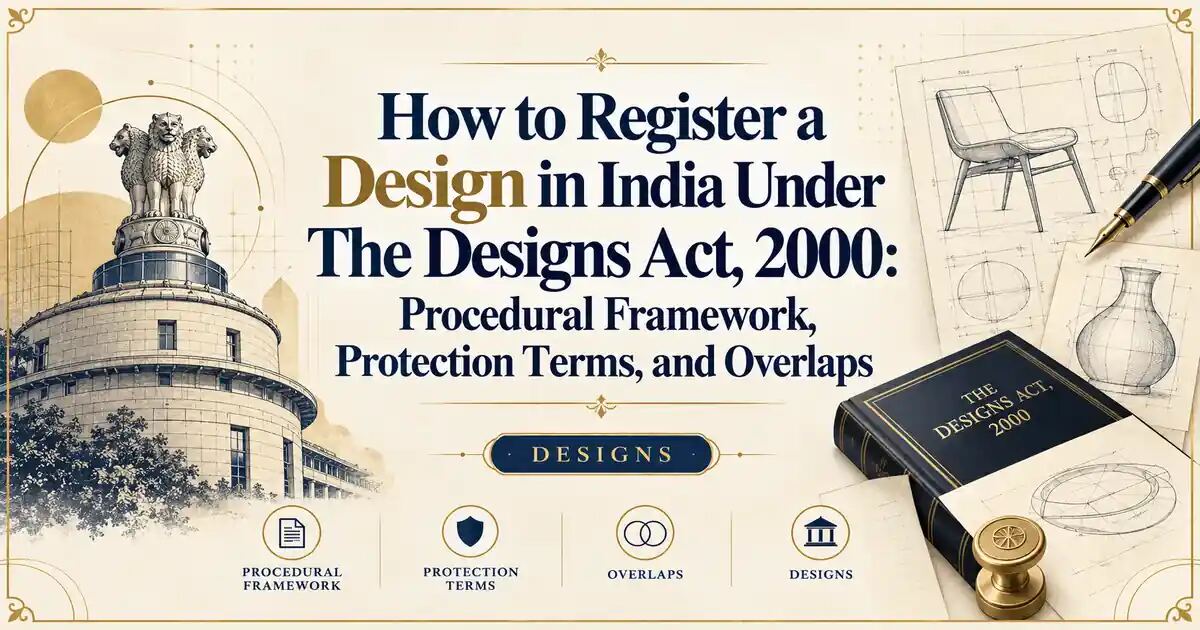
A product’s visual appearance can be as commercially valuable as its technical function. The shape of a beverage bottle, the configuration of a chair, the pattern on a woven textile, or the aesthetic exterior of a consumer electronic device directly influences consumer perception and purchasing choices. In India, these visual features are protected under the Designs Act, 2000, provided they satisfy the statutory prerequisites of a registrable design. Securing registration under design law in India is therefore not merely an administrative formality; it vests the proprietor with an exclusive, enforceable statutory monopoly over the visual presentation of an article.
However, obtaining design protection involves substantially more than lodging an application. An applicant must determine whether the subject matter qualifies as a statutory “design”, whether it satisfies absolute novelty, whether prior publication has occurred, and which international classification applies. Furthermore, the registration process interfaces with other intellectual property regimes: copyright law protects original artistic expression, while trademark law protects distinctive trade dress and shapes that signify commercial origin. This guide examines the substantive criteria and procedural roadmap for registering a design in India, the scope and duration of protection, boundary overlaps with copyright and trademarks, and practical precautions applicants must undertake prior to filing.
What Constitutes a Registrable “Design” Under Section 2(d)?
For foundational statutory analysis, consult our in-depth Design Law Guide.
Under Section 2(d) of the Designs Act, 2000, a “design” is defined as the features of shape, configuration, pattern, ornament, or composition of lines or colours applied to any article, whether in two-dimensional or three-dimensional or in both forms, by any industrial process or means, which in the finished article appeal to and are judged solely by the eye. Crucially, the statutory definition establishes strict positive and negative criteria:
- Visual Eye Appeal: The design must appeal solely to and be evaluated by the eye. It must not be an abstract aesthetic idea; it must be embodied within an identifiable commercial article.
- Exclusion of Functional Features: Any feature dictated purely by mechanical function or the mode or principle of construction falls outside design protection (which belongs properly to patent law).
- Statutory Carve-Outs: The definition explicitly excludes trademarks (as defined in Section 2(1)(zb) of the Trade Marks Act, 1999), property marks, and artistic works (as defined in Section 2(c) of the Copyright Act, 1957).
Statutory Criteria: Novelty, Prior Publication, and Pre-Filing Confidentiality Under Section 4
The substantive threshold for registrability is novelty and originality. Under Section 4 of the Designs Act, a design is strictly prohibited from registration if it:
- (a) Is not new or original;
- (b) Has been disclosed to the public anywhere in India or abroad by prior publication in tangible form, by commercial use, or in any other manner prior to the filing date (or priority date);
- (c) Is not significantly distinguishable from known designs or combinations of known designs; or
- (d) Comprises or contains scandalous or obscene matter.
This absolute novelty standard makes pre-filing confidentiality paramount. Unlike certain foreign jurisdictions that provide a grace period, Indian design law does not excuse prior commercial disclosure. If a business exhibits, advertises, samples, or offers an article embodying the design for sale before filing an application, that prior public disclosure vitiates novelty and renders the design unregistrable. Consequently, creators and enterprises must initiate design protection well before product launch rather than waiting until the product demonstrates market traction.
Furthermore, the design must possess a direct nexus to an industrial article. Statutory protection is granted not to an abstract artistic concept in the air, but to the specific visual shape or pattern applied to tangible goods through an industrial manufacturing process. This distinction is critical because an identical visual expression may be classified differently across intellectual property regimes depending upon whether it is deployed as an artistic work, an industrial product, or a source-identifying trademark.
Step-by-Step Registration Procedure: Locarno Classification, Form 1, and Examination
The registration process commences by identifying the article and determining its exact class under the international Locarno Classification system. India adopts the Locarno Classification pursuant to the Designs Rules, 2001 (incorporating the Tenth Edition of the Locarno Agreement). Administered by the Office of the Controller General of Patents, Designs and Trade Marks (CGPDTM), the system categorizes goods into 32 classes and multiple subclasses. Identifying the correct class is vital, as design protection is granted strictly in respect of the specific class of articles designated in the application.
The applicant then submits an application using Form 1, accompanied by the prescribed statutory fee and representation sheets. Pursuant to Rule 14 of the Designs Rules, representation sheets must depict the design clearly from multiple perspectives, including front, rear, top, bottom, left side, right side, and perspective views. Each view must be consistent, executed on durable A4 paper or uploaded in high-resolution digital format, and accompanied by a concise statement of novelty indicating whether exclusivity is claimed for shape, configuration, pattern, or ornamentation. Where registration of the same design is sought across multiple classes of articles, separate applications must be lodged for each individual class.
Upon submission, the Patent Office (Designs Wing, Kolkata) carries out formal and substantive examination under Section 5 of the Act. The Examiner evaluates formal compliance with the Rules and conducts a substantive novelty search against existing Indian registrations and global publications. If formal defects or substantive objections arise, the Controller issues a First Examination Report (FER) stating the objections. The applicant must comply with the objections or contest them within the statutory period (extendable up to six months). Upon overcoming objections, the Controller accepts the application, issues the Registration Certificate, and enters the design in the Register of Designs, followed by publication in the official Patent Office Journal.
Duration of Protection, Statutory Rights, and Restoration of Lapsed Designs
Under Section 11 of the Designs Act, 2000, registration confers upon the registered proprietor “copyright in the design” for an initial term of 10 years from the date of registration (or priority date). The statutory term can be extended for a further period of five years upon filing Form 3 and paying the prescribed extension fee before the expiry of the initial 10-year term, providing a maximum cumulative protection period of 15 years.
Registration confers exclusive statutory rights upon the proprietor to apply the design to any article in the registered class, and to prevent unauthorized third parties from applying the design or any fraudulent or obvious imitation thereof. Under Section 22 of the Act, any unauthorized commercial reproduction, importation, or sale constitutes “piracy of registered designs”. The proprietor can institute a civil suit before a competent District Court or High Court to obtain interim and permanent injunctions, damages, or statutory recovery under Section 22(2).
This statutory duration reflects a deliberate policy compromise. Unlike trademarks, which can be maintained indefinitely through successive 10-year renewals, design protection is intentionally time-limited. The legislative intent balances rewarding the creator’s aesthetic innovation with the public interest in ensuring that industrial designs eventually fall into the public domain for free commercial utilization.
If the proprietor fails to pay the requisite extension fee before the expiration of the original 10-year period, the design ceases to have effect. However, Sections 12 and 13 provide an equitable restoration mechanism: the proprietor may apply for restoration on Form 4 within one year from the date on which the design ceased, proving that the failure to pay was unintentional and that there was no undue delay in making the application.
Navigating Complex IP Overlaps: The Boundary with Copyright and Trademarks
A central doctrinal challenge in Indian intellectual property practice is managing the intersection between design law, copyright law, and trademark protection. Section 2(d) of the Designs Act explicitly excludes any “artistic work” as defined under Section 2(c) of the Copyright Act, 1957. This boundary is governed by Section 15(2) of the Copyright Act: where an artistic work is capable of being registered as a design under the Designs Act but is not so registered, copyright in the work ceases as soon as any article to which the design has been applied is reproduced more than 50 times by an industrial process by the owner or under license.
As affirmed by the Delhi High Court Division Bench in Microfibres Inc. v. Girdhar & Co., this statutory threshold prevents an author from claiming perpetual 60-year artistic copyright in an applied industrial product that ought to have been registered under the finite 15-year design regime. The owner of an original artistic drawing must decide at the outset whether the work will remain a standalone work of art or will be applied to commercial products.
The interface with trademark law involves a distinct statutory inquiry. Under Section 2(1)(m) and Section 2(1)(zb) of the Trade Marks Act, 1999, a trademark may protect the shape of goods, packaging, and combination of colors, provided the shape functions as a source identifier. However, Section 9(3) of the Trade Marks Act establishes absolute grounds of refusal: a shape mark cannot be registered if it results from the nature of the goods themselves, is necessary to obtain a technical result, or gives substantial value to the goods. Thus, while design law protects aesthetic novelty for a maximum of 15 years, trademark law protects distinctive shape branding indefinitely through perpetual renewals.
For commercial enterprises, these overlaps require proactive, upfront IP portfolio structuring. While an industrial design protects the visual appearance of a product against piracy during its peak market lifecycle, distinctive shape branding and trade dress can independently be developed and protected under trademark law as secondary meaning is acquired. Determining whether a specific feature serves primarily as an aesthetic industrial design or as an indicator of commercial source dictates the appropriate filing sequence.
Practical Best Practices for Prospective Design Applicants
Several practical best practices can streamline registration and mitigate examination objections:
- Exhaustive Prior-Art Search: Applicants should conduct a comprehensive prior-art search across the CGPDTM Designs Registry database and international databases (such as WIPO’s Global Design Database) to verify that identical or substantially similar designs have not been published globally.
- Accurate Locarno Classification: Applicants must ensure precise classification under the Locarno system, avoiding overly broad descriptions of articles and verifying subclass alignments.
- Flawless Representation Sheets: Drawings or photographs must comply rigorously with Rule 14 of the Designs Rules, maintaining clear contrast, eliminating background clutter, and accurately illustrating all surface views.
- Strict Pre-Filing Confidentiality: Enforcing robust Non-Disclosure Agreements (NDAs) with contractors, manufacturers, and commercial partners prior to filing Form 1 is imperative. Public exhibitions, social media teasers, trade show displays, or retail sampling prior to filing will destroy novelty under Section 4.
- Contemporaneous Conception Records: Maintaining design development logs, CAD files, and dated conception sketches provides vital evidentiary support if inventorship or novelty is ever contested during cancellation proceedings.
Also Read: India’s Semiconductor IP Paradox: Layout-Design Registrations, the SICLD Act, and Domestic Ownership
Key Precedents & Statutory Guidance
- Search recent High Court judgments in our Latest Indian IP Law Cases Directory.
- Examine core statutory doctrines in our Indian Design Law Guide.
- Review nationwide litigation trends in our Monthly IP Law Roundup.
References
- Government of India, The Designs Act, 2000 (Act No. 16 of 2000), Sections 2(d), 4, 5, 11, 12, 13, and 22, India Code.
- Office of the Controller General of Patents, Designs and Trade Marks (CGPDTM), The Designs Rules, 2001 (as amended), Rules 10, 11, 12, 13, and 14 (Presentation of representations and Locarno classification).
- Office of the CGPDTM, Manual of Designs Practice and Procedure, Department for Promotion of Industry and Internal Trade (DPIIT), Ministry of Commerce and Industry, Government of India.
- World Intellectual Property Organization (WIPO), Locarno Classification for Industrial Designs (International Classification for Industrial Designs under the Locarno Agreement).
- Government of India, The Copyright Act, 1957 (Act No. 14 of 1957), Section 2(c) and Section 15(2) (Copyright in designs registered or capable of being registered under the Designs Act).
- Government of India, The Trade Marks Act, 1999 (Act No. 47 of 1999), Section 2(1)(m), Section 2(1)(zb), and Section 9(3) (Shape marks and trade dress exclusions).
- Delhi High Court (Division Bench), Microfibres Inc. v. Girdhar & Co. & Anr., 2009 (40) PTC 519 (Del) (DB) (Harmonizing copyright subsistence with industrial application and design registration).