
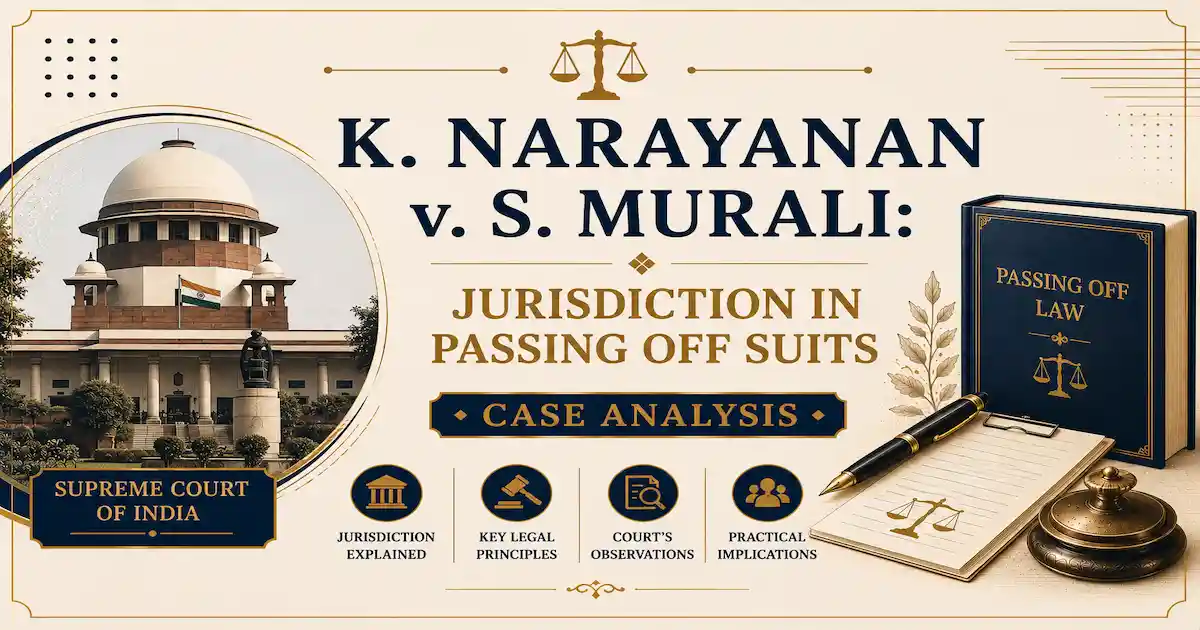
K. Narayanan and another had manufactured and sold banana chips under the mark A-ONE since 1986. In 1999 they applied to register the mark before the Trade Marks Registry at Chennai. That application was still pending when this dispute reached the Supreme Court, reported at 2008 (10) SCC 479. In 2000, S. Murali filed a suit in Coimbatore seeking to restrain the appellants from passing off their goods as his. The District Judge dismissed that suit in 2001. Around the same time, Murali filed three trademark applications of his own before the Trade Marks Office at Chennai, each claiming use of A-ONE across India since 1995.
The appellants then moved the Madras High Court in June 2001, seeking an injunction against Murali. Their basis for approaching a Chennai forum rested on Murali’s own applications: those applications named no geographical restriction and had been lodged at the Chennai office, which the appellants argued was enough to fix jurisdiction there. Leave to sue, granted initially, was revoked in 2002. The Division Bench dismissed the appeals that followed, and the appellants carried the matter to the Supreme Court.
Issues Before the Hon’ble Court
New to Trademark Law? Start with our complete Trademark Law Guide.
Two questions ran together in this appeal, though the Court treated them as two sides of one problem.
- Does the filing of a trademark application at a particular Trade Marks Office, without more, fix territorial jurisdiction in the courts of that place for a passing-off action?
- Does a pending application, unaccompanied by proof of use, itself supply the cause of action that a passing-off suit requires?
Issue 1 – The territorial Jurisdiction and the Location of a Filing
The appellants’ jurisdictional argument was structural rather than factual. Murali’s three applications carried no territorial limitation and had been filed at the Chennai office. On that basis, the appellants argued, any passing-off claim touching those applications could be litigated at Chennai, regardless of where actual trading activity took place.
The Court rejected the premise directly. A trademark application is a request lodged with the Registry. It records where a form was filed, not where goods were sold, where a mark was used, or where consumers encountered it. Passing off protects goodwill built through trade, and jurisdiction in a passing-off suit follows the place where that trade occurred and where the misrepresentation is felt, not the address of the office where a party happened to file paperwork.
The appellants tried to draw support from an earlier precedent in which a registered proprietor’s rights were treated as extending across the territory covered by the registration. The Court found that comparison did not hold. Murali held no registration. He held only pending applications. A registration carries statutory consequences under the Trade Marks Act, including presumptive rights tied to its registered scope. A pending application carries none of that until the Registry actually grants it.
Finding
The mere filing of a trademark application at Chennai does not confer territorial jurisdiction on the Madras High Court for a passing-off suit concerning that mark.
Issue 2 – Does a Pending Application Supply the Cause of Action?
The second question was more fundamental. Even setting jurisdiction aside, could a pending application, on its own, be treated as the factual basis for a passing-off claim, either for the person who filed it or against them?
The Division Bench had already answered this at the High Court stage, holding that before registration is granted there is no right capable of being asserted as infringed, and that a proposed registration which may or may not be granted confers no cause of action, whether the application was filed by the plaintiff or by the defendant. The Supreme Court agreed with that reasoning and extended it explicitly to the passing-off context. Passing off does not ask who has applied to register a mark. It asks who has built goodwill through actual use, and whether the defendant’s conduct is likely to deceive an average purchaser into believing the two are connected. An application sitting on the Registry’s file answers neither question.
Finding
Filing of an application for registration of a trademark does not constitute part of the cause of action in a suit for passing off.
The Court’s Reasoning
Registration Proceedings Are a Different Inquiry
The Court’s central move was to separate two proceedings that litigants often collapse into one. Registration proceedings test registrability: distinctiveness, conflicting prior marks, and the grounds of refusal under the Trade Marks Act. A passing-off action tests something else: actual goodwill, actual misrepresentation, and actual likelihood of damage in the market. These inquiries sit before different decision-makers and rest on different evidence. A pending application belongs to the first inquiry. It has no place doing work in the second, and the Court declined to let it.
Why the Cited Precedent Did Not Help the Appellants
The distinction the appellants tried to erase turned out to matter a great deal. Where a plaintiff holds an actual registration, the registration itself is a legal fact with defined consequences, including a defined territorial scope under the statute. Where a party holds only an application, there is no equivalent legal fact yet. The Registry may grant it, may refuse it, or may grant it in a modified form after opposition. Treating a pending application as though it already carried the weight of registration would let a party manufacture rights, and manufacture jurisdiction, before the Registry has decided anything at all. The Court was not willing to extend that latitude.
Why the Case Still Gets Cited
The Client Who Wants to Pre-Empt a Passing-Off Claim
A common instinct at the client-advice stage runs in one of two directions. Either the client believes a filed application shields them from a passing-off claim, or the client believes the opposing side’s mere application means there is nothing to worry about yet. K. Narayanan answers both instincts the same way. A pending application, without use, does not protect the filer and does not weaken the other side’s position either. Where the real question is exposure to a passing-off claim, the answer depends entirely on trading activity: who sold what, where, and since when. The filing date of an application is not a substitute for that inquiry, and advising a client as though it were invites the same result the appellants got here.
Drafting for Jurisdiction
The jurisdictional holding carries its own separate lesson for drafting. A plaint cannot rest territorial jurisdiction on the location of a Trade Marks Office simply because the opposing party’s application was lodged there. Jurisdiction in a passing-off suit has to be built on the ordinary facts of trade: place of business, place of sale, or place where the misrepresentation reaches consumers, read alongside the applicable provisions of the Code of Civil Procedure. Pleadings that substitute a registry filing for these facts are vulnerable to the same objection that succeeded in this case.
Also Read: Calcutta HC Returns ITC Plaint for Skipping Section 12A Mediation
Final Order
The Supreme Court dismissed the appeal. Its findings, confined to the questions before it, were:
- The filing of a trademark application at a particular Trade Marks Office does not, by itself, confer territorial jurisdiction on the courts of that place for a passing-off suit.
- A pending application for registration does not constitute part of the cause of action in a suit for passing off, whether the application was filed by the plaintiff or the defendant.
- The distinction between a registered proprietor’s rights and an applicant’s position remains material: the former carries defined statutory consequences, the latter does not, until the Registry actually decides the application.
Two decades later, K. Narayanan and Another v. S. Murali remains a clean answer to a question that has not stopped recurring at the trial court stage: an application is not use, and it is not a shortcut to either a cause of action or a forum.