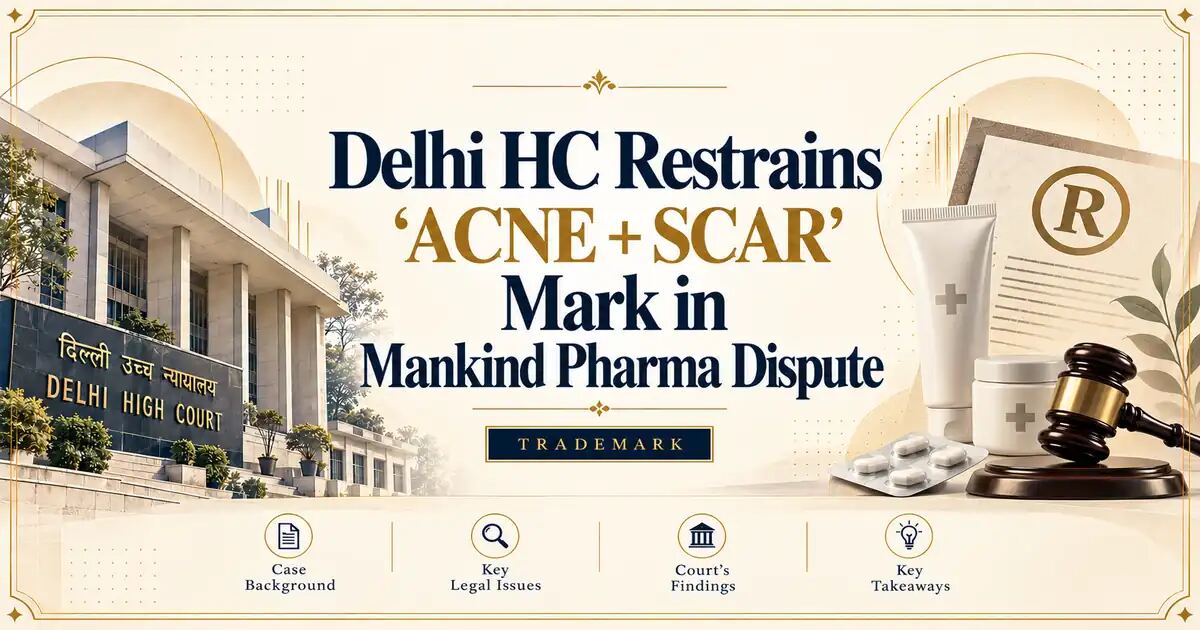
In MANKIND CONSUMER PRODUCTS PRIVATE LIMITED Vs ALAINA HEALTHCARE PRIVATE LIMITED & ANR. [CS(COMM)-280/2026 2026:DHC:9367], the Delhi High Court held that the adoption of a phonetically and structurally deceptively similar mark for dermatological products constitutes actionable trademark infringement under Section 29(2)(b) of the Trade Marks Act, 1999, which cannot be cured by superimposing a corporate house mark or alleging sub-branding. Presided over by Justice Purushaindra Kumar Kaurav, the Court evaluated the interplay between statutory rights under Section 28, descriptive exceptions under Sections 30(2)(a) and 35, and the threshold bar of material suppression in interlocutory injunction applications under Order XXXIX Rules 1 and 2 of the Code of Civil Procedure, 1908 (CPC).
| Disputed Subject Matter | Registered Word Mark ACNESTAR (Class 5) vs. Impugned Marks HEXILAK ACNE + SCAR / ACNE SCAR / ACNESCAR (Class 5) |
|---|---|
| Plaintiff / Petitioner’s Case | Mankind Consumer Products Pvt. Ltd. asserted proprietary rights over ACNESTAR via continuous commercial use since 2005 and cumulative sales of ₹540 crores, claiming the defendants’ mark HEXILAK ACNE + SCAR adopted the core structural identity of its registered coined mark. |
| Defendant / Respondent’s Defense | A. Menarini India Pvt. Ltd. and Alaina Healthcare Pvt. Ltd. pleaded equitable disentitlement due to material suppression of prior 2022 market entry, descriptiveness under Sections 30(2)(a) and 35, publici juris status of ‘ACNE’, and prosecution history estoppel. |
| Governing Law & Authorities | Trade Marks Act, 1999 (Sections 28, 29(2)(b), 30(2)(a), 31(1), 34, 35); Order XXXIX CPC; Cadila Health Care; Brinton Pharmaceuticals; Raman Kwatra; Arunima Baruah; S. Syed Mohideen; Neon Laboratories. |
| Decisive Holding & Relief | Rejection of threshold suppression defenses; reaffirmation that registration creates a presumption of validity under Section 31(1), establishing that sub-branding with a house mark does not neutralize structural infringement of a coined pharmaceutical mark. |
Statutory registration under Class 5 confers exclusive rights under Section 28 and establishes a presumption of validity under Section 31(1). Adopting the essential structural and phonetic elements of a registered coined mark for allied or cognate dermatological goods creates actionable confusion under Section 29(2)(b), which cannot be shielded by appending a corporate house brand or claiming descriptive immunity under Section 30(2)(a).
Interlocutory Injunction Standards and Doctrinal Friction Between Section 28 Registration Rights and Section 30/35 Descriptive Defenses
Struggling to understand Trademark Law? Read our complete Trademark Law Guide.
The commercial clash originated within the dermatological and cosmeceutical markets, centered on Plaintiff Mankind Consumer Products Private Limited’s suit for interlocutory restraint under Order XXXIX Rules 1 and 2 CPC. The Plaintiff asserted exclusive statutory rights over the word mark ACNESTAR, registered under Class 5 (Registration No. 1352577) with effect from April 25, 2005. The mark was originally secured by Lifestar Pharma Private Limited, subsequently amalgamated into Mankind Pharma Limited, and assigned to the Plaintiff via a Deed of Assignment dated February 19, 2025 (effective September 3, 2024), for which Form TM-P was submitted on August 22, 2025. The Plaintiff demonstrated substantial commercial standing, generating cumulative sales exceeding ₹540 crores since inception for its clindamycin and nicotinamide anti-acne gel, soaps, and face washes.
The core dispute arose when Defendant No. 1 (Alaina Healthcare Private Limited, manufacturer) and Defendant No. 2 (A. Menarini India Private Limited, marketer) introduced a post-acne repair serum under the product name HEXILAK ACNE + SCAR. Defendant No. 2 maintained a Class 5 registration for HEXILAK (Registration No. 1270019 dated March 3, 2004), but featured ACNE + SCAR prominently on the front packaging. The Plaintiff contended that ACNE + SCAR constituted an infringing sub-brand designed to trade upon the goodwill of ACNESTAR. Senior Advocate Akhil Sibal appeared for the Plaintiff, while Senior Advocates Sandeep Sethi and Manish K. Jha represented Defendant No. 2. An initial ex-parte ad-interim order granted on March 20, 2026, was placed in abeyance by a Division Bench in FAO (OS) (COMM) 107/2026 on April 24, 2026, directing a fresh inter-partes adjudication on the interim injunction application.
In analyzing the interlocutory application, the Court evaluated the statutory interplay between Section 28(1), which confers exclusive rights upon registered proprietors, Section 31(1), which attaches a legal presumption of validity to registered marks, and the descriptive defense under Section 30(2)(a) and Section 35. The defendants asserted that ACNE + SCAR was merely descriptive of the product’s function: treating scars resulting from acne. However, in pharmaceutical and dermatological intellectual property litigation, courts apply a heightened standard of scrutiny under the landmark rule of Cadila Health Care Ltd. v. Cadila Pharmaceuticals Ltd. (2001) 5 SCC 73. Where a registered mark consists of a coined combination, statutory exclusivity under Section 28 overrides minor descriptive assertions, establishing a strong prima facie case for interlocutory protection under Order XXXIX Rules 1 and 2 CPC.
Evidentiary Forensics of Prior Sales, CA Certificates, and E-Commerce Record Scraping in Material Suppression Inquiries
Defendant No. 2 raised a preliminary objection regarding the maintainability of the application, contending that the Plaintiff was disentitled from equitable relief due to deliberate suppression of material facts. Defendant No. 2 pointed out that while paragraph 25 of the plaint pleaded initial knowledge on February 17, 2026, paragraph 11 stated that the defendants began marketing the product in May 2025. Furthermore, Defendant No. 2 produced Chartered Accountant certificates, e-commerce listings on Amazon and Flipkart, Instagram posts from 2023, judge.me consumer reviews, and a 2023 published clinical study showing open commercial sales since August 2022 totaling over ₹9.8 crores. Citing ANZ Grindlays Bank Plc v. MCD and Kent RO Systems Ltd. v. Gattubhai, Defendant No. 2 argued that misrepresentation of market entry dates invalidates equitable claims.
Justice Kaurav examined the evidentiary standard for material non-disclosure, applying the Supreme Court doctrine established in Arunima Baruah v. Union of India (2007) 6 SCC 120. The Court held that to attract the equitable bar, the non-disclosure must concern a fact material to the determination of the core legal controversy. Examining the record, the Court noted that the Plaintiff had itself annexed a Flipkart listing dated March 10, 2026, containing a user review dated May 2024. The voluntary filing of documents containing earlier dates negated any inference of bad faith or intent to deceive the Court.
Evaluating the Plaintiff’s candid disclosure of the underlying e-commerce documents, the Court recorded an explicit factual finding regarding the bona fide character of the pleadings:
At the same time, the plaintiff itself placed on record, along with the plaint, a Flipkart listing of the impugned product, captured on 10.03.2026, which carries a review of the product dated May 2024 (p. 258 of the plaintiff’s documents). There was no compulsion on the plaintiff to file the document, and its production shows that the plaintiff placed the material in its possession before the Court in a bona fide manner.
Hon’ble Mr. Justice Purushaindra Kumar Kaurav, Delhi High Court
Thereafter, Justice Kaurav articulated the controlling legal principle governing discretionary bars in interlocutory proceedings, contrasting minor pleading inaccuracies with threshold material suppressions:
At the same time, the principle enunciated in ANZ Grindlays Bank Plc (supra) is attracted where the misstatement or suppression relates to a fact which has a bearing on the exercise of the Court’s discretion. Not every inaccuracy in the pleadings would disentitle a party to relief. The fact suppressed must be one which is material for the determination of the lis.
Hon’ble Mr. Justice Purushaindra Kumar Kaurav, Delhi High Court
Consequently, because the ex-parte order had been kept in abeyance and the matter was fully argued inter-partes on complete filings, the minor date discrepancies did not bar the Court from adjudicating the substantive statutory infringement claim on its merits.
Reconciling Prosecution History Estoppel with Third-Party Opposition Standards Under Raman Kwatra and Brinton
Defendant No. 2 asserted an estoppel defense based on prosecution history. In a December 2017 counter statement filed during Class 3 Registry opposition proceedings against a third-party mark (ACNESTAL by Biomedica Life Science), the Plaintiff’s predecessor stated that ‘ACNE’ is publici juris in dermatological trade and denotes a disease over which no trader can claim exclusive monopoly. Citing S.K. Sachdeva v. Shri Educare Ltd., Defendant No. 2 argued that the Plaintiff was bound by its prior admissions before the Trade Marks Registry and could not assert exclusivity over an expression incorporating ‘ACNE’.
Justice Kaurav rejected this contention by applying the binding Division Bench precedent in Raman Kwatra v. KEI Industries Ltd., as reaffirmed in Mankind Pharma Ltd. v. Brinton Pharmaceuticals Ltd. (FAO (COMM) 166/2024). The Court clarified that prosecution history estoppel in trademark law does not create a universal bar against enforcing a registered mark against unrelated third parties. Admissions made during opposition proceedings against distinct third-party marks cannot be extracted out of context to excuse direct structural infringement by a new market entrant.
Under the common law principles recognized in S. Syed Mohideen v. P. Sulochana Bai (2016) 2 SCC 683 and Neon Laboratories Ltd. v. Medical Technologies Ltd. (2016) 2 SCC 672, statutory registration reinforces underlying proprietary rights against deceptive look-alikes. Prosecution history estoppel is strictly confined to statements made between the specific contesting parties regarding the specific cited marks. Because the 2017 counter statement involved an unrelated Class 3 dispute with Biomedica Life Science, and because the Plaintiff disclosed the opposition filings in its plaint, the prior statements did not operate as a judicial estoppel against enforcing Class 5 statutory rights against Defendant No. 2.
Anti-Dissection Rule, House Mark Sub-Branding, and Overlapping Channels in Cosmeceutical Infringement Jurisprudence
On the substantive merits of infringement under Section 29(2)(b), Defendant No. 2 argued that ‘ACNE + SCAR’ was merely a descriptive phrase detailing the product’s intended purpose, protecting its usage under Sections 30(2)(a) and 35. Furthermore, Defendant No. 2 argued that combining the house mark HEXILAK with the corporate name MENARINI eliminated all risk of commercial confusion, particularly since the Plaintiff’s product is a Schedule H prescription gel (clindamycin/nicotinamide) for active acne, whereas the Defendant’s product is an over-the-counter cosmetic scar serum.
The Court rejected these defenses, enforcing the anti-dissection rule and established principles governing pharmaceutical trademark comparisons from Kaviraj Pandit Durga Dutt Sharma v. Navaratna Pharmaceutical Laboratories AIR 1965 SC 980 and Brinton Pharmaceuticals. The rival marks share an identical structural skeleton ‘ACNE-S-_-A-R’, differing by only a single letter (‘T’ in ACNESTAR versus ‘C’ in ACNESCAR/ACNE SCAR). Applying the rule from V-Guard Industries Ltd. v. Crompton Greaves Consumer Electricals Ltd. and United Biotech (P) Ltd. v. Orchid Chemicals & Pharmaceuticals Ltd., the Court affirmed that affixing a corporate house mark (HEXILAK/MENARINI) beside a deceptively similar product mark does not sanitize the infringement, as it functions merely as illegal sub-branding.
Addressing the distinction between prescription pharmaceutical drugs and over-the-counter cosmetic serums, the Court applied the allied and cognate goods doctrine formulated in Himalaya Wellness Co. v. Wipro Enterprises (P) Ltd. Both products target skin conditions associated with acne, are displayed across identical retail counters, and compete across identical e-commerce platforms like Amazon, Flipkart, and 1mg. Consumers of average intelligence and imperfect recollection do not engage in subtle clinical dissections when purchasing dermatological products within overlapping trade channels.
Also Read: Karnataka HC Sets Aside Injunction: ‘Section 34’ Protects Prior Users
Corporate Due Diligence Rules, Section 57 Rectification Strategies, and In-House IP Portfolio Risk Management
This ruling delivers strategic directives for corporate counsel, litigation practitioners, and brand protection directors operating in high-value consumer health and dermatological sectors.
Litigation Playbook for Plaintiff Advocates
- Pre-Filing Forensic Scrapes: Litigators must perform rigorous marketplace audits, including scraped e-commerce metadata, archived web pages, and social media registries, before seeking ex-parte interlocutory relief under Order XXXIX Rules 1 and 2 CPC.
- Neutralizing Suppression Pleas: Voluntary disclosure of historical user reviews or third-party web listings in the plaint eliminates preliminary pleas of material suppression under Arunima Baruah principles.
- Enforcing Coined Mark Protection: Counsel asserting rights over coined marks should rely on Brinton Pharmaceuticals to establish that changing a single letter within an established structural framework (‘ACNESTAR’ vs ‘ACNESCAR’) constitutes structural infringement regardless of packaging get-up.
Defensive Playbook for Incumbent Brands
- Pleading Prosecution History Scope: Under Raman Kwatra, defense counsel cannot rely on third-party registry statements made by the plaintiff unless those specific statements directly involved the defendant’s cited mark.
- Section 57 Rectification Strategy: Defendants confronting infringement suits based on sub-branded expressions must file cancellation petitions under Section 57 before the Intellectual Property Division (IPD) to directly challenge the descriptive or publici juris nature of the plaintiff’s mark.
- Verifiable Audit Records: To contest the balance of convenience test, defendants must present GST e-way bills with Invoice Reference Numbers (IRNs) and audited financial accounts establishing substantial, uninterrupted commercial presence.
Corporate Risk Mitigation and Portfolio Governance
- Beyond Registry Searches: Corporate legal departments must look beyond standard Trade Marks Registry search reports before launching sub-brands. Product naming clearance protocols must include off-register marketplace scraping, state manufacturing licence filings, and e-commerce listings.
- Sub-Branding Vulnerabilities: Combining an established corporate house mark with a descriptive product identifier that structurally mirrors a competitor’s registered mark does not confer immunity under Section 30(2)(a).
- Coexistence Agreements: Where a proposed brand line approaches the visual or phonetic perimeter of an established Class 5 registration, corporate counsel should secure formal coexistence agreements or adopt structural modifications prior to commercial deployment.
Case Details: MANKIND CONSUMER PRODUCTS PRIVATE LIMITED Vs ALAINA HEALTHCARE PRIVATE LIMITED & ANR. | Neutral Citation: 2026:DHC:9367 | Case Number: CS(COMM)-280/2026 2026:DHC:9367 | Court: Delhi High Court | Date: 16-10-2026 (pdf) 16-10-2026 (txt)
Presiding Bench: HON’BLE MR. JUSTICE PURUSHAINDRA KUMAR KAURAV
Appearances: for the plaintiff that the