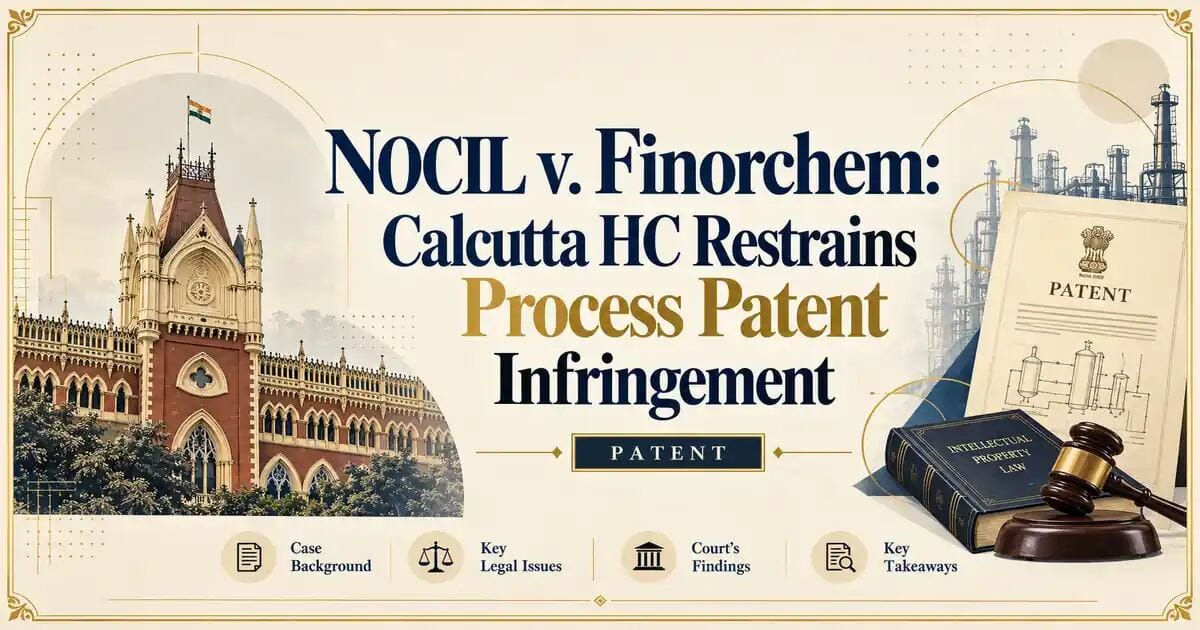
In NOCIL LTD vs. FINORCHEM LTD AND ANR [IP-COM/25/2024], the Calcutta High Court granted an interim injunction against the respondents, effectively interdicting the unauthorized manufacture of the chemical intermediate 4-ADPA and reinforcing the standards for protecting trade secrets and process patents.
| Case Issue | Process Patent Infringement and Breach of Confidentiality |
|---|---|
| Key Judicial Test | Section 104A Burden of Proof and the Pith and Marrow Doctrine |
| Primary Allegation | Surreptitious hiring of key technical personnel and copying of manufacturing processes |
| Court Order | Interim injunction restraining commercial production and use of proprietary data |
| Legal Precedents Applied | S. Syed Mohideen, Neon Laboratories, Bishwanath Prasad Radhey Shyam |
Jurisprudential Foundations and the Burden of Proof under Section 104A
Want to learn the fundamentals of Patent Law? Read our complete Patent Law Guide.
The dispute centres on the high threshold for challenging patent validity at the interlocutory stage. While the respondent argued that mere registration does not immunize a patent from scrutiny, the Court correctly distinguished between a fanciful challenge and a credible one. Under Section 104A of the Patents Act, 1970, the legislative intent is to place a heavy burden on the defendant when a patented process yields an identical product. The judicial reasoning confirms that once a prima facie case of product identity is established, the onus shifts to the defendant to demonstrate that their process differs from the patented methodology.
The Court’s approach aligns with the principle in Bishwanath Prasad Radhey Shyam, wherein the challenge to a patent must be substantial and not merely a “shot in the dark.” The Court held that even in the absence of a presumption of validity under the Patents Act, the established commercial working of the patent for over a decade serves as a critical factor in tilting the balance of convenience. This is a vital correction to the trend of defendants attempting to stall injunctions via meritless revocation counterclaims, a tactic frequently observed in the Indian patent ecosystem.
Forensic Analysis of Technical Documentation and EIRA Reports
A significant component of the litigation involved the comparative analysis of the Environmental Impact and Risk Assessment (EIRA) reports. In technical patent disputes, these public-facing documents often serve as the “smoking gun” that reveals the true nature of a manufacturing process. The Court observed that the uncanny similarity between the petitioner and respondent reports could not be dismissed as a coincidence arising from the use of a common agency.
Regarding the evidentiary assessment of the respondents’ conduct during the proceedings, the Court noted the following:
The respondent no. 1 has knowingly procured breach of the NDA between the petitioner and the respondent no. 2. In such circumstances, there has been breach of confidentiality and misappropriation of trade secrets by the respondent no. 2 in connivance with the respondent no. 1.
Hon’ble Mr. Justice Ravi Krishan Kapur, Calcutta High Court
The Court’s focus on the respondents’ failure to provide a personal affidavit from the key technical employee is noteworthy. Relying on an administrative employee to explain away the complexities of a technical process transfer is insufficient to discharge the burden of proof. This lack of transparency, coupled with the shifting narratives regarding the manufacturing catalyst and process flow, stripped the defendants of their ability to claim that their process was developed independently.
Doctrinal Clarification on Pith and Marrow Infringement
The Court delved into the “pith and marrow” doctrine, which dictates that courts should not get lost in the minute details of a patent specification if the essential inventive features have been misappropriated. In Nocil Ltd, the attempt by the respondent to label a second hydrogenation step as “optional” in an amended application was rightly interpreted as an attempt to create a colorable variation to evade infringement claims.
On the principles of patent protection and the necessity of preventing the piracy of innovation, the Court remarked:
The danger to innovation is all too obvious. The law protects something which would not have existed but for the inventor. Otherwise, it would be more profitable to be a copyist rather than an inventor and that is what the Act seeks to prohibit.
Hon’ble Mr. Justice Ravi Krishan Kapur, Calcutta High Court
This ratio decidendi reinforces the position that the judiciary will not permit the “disguising” of a patented process through minor, non-essential modifications. By identifying the core inventive steps, such as the use of continuous flow reactors and specific catalyst recovery systems, the Court confirmed that the respondent was employing the plaintiff’s proprietary technology under the guise of technical improvement.
Where the subject matter of the patent is a process for obtaining a product, the court may direct the defendant to prove that the process used by him to obtain the product is different from the patented process, provided the product obtained by the defendant is identical.
The Failure to Clear the Way: A Strategic Blunder
The “clear the way” doctrine, often cited in international patent practice and now firmly embedded in Indian jurisprudence, dictates that a party should proactively resolve potential infringements before commercializing a process. The respondent’s failure to utilize Section 25, Section 64, or Section 105 remedies prior to their plant setup signifies a lack of commercial due diligence. In-house counsel must understand that wait-and-see approaches are viewed with extreme skepticism by the judiciary. The failure to challenge a patent until the moment of potential infringement acts as a major indicator of a lack of bona fide intent.
Corporate Governance and Trade Secret Protection
The recruitment of Respondent No. 2 from the petitioner’s senior ranks provides a quintessential case study in trade secret litigation. The court recognized that a Non-Disclosure Agreement (NDA) is a binding obligation that attaches to the employee regardless of their change in employer. The petitioner’s ability to prove the respondent’s prior role as DGM of Process Technology, coupled with the restrictive covenants in the NDA, rendered the respondent’s defense of “no access” entirely untenable.
For corporate entities, this case mandates a review of how they integrate high-level technical hires from competitors. The lack of a “Chinese Wall” or any documented effort to insulate the employee from their prior knowledge is a liability that invites litigation. When a competitor hires a former employee with access to “unique steps and methods,” the subsequent similarity in manufacturing processes creates a rebuttable presumption of misuse that is nearly impossible for a defendant to overcome without rigorous evidence.
Also Read: Patents vs Trade Secrets in India: Strategic Choices, Reverse Engineering, and the Draft Bill 2024
Implications for Future Litigation
This judgement is a clear signal that the Indian judiciary is moving toward a more sophisticated and technical assessment of IP disputes. The Court’s willingness to look past the “illusion” of modified patent applications indicates that counsel must be prepared for rigorous, forensic-level scrutiny of their client’s processes.
For the IP practitioner, the following steps are essential to manage future risk:
1. Aggressive Monitoring: IP departments must treat public regulatory documents (EIRA reports, pollution control audits) as patent-related disclosures.
2. Documenting the Pith: Develop “essential feature” charts early in the litigation cycle, separating these from “trivial” variables that defendants use to cloud the court’s understanding.
3. Internal Due Diligence: During the hiring of senior technical staff from competitors, conduct internal audits to ensure that the employee’s integration does not lead to the contamination of existing trade secrets.
4. Pre-emptive Clearance: Counsel should encourage the filing of declaratory suits or oppositions at the earliest signs of market encroachment, rather than waiting for the infringement suit to commence.
The Nocil Ltd decision serves as a significant precedent for protecting high-value industrial processes. By prioritizing the protection of the inventor’s labour over the technical maneuvering of the competitor, the Calcutta High Court has ensured that the “pith and marrow” of a patent remains the focus of infringement analysis. Practitioners should view this as a landmark case on the intersection of contract law (NDA enforcement) and statutory patent protection, setting a firm tone for future IP litigation in India.
The case underscores the reality that while patent law is complex, the underlying ethics of fair competition remain a constant touchstone for judicial intervention. The refusal to entertain the respondent’s attempt to “rewrite” their own patent application is a warning to those who believe that administrative law processes can be manipulated to mask infringement. The Court’s reliance on expert evidence, the history of the working of the patents, and the clandestine conduct of the respondents creates a cohesive framework for granting interim relief in high-stakes manufacturing disputes. This judgement will undoubtedly become a foundational reference for courts in India addressing the balance between fair competition and the absolute necessity of protecting registered intellectual property rights.
Case Details: NOCIL LTD vs. FINORCHEM LTD AND ANR | Case Number: IP-COM/25/2024 | Court: Calcutta High Court | Date: 07-10-2026
Presiding Bench: Hon’ble Mr. Justice Ravi Krishan Kapur