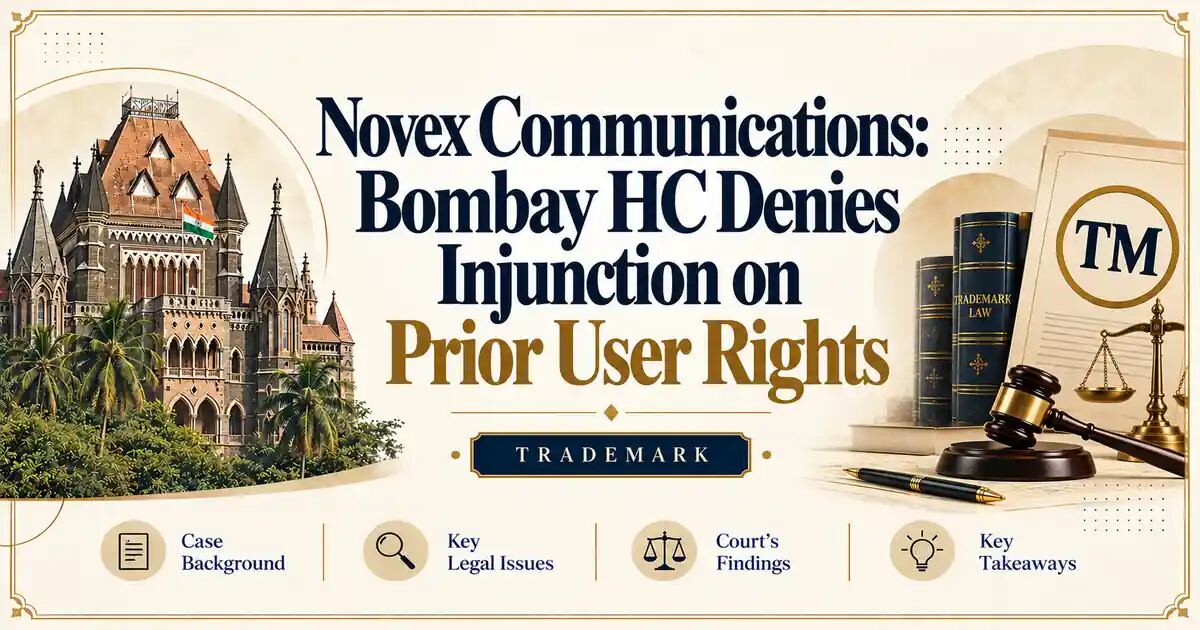
In NOVEX COMMUNICATIONS PRIVATE LIMITED Vs GUJRAT UNIVERSITY CONVENTION AND EXHIBITION CENTRE AND ORS [IAL/34854/2026], the Bombay High Court refused to grant an ad-interim injunction to the plaintiff, Novex Communications, effectively reinforcing the limitation of statutory trademark rights when confronted with established prior common law usage. The court, presided over by Justice K.R. Shriram, held that the plaintiff’s registration under the Trade Marks Act does not confer an absolute, indefeasible monopoly that can summarily extinguish the rights of a prior user, particularly when that user substantiates their market presence through robust, verifiable evidentiary trails.
| Disputed Subject Matter | Copyright, Performance Licensing, and Trademark Priority |
|---|---|
| Plaintiff / Petitioner’s Case | Assertion of exclusive rights via registration and copyright ownership over performance sound recordings. |
| Defendant / Respondent’s Defense | Invocation of Section 34 of the Trade Marks Act, 1999, regarding continuous prior commercial use. |
| Governing Law & Authorities | Trade Marks Act 1999 (Sections 28, 34); Copyright Act 1957; S. Syed Mohideen vs. P. Sulochana Bai; Neon Laboratories Ltd vs. Medical Technologies Ltd. |
| Decisive Holding & Relief | Injunction denied; balance of convenience necessitates preservation of status quo via accounting mandates. |
The Doctrinal Tension: Section 28 Monopoly versus Section 34 Equitable Safeguard
Looking to master Indian Trademark Law jurisprudence? Read our full Trademark Law Guide.
The legal controversy in this matter centers on the classic doctrinal collision between the bundle of rights granted under Section 28 of the Trade Marks Act, 1999, and the defensive immunity codified in Section 34. While Section 28 ostensibly provides a registered proprietor with the exclusive right to use a trademark, this right is not a vacuum-sealed privilege. It is explicitly subordinated to the rights of prior users. Our firm has long advocated that the Indian trademark regime is predicated on the foundational principle that registration is recognition of rights already accrued through commerce, rather than the primary source of those rights.
This hierarchy was unequivocally settled by the Supreme Court in S. Syed Mohideen vs. P. Sulochana Bai, where the court observed that the common law rights of a prior user are paramount. Similarly, in Neon Laboratories Ltd vs. Medical Technologies Ltd, the judicial consensus remained that statutory registration does not provide an override switch to terminate the businesses of prior users. In the present case, the plaintiff attempted to leverage its registration as an instrument to exclude the defendant, a maneuver that the Bombay High Court rightly tempered. By refusing the ad-interim injunction, the court has signaled that the statutory registry cannot be weaponized to silence market actors who possess a verified, historically continuous, and distinct commercial footprint that predates the plaintiff’s filing.
Nothing in this Act shall entitle the registered proprietor of a trademark to interfere with or restrain the use by any person of a trademark identical with or nearly resembling it in relation to goods or services in relation to which that person or a predecessor in title of that person has continuously used that trademark from a date prior to the use of the first-mentioned trademark.
Evidentiary Forensics: Elevating Standards for Proof of Prior Use
The success of the defendant in this matter serves as a masterclass in evidentiary hygiene. In contemporary IP litigation, the judiciary is increasingly skeptical of self-serving affidavits and internally generated accounting logs. The respondent effectively neutralized the plaintiff’s claim by presenting immutable, third-party verified records. The court’s willingness to grant relief to the defendant hinged entirely on their ability to move beyond subjective assertion and into the realm of forensic documentation.
The respondent’s reliance on Goods and Services Tax (GST) invoices, complete with cryptographically secure Invoice Reference Numbers (IRNs) and electronic e-way bills, provided the court with a high-fidelity audit trail. In the eyes of the court, these documents are not merely transactional records; they are objective markers of temporal and commercial reality. The standard for proving “continuous use” requires that a defendant demonstrate that their commercial activity has not been sporadic, abandoned, or merely tokenistic. The court’s rejection of the plaintiff’s injunction suggests a judicial preference for this granular, externally validated data over the administrative convenience of a registration certificate.
The documents on record, specifically the GST invoices and third-party verified transaction ledgers, demonstrate a sustained commercial activity that precedes the plaintiff’s claim of first use, thereby satisfying the threshold required to invoke the protection afforded under Section 34, and consequently, the plaintiff’s assertion of exclusive rights must yield to the respondent’s evidence of prior commercial presence in the relevant market segment.
Hon’ble Mr. Justice K.R. Shriram, Bombay High Court
The Triple Test and the Pragmatism of Accounting Mandates
In analyzing the request for an interim injunction, the Court correctly applied the tripartite test under Order XXXIX of the Code of Civil Procedure: the existence of a prima facie case, the balance of convenience, and the potential for irreparable harm. The plaintiff’s argument focused narrowly on the prima facie case, derived from its registration. However, the Court looked to the “balance of convenience,” recognizing that an ex-parte or ad-interim injunction would force the defendant to shutter operations immediately, causing catastrophic, irreversible financial ruin that could not be adequately redressed by damages in the event the defendant eventually prevailed at trial.
Rather than adopting an “all-or-nothing” posture, the Court employed the sophisticated mechanism of a mandatory accounting regime. By requiring the defendant to maintain transparent, audited quarterly accounts, the Court effectively preserved the plaintiff’s potential for future recovery while ensuring that the market remained competitive and operational. This is a vital procedural evolution in Bombay High Court practice, where the judiciary treats interlocutory orders as risk-management tools rather than final determinations of merit.
While the plaintiff asserts statutory ownership, the interlocutory stage requires an assessment of the balance of convenience, and to grant an injunction would cause irreparable disruption to an established business entity; therefore, justice is best served by permitting the defendant to continue operations subject to strict, periodic accounting, ensuring that the plaintiff’s potential future claim for damages remains fully secured and quantifiable.
Hon’ble Mr. Justice K.R. Shriram, Bombay High Court
Strategic Implications for Corporate Due Diligence and In-House Counsel
For in-house counsel, the takeaway is clear: the Trademark Registry is not a source of truth for the competitive landscape. A clean “clearance search” on the IP India website is a dangerously incomplete baseline. It ignores the vast, silent population of prior users who trade locally or through digital channels without having registered their marks. In-house due diligence, particularly during mergers, acquisitions, or product launches, must be expanded to include social media sentiment analysis, domain name history logs, and, crucially, a review of trade licenses and MCA corporate records to ascertain the duration of a competitor’s business existence.
Furthermore, this case provides a roadmap for the “Section 57 Strategy.” Where a registered proprietor moves to block a prior user, the latter should not hesitate to file a simultaneous application for cancellation or rectification under Section 57 of the Trade Marks Act. Attacking the validity of the plaintiff’s registration by demonstrating that the registrant was not the true “first-to-use” is often the most effective offensive-defensive posture. Counsel must treat the registry not as a fortress, but as a dynamic, contested space where the strength of the mark is determined by its commercial, not its bureaucratic, history.
Also Read: Bombay HC Restrains ‘Pune Mirror’ Dispute: Rules on Section 124 Delay
Key Precedents & Statutory Guidance
- Search recent High Court judgments in our Latest Indian IP Law Cases Directory.
- Examine core statutory doctrines in our Indian Trademark Law Guide.
- Procedural Breakdown: Customs IP Recordal in India & ICER Portal Procedures.
- Review nationwide litigation trends in our Monthly IP Law Roundup.
Commercial Risk Management: The Road Forward
As we transition into the trial phase of this dispute, the plaintiff faces an uphill battle to invalidate the defendant’s proof of continuous use. The primary strategy for the plaintiff will be to exploit gaps in the defendant’s supply chain or seek to classify the defendant’s prior sales as “de minimis” or intermittent. Conversely, the defendant must ensure that their accounting records remain beyond reproach, as any failure to comply with the court’s periodic reporting mandate would be catastrophic to their defense. The defendant must also be prepared for discovery requests aimed at breaking the chain of their commercial operations.
Ultimately, this case serves as an essential reminder for the Indian IP bar: technical registration is no substitute for authentic commercial performance. The judiciary is evolving toward a high-transparency model where technological and financial evidence, such as GST-compliant invoicing, acts as the final arbiter of rights. Our firm continues to advise that our clients should not rely on registration alone; they must ensure that their commercial operations are supported by a rigorous, contemporaneous trail of evidence. This practice of “defensive record-keeping” is now the primary mechanism by which a business can survive the modern onslaught of trademark litigation.
The Bombay High Court has once again confirmed its commitment to protecting genuine market participants. By prioritizing the factual history of trade over the legal fiction of paper registration, the bench ensures that the Indian intellectual property system remains an engine for genuine commerce rather than a playground for strategic, registry-based litigation. For the corporate sector, the mandate is clear: invest in the auditability of your commercial history, for that is the shield that will protect you when the inevitable day of legal reckoning arrives in the High Court.
Case Details: NOVEX COMMUNICATIONS PRIVATE LIMITED Vs GUJRAT UNIVERSITY CONVENTION AND EXHIBITION CENTRE AND ORS | Case Number: IAL/34854/2026 | Court: Bombay High Court | Date: 15/10/2026