Case Snapshot: Phantom Studios vs. Jiostar India
For foundational statutory analysis, consult our in-depth Trademark Law Guide.
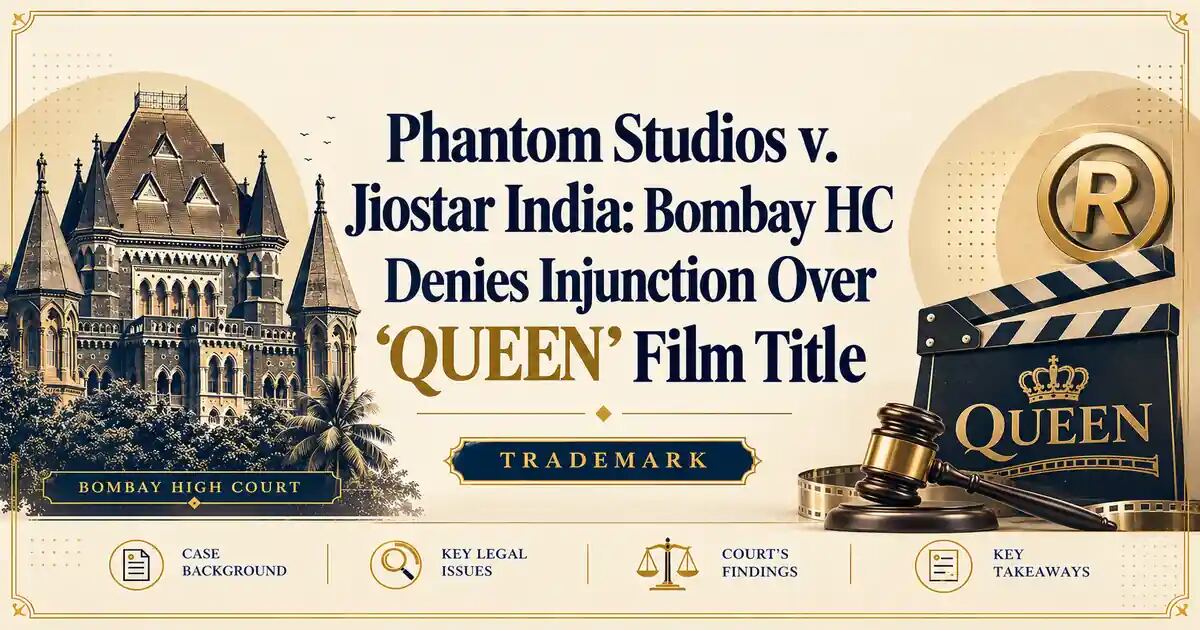
The Bombay High Court has delivered a stern reminder on the limits of film title protection in PHANTOM STUDIOS INDIA PRIVATE LIMITED Vs JIOSTAR INDIA PRIVATE LIMITED (COMS/97/2026). Decided on October 14, 2026, this litigation involved a battle over the cinematic title ‘QUEEN’. Phantom Studios sought an ad-interim injunction to restrain Jiostar India from producing or releasing a film titled ‘QUEEN FULL POWER’. The Plaintiff argued that their prior rights in the 2013 film ‘QUEEN’ entitled them to exclusivity over the mark as a source identifier. The Court categorically rejected this position.
Procedurally, the matter reached the court via an Interim Application seeking to block production and release of the defendant’s film. The Bench assessed whether a film title, absent secondary meaning, functions as an enforceable trademark. By dismissing the application, the Court has signaled that owners of individual literary or cinematic works face a high evidentiary burden when claiming title exclusivity. Producers seeking to leverage franchise equity through similar naming conventions must now carefully navigate the strict judicial requirement for secondary meaning.
Parties’ Submissions: The Clash of Title Equity
Phantom Studios, represented by Mr. Khambata, anchored their case in the theory of franchise continuity and trademark exclusivity. They contended that the title ‘QUEEN’ had acquired a secondary meaning that acts as a source identifier. Consequently, any use of the word by another party in a cinematographic context would lead to confusion in the market. The Plaintiff emphasized that the intellectual property rights in the original film, including prequel and sequel rights, were violated by the defendants’ unauthorized adoption of the title.
Conversely, the defendants, represented by Mr. Kadam, dismantled the claim by focusing on the absence of inherent distinctiveness. They argued that ‘QUEEN’ is a common term, and the Plaintiff failed to demonstrate any factual goodwill or secondary meaning that would grant them a monopoly over it. Mr. Kadam underscored that the proposed film ‘QUEEN FULL POWER’ was not a sequel, but an independent creative work featuring individuals who previously collaborated with the Plaintiff. The defense successfully argued that this dispute was a misguided effort to monopolize a word rather than a legitimate intellectual property enforcement action.
Court’s Analysis: Dissecting Title Protection
The Court’s reasoning centered on the fundamental principles of trademark law as applied to literary and dramatic titles. Justice Narula underscored that titles of single works do not automatically command the same protection as corporate logos or brand names. The judgment establishes that for a film title to be shielded from use by others, it must have attained a secondary meaning that is clearly identifiable by the public. Without such proof, the mere usage of a common word in a title does not create a trademark monopoly.
Further, the Court addressed the intersection of copyright and trademark law. While the Plaintiff held rights to their original film, they failed to establish how the defendant’s title amounted to a copyright infringement of their specific expression or arrangement. The Bench noted the distinction between protecting an original work and attempting to stifle subsequent works that merely share a title. By emphasizing that the suit was essentially a commercial dispute lacking a robust IP foundation, the judge refused to grant the requested ad-interim injunction.
The Court also scrutinized the ‘balance of convenience’ in favor of the defendants. The judgment clarifies that the potential success of the original film does not automatically entitle the owner to prevent others from using similar, generic titles in future projects. The Plaintiff’s failure to establish a prima facie case led the court to conclude that the defendants should not be restrained from pursuing their creative activities. This finding is critical, as it limits the scope of what can be considered a ‘source identifier’ in the Indian film industry.
Outcome: The Denied Injunction
The Bombay High Court denied the Plaintiff’s application for an ad-interim injunction. The Court held that Phantom Studios failed to meet the threshold required to restrain the defendants from producing or releasing their film. This ruling explicitly rejects the notion that a single word title, even from a successful film, provides the producer with an indefinite, exclusive right to use that word for all future cinematographic endeavors.
Ultimately, the suit remains a ‘Commercial Suit’ rather than a high-stakes ‘Commercial IP Suit’ because the underlying claim lacked the necessary evidence of trademark infringement. The decision confirms that courts will not intervene to protect film titles where the plaintiff cannot prove genuine confusion or secondary meaning. Rights holders must now accept that generic or common words used in titles remain open for use unless a significant level of consumer association is proven in court.
Also Read: Bombay HC Restrains ‘Pune Mirror’ Dispute: Rules on Section 124 Delay
Key Precedents & Statutory Guidance
- Search recent High Court judgments in our Latest Indian IP Law Cases Directory.
- Examine core statutory doctrines in our Indian Trademark Law Guide.
- Procedural Breakdown: Customs IP Recordal in India & ICER Portal Procedures.
- Review nationwide litigation trends in our Monthly IP Law Roundup.
Implications for IP Practice
Practitioners must recognize that this ruling tightens the requirements for seeking interim protection in title-based disputes. Moving forward, counsel should focus on documenting market surveys or evidence of consumer confusion during the pre-litigation phase. If you are advising a client on film title acquisition or enforcement, rely less on the fame of the original film and more on concrete data showing that the public perceives the title specifically as a brand of the plaintiff’s production house.
- Documentary Evidence: When asserting title protection, avoid broad claims of “franchise value.” Focus on direct evidence of secondary meaning, such as licensing agreements, specific consumer-facing marketing campaigns, or third-party analysis that links the title to the producer’s specific identity.
- Franchise Strategy: For production companies, ensure that contracts clearly distinguish between title usage for sequels and the use of the title in entirely new, independent productions. Joint ownership agreements, as seen in the Phantom Films and Viacom-18 partnership, must be precise to avoid internal disputes regarding future sequels or remakes.
- Judicial Skepticism: Be prepared for courts to view title-based injunctions with heightened scrutiny. The Bombay High Court has signaled a clear preference for protecting competitive creativity over absolute monopolies in descriptive or common-word titles.
- Litigation Framing: A poorly drafted petition that conflates copyright infringement with trademark passing-off will likely fail. Focus your submissions on the distinct legal tests for each, and ensure that your client’s, or the respondent’s, actions are measured against the correct statutory framework, whether it be the Trade Marks Act or the Copyright Act.
This decision serves as a significant check on the aggressive enforcement of title-based rights in India. For defendant-side counsel, the path forward is clear: emphasize the lack of inherent distinctiveness in common words and force the plaintiff to prove actual market confusion. For plaintiff-side counsel, the message is equally stark: prepare a evidentiary record that goes beyond mere title usage to establish a genuine, identifiable brand presence in the public consciousness.
Case Details: PHANTOM STUDIOS INDIA PRIVATE LIMITED Vs JIOSTAR INDIA PRIVATE LIMITED | Case Number: COMS/97/2026 | Court: Bombay High Court | Date: 14/10/2026