
Dispute Before the Court
Looking to understand Trademark Law better? Read our complete Trademark Law Guide.
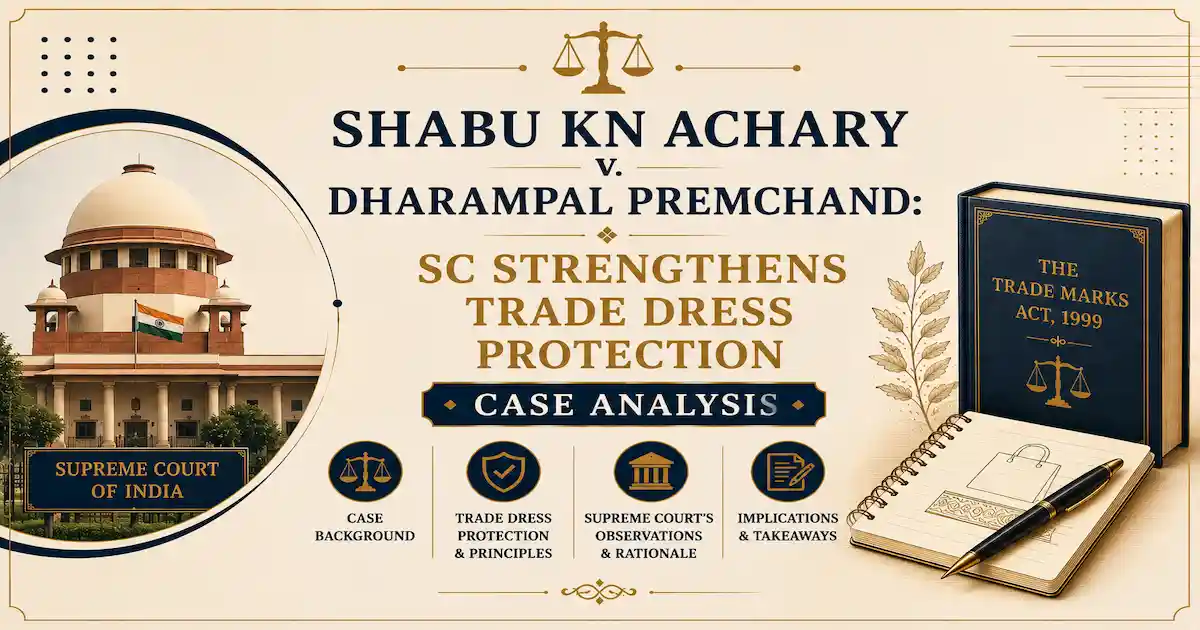
The matter of Shabu Kn Achary vs. Dharampal Premchand Limited (C.A. No. 10260/2026), adjudicated by the Supreme Court of India on August 7, 2026, concerns a classic intellectual property conflict involving allegations of trademark infringement and trade dress imitation. The dispute centers on the protection of established brand identifiers against alleged unauthorized adoption by a competitor. At the heart of the litigation is the plaintiff’s assertion that the defendant has engaged in activities that dilute the distinctiveness of its brand and capitalize on its established market reputation.
The court examined the scope of protection afforded to registered intellectual property under the Trade Marks Act, 1999. The controversy specifically involves the interpretation of Section 2(1)(zg), which provides the statutory definition of a “well-known trademark” in relation to any goods or services, and Section 11(6), which sets out the factors the Registrar must consider when determining whether a trademark is well-known. These provisions serve as the essential legal framework for evaluating whether the plaintiff’s brand holds the requisite recognition to command broader protection against infringement, even in cases where the competing goods may not be identical or where the consumer base might be misled by deceptive similarity in packaging or trade dress.
Relief Sought
The plaintiff, Dharampal Premchand Limited, initiated legal proceedings to secure immediate and permanent protection for its brand identity. The relief sought was primarily injunctive in nature, aiming to restrain the defendant from continuing the use of the impugned trademark and the associated trade dress. The plaintiff argued that the defendant’s packaging and commercial appearance mirrored its own, creating a likelihood of confusion among consumers and facilitating the unauthorized appropriation of goodwill.
Beyond the prayer for an injunction, the plaintiff sought monetary relief in the form of damages. This claim for damages is predicated on the financial losses purportedly suffered due to the defendant’s alleged infringement of both registered copyright and trademark. The litigation highlights the dual-pronged approach frequently utilized by rights holders in India, where claims for trademark infringement are supported by arguments regarding the deceptive similarity of trade dress, as prohibited under the broader principles of passing off and the specific provisions of the Trade Marks Act, 1999.
Parties’ Contentions
The plaintiff contended that its brand name and unique trade dress serve as primary identifiers of source and quality for its products. It argued that the defendant’s product packaging is identical to its own, thereby infringing upon its registered intellectual property rights. The plaintiff emphasized that the similarity is not merely incidental but appears calculated to cause confusion among the relevant public. The legal foundation for this argument rests on the infringement of the plaintiff’s registered copyright and trademark, asserting that the defendant’s actions constitute a direct violation of its proprietary interests.
Conversely, the defendant’s position, as reflected in the court’s summary, involved contesting the plaintiff’s claims regarding the exclusivity and strength of the brand name in question. The specific contention raised by the defendant focused on the threshold of evidence required to establish infringement and the quantum of damages claimed. The defendant challenged the premise that its branding and trade dress crossed the line into actionable infringement, suggesting that the similarities cited by the plaintiff do not meet the legal standard required to justify the stringent relief of an injunction or the imposition of damages.
Court’s Approach
The Supreme Court adopted a rigorous analytical approach, focusing on the intersection of statutory definitions and factual evidence. In reviewing the trial and lower appellate court proceedings, the apex court scrutinized the application of Section 2(1)(zg) and Section 11(6) of the Trade Marks Act, 1999. By examining these provisions, the court assessed the extent to which the plaintiff’s brand satisfies the criteria for a well-known trademark, a classification that provides a significant layer of protection in IP disputes.
The court paid particular attention to the visual and conceptual similarities between the two products. The judicial inquiry was directed toward whether the defendant’s trade dress, defined as the total image and overall appearance of a product, created a deceptive similarity that would likely lead a consumer of average intelligence and imperfect recollection to mistake the defendant’s goods for those of the plaintiff. This assessment was grounded in the evidence provided, which included comparisons of the packaging and the specific brand names in question. The court’s methodology underscores the importance of the “likelihood of confusion” test, which is a standard benchmark in Indian trademark jurisprudence for determining if an infringement has occurred.
Order
The Supreme Court’s order focuses on the legal consequences of the findings regarding the brand name and trade dress. The court concluded that the infringement of the plaintiff’s registered copyright and trademark formed a substantive foundation for the claim for damages. The order acknowledges the severity of the unauthorized usage and provides a framework for addressing the harm caused to the plaintiff’s brand equity.
By invoking the specific provisions of the Trade Marks Act, the court affirmed the necessity of protecting registered marks against infringers who attempt to leverage the brand equity and aesthetic investment of an existing player. The order mandates a resolution that respects the plaintiff’s intellectual property rights, effectively setting a trajectory for the quantification of damages based on the scale of the infringement identified during the proceedings.
Also Read: Calcutta HC Returns ITC Plaint for Skipping Section 12A Mediation
What the Order Means
The judgment serves as a definitive reinforcement of the legal mechanisms available to trademark owners when their intellectual property is challenged by infringing packaging and trade dress. For legal practitioners and law students, the order clarifies several vital points regarding the burden of proof in trademark litigation:
- Well-Known Trademarks: The reliance on Section 2(1)(zg) and Section 11(6) confirms that owners must proactively establish the repute of their marks to leverage the heightened protections associated with “well-known” status.
- Trade Dress Protection: The court’s focus on the “unique trade dress and packaging” indicates that courts are prepared to treat the visual identity of a product with the same protective urgency as the registered word mark itself.
- Damages as a Remedy: The explicit connection between the infringement and the foundation for damages signals that the courts will not hesitate to award financial compensation when a clear case of trademark and copyright violation is established.
- Consistency in Enforcement: The decision reinforces the principle that intellectual property rights are not merely nominal but are robust protections that, when challenged by identical or deceptive packaging, require consistent judicial intervention to preserve market integrity and consumer trust.
This decision underscores the necessity for companies to maintain rigorous records of their branding evolution, sales data, and promotional efforts, as these are the exact evidentiary tools required to successfully invoke Section 11(6) of the Act. As the Indian IP landscape continues to mature, this ruling clarifies that the standard for infringement remains firmly rooted in the prevention of consumer confusion and the protection of the registered rights holder’s investment in their brand identity. Practitioners should note that the court’s willingness to tie trade dress imitation directly to the infringement of registered trademarks provides a streamlined pathway for future litigation involving similar forms of deceptive competition.
For the legal community, this judgment functions as a reminder that the Supreme Court continues to place a high value on the sanctity of registered intellectual property. The application of the Trade Marks Act is not merely mechanical; it requires a nuanced reading of the statutes in light of the specific competitive harms presented in each case. The court’s approach suggests that where the identity of a product is clearly misappropriated, the law will provide clear and actionable relief to the aggrieved party.
Case Details: SHABU KN ACHARY VS. DHARAMPAL PREMCHAND LIMITED, C.A. No. 10260/2026 | Diary Number 21018 / 2026, Supreme Court of India, 07-Aug-2026