
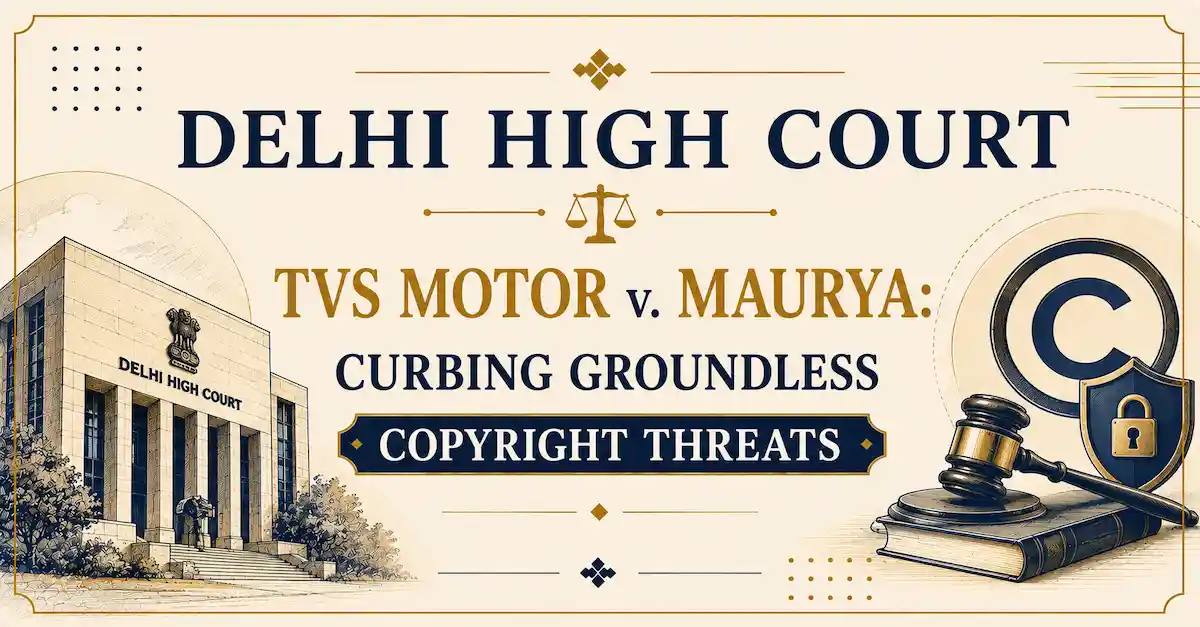
An engine does not usually invite a copyright dispute. Pistons and gears move according to the laws of physics, not according to the wording of a research paper, yet TVS Motor Company Limited found itself defending its engines against precisely that argument in TVS Motor Company Limited v. Ram Chandra Maurya & Ors. before the Delhi High Court. Justice Jyoti Singh restrained the defendants from sending TVS any further notices alleging copyright infringement and directed them to give the company seven days notice before starting any fresh proceedings. The order reads less like a routine copyright skirmish and more like a court finally losing patience with a litigant who refused to accept four straight defeats on the same claim.
A Notice With A Long History Of Failure
Looking to understand Copyright Law better? Read our complete Copyright Law Guide.
The dispute traces back to two copyright registrations held by Ram Chandra Maurya over literary works titled Motion’s Fourth and Fifth Law and Motion’s Sixth Law. These titles describe additional laws of motion that Maurya proposed beyond the three Isaac Newton formulated centuries ago. Registering a written explanation of a scientific theory as a literary work is a lawful and fairly routine step available to any author, regardless of whether the underlying scientific claims hold up to scrutiny. The trouble began when Maurya tried to convert that literary registration into a weapon against a motor vehicle manufacturer.
Maurya’s argument, repeated across several forums over the years, ran along the lines that TVS engines somehow embodied or made use of the physical principles he claimed to have discovered and written about, and that this amounted to infringement of his literary copyright. He carried this theory to the Copyright Authority, then in appeal to the erstwhile Intellectual Property Appellate Board, then to the Allahabad High Court, and finally to the Supreme Court of India. Every one of these forums rejected the claim. Undeterred, Maurya issued a fresh cease and desist notice to TVS raising the identical allegation, prompting TVS to approach the Delhi High Court under Section 60 of the Copyright Act seeking a declaration that this latest notice amounted to nothing more than a groundless threat.
What Section 60 Actually Guards Against
Section 60 exists because copyright holders, like patent and trademark holders, sometimes send threatening letters without any real intention of following through in court, treating the letter itself as a form of pressure. The provision lets a person aggrieved by such a threat file a suit seeking a declaration that the threat is unjustified, an injunction restraining its continuation, and damages for any loss suffered. The proviso to the section removes this remedy where the person making the threat commences and diligently pursues an infringement action within a reasonable time, since a genuine claim carried through proper channels is not a groundless threat no matter how alarming the language of the notice sounds. What Section 60 punishes is a letter sent to intimidate rather than to litigate.
Courts have read the word threat under Section 60 broadly. A circular, an advertisement, an email, or a cease and desist letter can all qualify, and the recipient does not need to wait for a lawsuit to be filed before seeking protection. Once a claimant establishes that a threat was made, the burden shifts to the person who made the threat to show that the acts complained of actually infringe a valid copyright. This burden shifting device explains why groundless threat suits tend to move quickly to the substance of the underlying infringement claim rather than getting stuck on procedural arguments about whether a letter counts as a threat in the first place.
Justice Jyoti Singh’s reasoning fits comfortably within this framework, though the facts handed the court an unusually strong case to work with. A single failed claim followed by a fresh notice might still leave room to argue that the sender genuinely believed in the merits of trying again. Four consecutive failures across four different forums, including the Supreme Court itself, leave very little room for that benefit of the doubt. The court treated this litigation history as directly relevant to the groundless character of the notice rather than as mere background colour.
The Missing Link Between Claim And Product
Beyond the history of repeated failure, the court identified a more basic defect in the notice itself. A copyright infringement threat, to be taken seriously, needs to identify the specific expression the copyright owner claims has been copied and then show how that expression turns up in the accused product. Maurya’s notice did neither. It asserted that TVS engines infringed his literary works without pointing to any passage or specific textual element from his registered writing that TVS had supposedly reproduced, and without comparing his literary work against the design or specification of the TVS engines in any meaningful way.
This gap matters because copyright protects expression, not the underlying idea, principle, or discovery that the expression describes. The Supreme Court settled this idea expression distinction decades ago in R.G. Anand v. Delux Films, holding that copyright subsists in the particular manner an idea is expressed rather than in the idea itself, so two authors can write about the same subject without either infringing the other so long as neither copies the specific expression the other used. A scientific theory about additional laws of motion, however unconventional, remains an idea. Writing it down in a particular way creates a literary work capable of protection, but that protection extends only to the specific written expression, not to the underlying physical claim, and certainly not to any product that happens to operate according to the laws of physics generally, laws Newton described long before Maurya wrote a word.
An engine running on established mechanical principles cannot, by that fact alone, be said to copy a literary description of a proposed new law of motion. Without identifying which sentences or descriptions from his registered work TVS had allegedly reproduced, and without placing that expression beside anything TVS actually manufactured, Maurya’s notice asked the court and TVS to accept on faith that infringement had occurred. Justice Jyoti Singh declined to do so, particularly against a background of four prior judicial rejections of the same underlying theory.
The Relief The Court Crafted
Rather than simply declaring the notice unjustified and leaving matters there, the court restrained the defendants from issuing further threats of copyright infringement proceedings against TVS and imposed a condition that any future proceedings could only begin after giving TVS seven days prior notice. This combination deserves attention because it does not shut the courthouse door on Maurya permanently. If he genuinely believes at some future point that he has a fresh and different basis for a claim, he retains the ability to pursue it, but only after alerting TVS in advance rather than through the sudden issuance of another notice designed to unsettle the company’s commercial operations.
The seven day condition functions as a practical safeguard against the exact pattern that brought the parties to court in the first place, a pattern of repeat notices sent without warning after previous claims had already failed. It gives TVS the chance to seek protective orders or otherwise respond in an orderly way rather than being caught off guard again. Courts exercising jurisdiction under provisions like Section 60 retain considerable flexibility in shaping relief that fits the specific conduct before them, and this order shows that flexibility being used sensibly rather than mechanically.
Why This Matters Beyond TVS
Large manufacturers regularly face claims from individual patent, trademark, or copyright holders who believe, sometimes sincerely and sometimes strategically, that a major product infringes something they registered. Section 60 and its counterparts under the Patents Act and Trade Marks Act exist precisely to stop that dynamic from turning into a tool of harassment rather than a legitimate avenue for enforcing genuine rights. What makes this case a useful reference point is not the underlying scientific claim, which was always going to struggle on the merits, but the court’s willingness to treat repeated failure across multiple forums as itself a fact bearing on whether a fresh notice qualifies as groundless.
Companies facing a claimant who returns again and again with the same rejected theory dressed up in a new notice now have a reasonably clear template for the kind of relief a court is prepared to grant. A bare declaration often does little to stop a determined but misguided claimant from trying once more. An injunction coupled with a prior notice requirement gives that declaration actual teeth without shutting off a claimant’s access to justice altogether.
For practitioners drafting cease and desist notices on behalf of copyright owners, this case is a useful reminder that a notice needs to do more than assert a conclusion. It should identify the specific work, the specific expression claimed to have been copied, and the specific manner in which the accused product or service reproduces that expression. A notice that skips these steps invites exactly the kind of challenge TVS brought here, and a claimant with a documented history of losing the same argument before other forums invites it with even less room to manoeuvre.
Also Read: Zee Entertainment v. BSNL: Madras High Court Permits Withdrawal of Copyright Suit
Conclusion
An engine does not usually invite a copyright dispute. Pistons and gears move according to the laws of physics, not according to the wording of a research paper, yet TVS found itself defending its engines against precisely that argument in TVS Motor Company Limited v. Ram Chandra Maurya & Ors. before the Delhi High Court. Justice Jyoti Singh restrained the defendants from sending TVS any further notices alleging copyright infringement and directed them to give the company seven days notice before starting any fresh proceedings. The order reads less like a routine copyright skirmish and more like a court finally losing patience with a litigant who refused to accept four straight defeats on the same claim.
Case Title: TVS Motor Company Limited v. Ram Chandra Maurya & Ors., Delhi High COurt