
Introduction
Want to learn the fundamentals of Trademark Law? Read our complete Trademark Law Guide.
Trademark law, as a general rule, asks whether confusion is probable. The ordinary consumer test, the imperfect recollection standard, the overall commercial impression analysis, each of these, in essence is to check whether the public is likely to be misled. In most product categories, a merely possible confusion does not cross that line. Courts want to see a real and tangible risk before restraining a competitor from using its own mark.
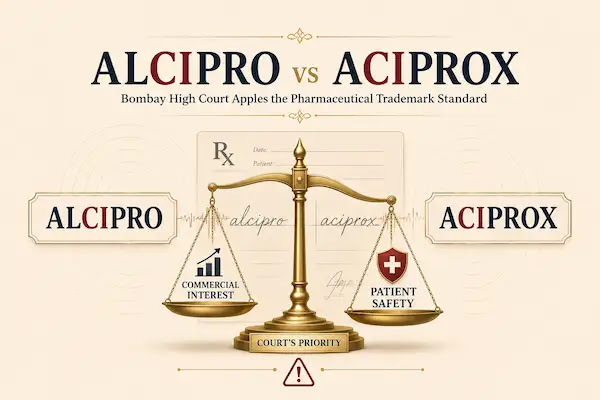
Pharmaceutical trademark law in India operates on a different base. When drugs are involved, the word “likely” gives one question, Is there any possibility of confusion at all? If the answer is yes, relief follows almost automatically. The reason is not about commercial injury to the plaintiff. It is about patient safety. A consumer who buys the wrong soft drink is inconvenienced. Whereas a patient who receives the wrong drug because a pharmacist misread or misheard a prescription name faces consequences of an entirely different character.
The Bombay High Court’s came delivered an important ruling in the Alkem Laboratories Ltd. v. Numen Pharma Pvt. Ltd case. The case tests the bare possibility test against facts Numen Pharma presented as genuinely borderline, i.e., two marks from different drug classes, different active pharmaceutical ingredients, different therapeutic indications, and pronounced (Numen insisted) in meaningfully different ways.
Background: The Marks and the Parties
Alkem Laboratories has used the trademark ALCIPRO since 1990 for a Ciprofloxacin-based antibiotic registered in Class 5 (Know more about trademark classes by clicking here). The registration, valid and subsisting at the time of the dispute, covers drugs used to treat bacterial infections, urinary tract infections, and infections of the skin, respiratory tract and soft tissues. Over three decades, Alkem built out the ALCIPRO range across multiple dosage strengths and formulations. Its 2023 sales turnover under the mark stood at Rs. 13.97 crore.
Numen Pharma was incorporated in 2023. It adopted the mark ACIPROX for a drug containing Aceclofenac, a non-steroidal anti-inflammatory prescribed for short-term relief of pain and inflammation in musculoskeletal conditions. The two drugs do not share an active ingredient, and they completely treat different conditions.
Alkem discovered Numen’s trademark application in December 2023, filed an opposition before the Trade Marks Registry, and ultimately instituted Commercial IP Suit No. 679 of 2025 before the Bombay High Court seeking reliefs for trademark infringement and passing off. An ad-interim injunction followed in October 2025. Interim Application No. 1606 of 2026 before Justice Deshmukh was the proceeding on whether to make that injunction absolute.
Numen’s Arguments for its Defence
Numen’s defence was:
Firstly, phonetic dissimilarity. Its counsel argued that the two marks would be pronounced differently: ACIPROX as “A-SI-PROX” and ALCIPRO as “AL-SI-PROX.” The difference in the opening syllable (“A” versus “AL”) and the presence of the terminal “X” in ACIPROX were, Numen said, sufficient to prevent confusion.
Secondly, it was the descriptive character of the shared element. Numen argued that “CIPRO” is a commonly understood shorthand for Ciprofloxacin and therefore generic within the pharmaceutical trade. On this basis, it contended that Alkem was attempting to monopolise the molecule itself rather than a legitimate brand identity.
And lastly, it was the difference in drug class. The two products contain different active ingredients prescribed for different clinical presentations. Numen’s position was that doctors and pharmacists are trained professionals capable of distinguishing the marks, even if a lay person could not.
These are not mere defensive and frivolous arguments. Courts have, in other cases, found that a shared generic prefix limits the scope of trademark protection. The professional consumer argument has occasionally found traction. In this case, it found none.
The Court’s Analysis
The Bare Possibility Test
The governing standard in pharmaceutical trademark matters in India is not the ordinary probability-of-confusion test. It is the bare possibility test: if any possibility of confusion exists between two marks, even a remote one, the court will intervene.
This standard originates in the Supreme Court’s ruling in Cadila Healthcare Ltd. v. Cadila Pharmaceuticals Ltd. (AIR 2001 SC 1952). The Supreme Court drew an explicit distinction between drug marks and marks in other categories. Confusion over a non-pharmaceutical product typically causes economic loss to the plaintiff. Confusion over drug marks can cause harm to patients. Drugs, as the Court observed, are not sweets. Dispensing the wrong medication, whether through oral mis prescription, hurried handwriting, or a pharmacist’s phonetic slip, can cause outcomes ranging from treatment failure to death. That is why the threshold for intervention in pharmaceutical trademark cases sits at possibility rather than probability.
Justice Deshmukh applied this and the order is clear, the bare possibility of confusion is liable to be arrested. There is no requirement to show that confusion is probable, or that any actual instance of confusion has occurred.
Phonetic Similarity
Numen’s phonetic dissimilarity argument received careful treatment before it was rejected.
The core of the Court’s reasoning was that trademark comparison cannot proceed by dissecting a mark into syllables and showing that each syllable, examined in sequence, differs from the corresponding syllable in the competing mark. That method had been expressly disapproved by a Division Bench of the Bombay High Court in Sun Pharmaceutical Industries Ltd. v. Meghmani Lifesciences Ltd. The correct approach requires looking at the marks as a whole and asking what impression they create on a listener in ordinary conditions of use, not in a careful side-by-side laboratory exercise.
Applying that test, Justice Deshmukh found ACIPROX and ALCIPRO phonetically similar. Both marks share the consonant cluster “CI-PRO” at their core. Hurried or casual pronunciation, the kind that occurs in a busy pharmacy or a noisy hospital corridor, tends to soften the initial syllable. The terminal “X” in ACIPROX could easily be slurred over. A mark ending in “X” does not distinguish itself automatically when spoken quickly.
The Court also gave specific weight to India’s linguistic and demographic context. The relevant population is not uniformly literate or fluent in English. In a multilingual society with significant functional illiteracy, marks that sound broadly alike carry greater confusion risk than they might in a population assumed to read carefully and compare deliberately. The Division Bench had recognised this in earlier proceedings as well.
The Anti-Dissection Rule
Numen’s argument about the descriptive character of “CIPRO” connects to a broader principle: the anti-dissection rule.
Courts evaluate trademarks as whole. A mark is not the sum of its parts and even where one element of a composite mark is generic or descriptive, the mark as a whole may still function as a distinctive identifier. The correct comparison runs between complete marks, not between shared syllables lifted from context. Numen’s attempt to isolate “CIPRO” and characterise it as descriptive was therefore unavailing. The relevant question was whether ACIPROX as a whole was confusingly similar to ALCIPRO as a whole. The Court answered that in the affirmative.
Prima Facie Case, Balance of Convenience, Irreparable Harm
On the three classic limbs of the interim injunction test, the Court found in Alkem’s favour on each.
The prima facie case was established through Alkem’s continuous use since 1990, its Class 5 registration, its sales evidence, and the phonetic similarity already discussed.
The balance of convenience favoured Alkem. A mark registered since 1990 and in active use for over three decades carries far greater accumulated goodwill than a mark adopted by a company incorporated in 2023. Numen’s commercial inconvenience in being restrained from using ACIPROX was considerably lighter than the harm Alkem risked from continued use of a confusingly similar mark.
Irreparable harm required no elaborate proof. In pharmaceutical trademark matters, the risk of patient harm, not just commercial harm, is itself irreparable in the ordinary sense. Financial compensation cannot undo a medication error after it occurs. The Court did not need evidence of actual confusion.
The Different Active Ingredient Question
One point deserves attention because it surfaces frequently in pharmaceutical trademark disputes. The argument that different active ingredients, different drug classes, or different therapeutic indications insulate a junior mark from an infringement claim.
The Bombay High Court rejected this implicitly, and rightly. The confusion at issue in pharmaceutical trademark cases does not always arise at the level of the prescribing physician. It can occur at the pharmacist’s counter, in the dispensary, on a prescription pad, or in a patient’s medicine cabinet. A pharmacist filling a handwritten or oral prescription for ALCIPRO who inadvertently dispenses ACIPROX does not need to know that the two drugs contain different active ingredients for the error to occur. The error happens before that knowledge becomes relevant.
The bare possibility test does not ask whether confusion would be clinically dangerous in a given case. It asks only whether confusion is possible. Once that threshold is crossed, patient safety considerations take over. The fact that ACIPROX contains Aceclofenac rather than Ciprofloxacin goes to the gravity of any potential error, not to whether the court should act.
Result
The interim injunction was made absolute on June 8, 2026. Numen Pharma stands restrained from manufacturing, marketing, selling, advertising or otherwise using the mark ACIPROX. The restraint extends to any other mark identical or deceptively similar to ALCIPRO, pending final disposal of the suit.
Also Read: Calcutta HC Returns ITC Plaint for Skipping Section 12A Mediation
Conclusion
Alkem v. Numen Pharma is, in one sense, a textbook application of settled law. The bare possibility test has been good law since Cadila Healthcare in 2001. Comparing marks as a whole rather than syllable by syllable has been a consistent principle for decades. What the case does well is demonstrate the test in operation against facts that look, at first glance, less obviously problematic than a typical pharmaceutical trademark dispute. Different drug classes, different active ingredients, no therapeutic overlap. Numen had a colourable argument on pronunciation. Courts in other contexts might have found more daylight for the defendant.
The Court reached the right result by applying the correct framework by comparing marks as a whole, assess phonetic similarity in realistic conditions of use, and hold the standard at bare possibility rather than probability.
My view is that there is a recurring temptation in pharmaceutical trademark litigation to treat the professional character of the prescribing and dispensing chain as a reason to relax the confusion analysis. Professionals are careful and they read labels. They know their pharmacopoeia.
That argument consistently underestimates how healthcare delivery actually works. Prescriptions get written under pressure. Pharmacies handle hundreds of transactions a day. Drug names get communicated by telephone, in noisy wards, through handwriting that runs the full spectrum from meticulous to illegible. The professional character of the chain matters less than the conditions under which the chain operates. In those conditions, phonetic similarity is a genuine risk even when the purchaser is trained.
The bare possibility test is not a plaintiff-friendly quirk in trademark law. It reflects a straightforward judgment, i.e., when the product is a drug, the margin for error is not the same as in other markets, and the law should say so.
Case: Alkem Laboratories Ltd. v. Numen Pharma Pvt. Ltd. Court: Bombay High Court (Commercial Division) Case No.: Interim Application No. 1606 of 2026 in Commercial IP Suit No. 679 of 2025