
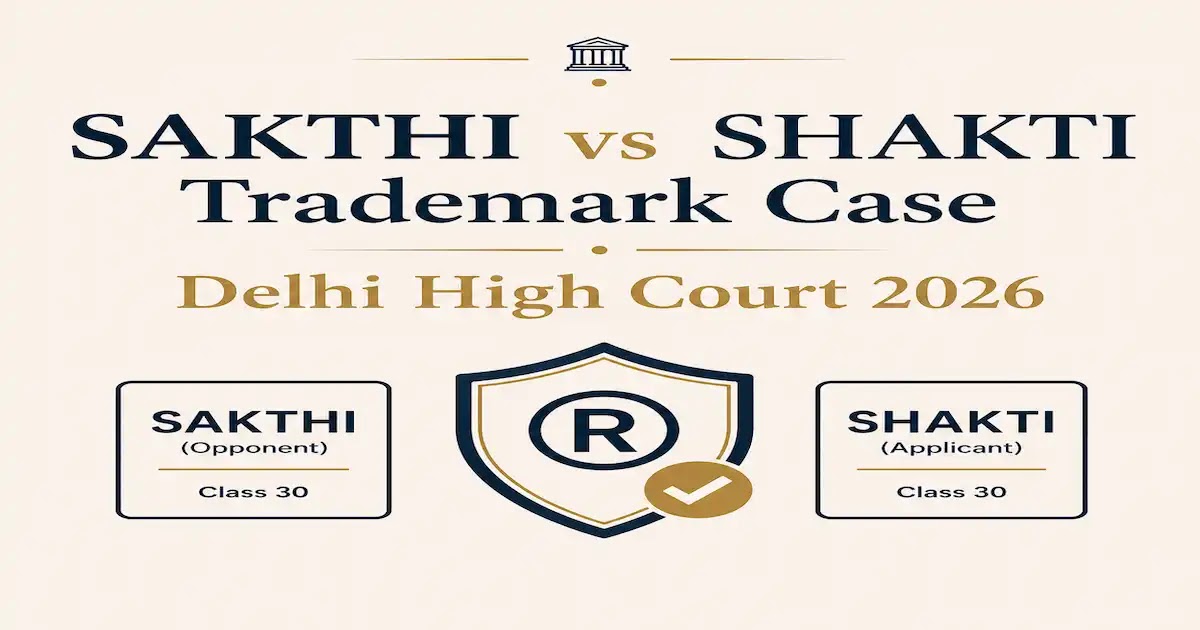
A masala brand built over four decades watched a rival mark sail through registration on the strength of a composite label it had used for half as long. P.C. Duraisamy, the proprietor behind the SAKTHI brand of spices, flour and pickles, asked the Delhi High Court in P.C. Duraisamy v. Kewal Krishan Kumar and Anr. case to remove the registered mark SHAKTI from the Register of Trade Marks. He argued that the registration was nothing more than paper, parked on the Register without a single year of genuine use behind it.
Introduction
New to Trademark Law? Start with our complete Trademark Law Guide.
On 24 June 2026, Justice Tushar Rao Gedela agreed with him entirely. The judgment in P.C. Duraisamy v. Kewal Krishan Kumar and Anr. expunged Registration for the word SHAKTI under Sections 47(1)(a) and 57(2) of the Trade Marks Act, 1999. The reasoning along the way deserves close attention because it deals with a tactic many proprietors quietly rely on, stretching the use of a composite mark to cover a standalone word buried inside it.
The Long History Between SAKTHI and SHAKTI
Duraisamy claimed to have adopted SAKTHI as a trade name and trademark since 1977, eventually building a business that exported food products to Australia, Europe, Malaysia, Singapore, South Korea and the United States. His earliest registration for the mark dates to 1979, and over the years he secured roughly sixty five registrations across Class 30 alone, covering everything from SAKTHI HONEY to SAKTHI VERMICELLI.
Kewal Krishan Kumar, the original proprietor of respondent no.1, ran a separate business under the mark SHAKTI BHOG, registered in 1989 with a user claim going back to 1975. His company, M/s Shakti Bhog Foods Limited, later took over the mark through an assignment, and after Shakti Bhog Foods slid into liquidation amid criminal proceedings against Kumar, the mark passed again to respondent no.3 through an assignment deed dated 30 December 2017 worth Rs 14.10 crores.
Buried inside this commercial history sat a separate application. On 12 March 1996, Kumar applied to register the standalone word SHAKTI in Class 30. Duraisamy opposed it, the opposition failed on procedural grounds, and the mark proceeded to registration on 22 May 2018, twenty two years after the original application was filed.
By the time the case reached Justice Gedela, the two sides were also pointing to a 2009 ruling by the Trade Marks Registry. In a separate dispute over Duraisamy’s mark SAKTHI TOOR DHALL, the Registrar had already found that Kumar could not prove use of SHAKTI BHOG and had dismissed his opposition outright, observing that Duraisamy was the proprietor of SAKTHI since 1977. Kumar never appealed that finding.
The Composite Mark Argument That Almost Worked
Counsel for respondent no.3 did not try to produce evidence that SHAKTI had ever been used on its own. Instead, he built an interpretive argument out of three provisions of the Trade Marks Act, Sections 15, 17 and 55(2), to claim that use of SHAKTI BHOG should count automatically as use of SHAKTI.
Stripping the Word BHOG Out of the Equation
Section 17 grants a proprietor exclusive rights over a composite mark taken as a whole, but Section 17(2) withholds exclusivity over any part of that mark which is common to the trade or lacks distinctive character. BHOG, the argument went, is exactly such a word, generic enough that no single trader could claim a monopoly over it. If BHOG carries no independent protection, then the only part of SHAKTI BHOG doing real trademark work is SHAKTI itself.
Section 55(2) supplied the second plank. It deems use of a whole registered mark to also count as use of any separately registered part of that mark belonging to the same proprietor. Stitch the two readings together and respondent no.3 arrived at a clean conclusion, every invoice showing a sale of SHAKTI BHOG ATTA since 1995 was, in law, also an invoice showing use of SHAKTI.
Justice Gedela called the argument brilliant and novel. He acknowledged that the interpretation was plausible on its own terms and noted that had any actual evidence of independent use existed, the Court might well have engaged with it seriously.
Why the Argument Failed on Facts
The Tangible Evidence Test
The problem for respondent no.3 was not legal theory. It was paper. Despite an application filed in 1996 and a registration granted in 2018, neither Kumar nor respondent no.3 produced a single invoice, advertisement or sales record showing SHAKTI used by itself, at any point across those twenty two years or in the years that followed. Every document on file showed SHAKTI BHOG or SHAKTI BHOG ATTA. The word SHAKTI, standing alone, simply did not appear anywhere in the commercial record.
The Court drew a sharp line here. A legal fiction created by statute cannot manufacture facts that do not exist. Section 55(2) deems use of a part to follow from use of the whole only where some baseline relationship between the two marks is genuinely demonstrated through actual trade. It cannot conjure independent use into existence where the proprietor never put the standalone mark before the public at all. Justice Gedela framed it directly, the interpretation could not be applied dehors the facts of the case, and respondent no.3, having failed on facts, could not fall back on legal interpretation to rescue the registration.
Duraisamy, by contrast, had real documents. His first invoice clearly displaying SAKTHI as a mark, rather than merely as part of a trade name, was dated 8 January 2010. Even discounting everything before that date, the Court found that fourteen years of demonstrated use, against zero years of demonstrated use for SHAKTI, settled the question of who actually deserved the Register entry.
Honest Concurrent Use Rejected
Respondent no.3 also invoked Section 12 of the Act, the provision allowing two similar marks to coexist on the Register where there has been honest and concurrent use by both parties. Counsel leaned heavily on London Rubber Co. Ltd. v. Durex Products Incorporated, where the Supreme Court had permitted a junior user to register a mark on the strength of documented use dating back decades.
The Court distinguished the case cleanly. In London Rubber, the Registrar had factually verified the junior party’s use of the mark from 1928 before allowing registration on the concurrent use ground. Here, there was no comparable factual foundation. Honest concurrent use requires actual use, demonstrated and corroborated, not merely an absence of bad faith. Since SHAKTI had never been used by anyone connected to respondent no.3, the doctrine simply had no facts to attach to.
Phonetic and Structural Identity
On the question of confusion, the Court examined the two marks side by side and found them phonetically and structurally identical, observing that the placement of the letter H makes no real difference between SAKTHI and SHAKTI. Both words carry the same meaning in everyday usage, conveying power, energy or strength. Given that both parties manufactured competing food products falling within Class 30, the Court held that an average consumer with imperfect recollection faced a real risk of confusing the two.
Counsel for respondent no.3 tried to draw support from Nandhini Deluxe v. Karnataka Cooperative Milk Producers Federation Ltd., where the Supreme Court allowed two similar marks to coexist because they covered different categories of goods. The Court rejected the comparison outright, noting that Duraisamy and Kumar competed in the exact same class for the exact same kind of products, a fact pattern that took the case outside Nandhini’s reasoning entirely.
We have previously examined situations where similar sounding trademarks were found not to infringe one another because the goods, trade channels or consumer base diverged enough to rule out confusion. The present case sits at the opposite end of that spectrum, identical goods, identical trade channel, and a phonetic overlap too close to ignore.
The Section 47(1)(b) Question
Duraisamy also sought removal under Section 47(1)(b), the provision targeting marks left unused for a continuous period of five years and three months after registration. This ground failed on a simple timeline. SHAKTI was registered on 22 May 2018, and the rectification petition was filed on 8 April 2019, well short of the statutory window. The Court accepted respondent no.3’s reliance on Rong Thai International Group Co. Ltd. v. Ena Footwear (P) Ltd. on this narrow point and dismissed the Section 47(1)(b) ground, though the failure carried no practical weight once Section 47(1)(a) succeeded on its own terms.
Locus of the Assignee
A smaller but interesting thread in the judgment concerned whether respondent no.3 even had standing to defend the petition. The 2017 assignment deed transferred rights in SHAKTI BHOG and its variants but never mentioned SHAKTI by name. Duraisamy argued this left respondent no.3 with no locus at all.
The Court read the word variants broadly enough to include the pending SHAKTI application, since it remained undecided on the date the assignment was executed and only matured to registration afterward. Relying on Sun Pharmaceuticals Industries Ltd. v. Cipla Ltd., the Court allowed respondent no.3 to participate fully in the proceedings, even while ultimately ruling against it on every substantive point.
Practical Lessons from this case
The judgment offers a clean checklist for anyone managing a composite mark portfolio. A registration for a composite mark gives no automatic protection to a word buried inside it unless that word has been put to genuine, independent commercial use, evidenced through invoices, advertisements or similar trade documents bearing the standalone term itself. Filing a separate application for a component word is not, by itself, enough. Someone eventually has to use that word on its own, in the market, in a form the Register can verify.
For prior users facing a paper registration, the lesson runs the other way. Persistence pays. Duraisamy kept opposing every application Kumar filed across two decades, succeeded once before the Registrar in 2009, lost the opposition on procedural grounds in the SHAKTI matter, and still secured the same outcome years later through rectification. A registration obtained without genuine intention to use, and never actually used, remains vulnerable to challenge regardless of how long it sits quietly on the Register.
For a deeper look at how courts assess deceptive similarity between two marks, see Trademark Infringement and Deceptively Similar Marks.
Also Read: Calcutta HC Returns ITC Plaint for Skipping Section 12A Mediation
Conclusion
I find the twenty two year gap between application and registration the most telling detail in the entire record. A mark that sat that long without anyone troubling to use it, defend it with evidence, or even produce a single invoice once challenged, was never going to survive serious scrutiny once the matter finally reached a judge willing to look past the cleverness of the argument and ask the only question that mattered, where is the proof.
Case P.C. Duraisamy v. Kewal Krishan Kumar and Anr., C.O. (COMM.IPD-TM) 180/2022, Delhi High Court, decided 24 June 2026.