
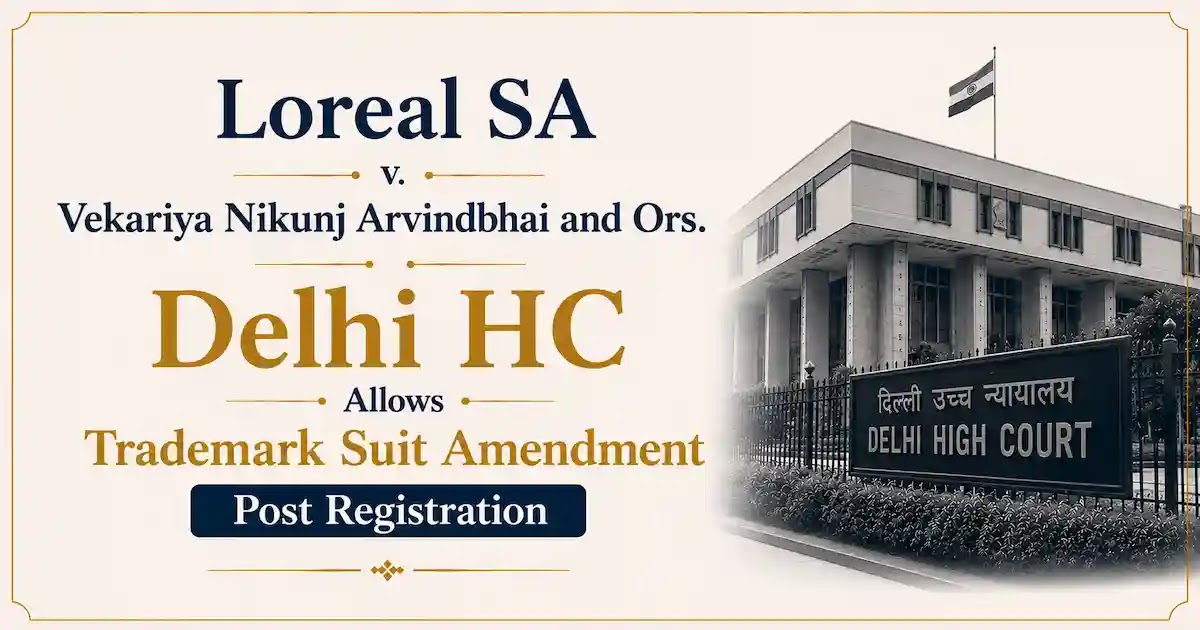
The Delhi High Court recently examined a problem that troubles trademark litigants across the country. A plaintiff files a suit for passing off because the mark stands unregistered at that point in time, and the registration comes through later, sometimes years into the litigation. The plaintiff then wants to add a claim for infringement to the same suit rather than starting a fresh one. In Loreal SA v. Vekariya Nikunj Arvindbhai and Ors, Justice Jyoti Singh addressed this question and set aside a trial court order that had refused such an amendment.
Loreal Garnier Bright Trademark Dispute
Struggling to understand Trademark Law? Read our complete Trademark Law Guide.
Loreal SA adopted the mark GARNIER BRIGHT COMPLETE along with a distinctive trade dress for its facial and skincare products in September 2020, and it built substantial goodwill around the mark through continuous use and promotion of its products. Loreal later found that the respondents were manufacturing and selling cosmetic products under the marks GARUDA BRIGHT COMPLETE 30x and 6 DROPS BRIGHT COMPLETE 3x and VITAMIN C, marks that closely resembled the Loreal branding and created confusion among consumers.
Loreal filed a suit for passing off before the District Judge at Saket District Court, registered as CS(COMM) 171/2024, and it secured an ex parte ad interim injunction on 16 May 2024. The GARNIER BRIGHT COMPLETE mark carried no registration when the suit was filed, so the claim rested purely on common law passing off principles.
Trial Court Order Rejecting Loreal’s Amendment Application Under Order VI Rule 17 CPC
While the suit remained pending, Loreal applied for registration of the mark on 26 April 2024, claiming user since 4 September 2020, and the Trademark Registry granted the registration on 20 April 2025. Armed with this registration, Loreal moved an application under Order VI Rule 17 CPC on 1 July 2025 seeking to amend the plaint and introduce a claim for trademark infringement alongside the existing passing off claim.
The Trial Court dismissed the amendment application on 10 February 2026. It reasoned that the original plaint contained no mention of a pending registration application, that the subsequent registration created a fresh cause of action for infringement with parameters distinct from passing off, and that the plaintiff’s evidence had already concluded, so allowing the amendment would effectively turn back the clock on the trial.
Delhi High Court Ruling on Amending a Passing Off Suit Into a Trademark Infringement Suit
Loreal challenged this order under Article 227 of the Constitution before the Delhi High Court. Justice Jyoti Singh framed the controversy narrowly, focusing on whether Loreal could amend its plaint in light of the registration that came through during the pendency of the suit.
The court held that the Trial Court had erred. It emphasised that the real controversy test remains the cardinal principle guiding amendment applications, and that courts must take note of subsequent events to shorten litigation and serve the ends of justice. The judgment relied heavily on Rajesh Kumar Aggarwal and Others v. K.K. Modi and Others, (2006) 4 SCC 385, where the Supreme Court held that courts should allow amendments necessary for determining the real question in controversy, provided the amendment causes no injustice to the other side.
Justice Jyoti Singh also drew on a coordinate bench ruling in Pravesh Narula Trading as M/s. Capital Enterprises v. Raj Kumar Jain Trading as M/s. Bholaram Puranmall and Another, 2024 SCC OnLine Del 7537, which itself relied on the Division Bench decision in Usha International and Another v. Usha Television Limited, 2002 SCC OnLine Del 306. Both decisions recognised that a plaintiff can amend a passing off suit into one for infringement once the plaintiff obtains registration after institution of the suit, since the cause of action and the underlying facts remain the same. The court noted that such an amendment does not change the cause of action and merely adds an alternative relief, while also avoiding multiplicity of proceedings.
Why the Loreal Suit’s Nature and Character Remained Unchanged
The Delhi High Court found that the infringement and passing off actions in this case rested on identical facts, the same rival trademarks, and the same products. The registration that Loreal obtained during the pendency of the suit did not alter the basic structure of the case, and it only added a further relief that flowed naturally from the same allegations Loreal had already pleaded. The court observed that the Trial Court’s own order acknowledged that Loreal had filed the registration application only after the suit began, which made the finding that the plaint omitted any mention of the application somewhat beside the point.
Delay and Conclusion of Evidence No Bar to Amendment of Pleadings
The court also rejected the argument that the conclusion of the plaintiff’s evidence should block the amendment. It reasoned that the Trial Court had already proceeded ex parte against Respondents No. 2 to 5, and that dismissing the amendment application would only push Loreal toward filing a fresh suit, prolonging litigation between the same parties over the same trademark and products. Mere delay or the advanced stage of trial, the court held, cannot by itself defeat an otherwise bona fide and necessary amendment.
Delhi High Court Verdict in the Loreal v Vekariya Trademark Case
The Delhi High Court quashed and set aside the Trial Court’s order dated 10 February 2026 and allowed the application that Loreal had filed under Order VI Rule 17 CPC. The Delhi High Court directed the Trial Court to take the amended plaint on record and proceed with the suit accordingly, and it disposed of the petition along with the connected applications.
Also Read: Calcutta HC Returns ITC Plaint for Skipping Section 12A Mediation
Conclusion
This ruling reinforces a principle that trademark owners often overlook while litigating passing off actions. A plaintiff need not wait for registration before suing, and once registration comes through during the pendency of the suit, the plaintiff gets a fair opportunity to add an infringement claim to the same proceeding instead of running a parallel suit.
I find the Delhi High Court’s reasoning sound because it prevents multiplicity of litigation and respects the real controversy test that Indian courts have followed for decades. Trial courts sometimes treat subsequent registration as a rigid new cause of action, but this judgment reminds litigants and judges alike that passing off and infringement share the same factual foundation whenever the marks and products at the centre of the dispute stay unchanged.
Case Title: Loreal SA v. Vekariya Nikunj Arvindbhai and Ors, CM(M)-IPD 21/2026 and CMs 91/2026, 92/2026, decided by the Delhi High Court on 13 July 2026.