
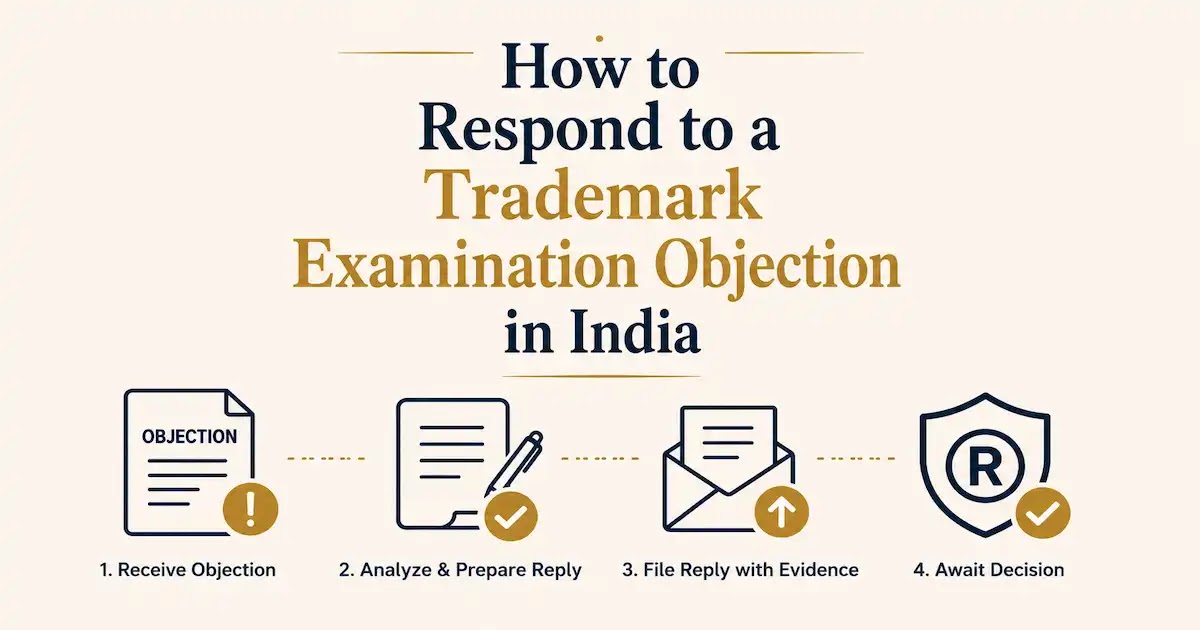
You filed your trademark application and waited. Then you received an email: “Objected.” For most applicants, this is the moment panic sets in. A trademark examination report is not a plain rejection. The Trade Marks Registry has said give me a reason to accept the mark. The examiner has raised objections under the Trade Marks Act, 1999, and has asked you to answer them. The application is still active. This guide walks through the examination process, how to read each category of objection, what a proper reply must contain, the timeline you are working against, and what happens at a show cause hearing if the reply does not satisfy the Registrar.
Introduction
Looking to understand Trademark Law better? Read our complete Trademark Law Guide.
Most objections fall under two statutory heads. Section 9 covers absolute grounds, and Section 11 covers relative grounds. Some reports carry both. A well-drafted reply, filed within the deadline, resolves the majority of examination-stage objections on paper. The hearing is the exception, not the rule. What turns an answerable objection into an avoidable hearing is almost always the quality of the reply, not the strength of the mark itself.
What is a Trademark Examination Report
After a TM-A application is filed, the Trade Marks Registry sends it to an examiner. The examiner searches the register for conflicting marks, evaluates whether the applied mark satisfies the conditions for registration under the Act, and issues an examination report setting out any objections.
Under Rule 33(2) of the Trade Marks Rules, 2017, the Registrar communicates objections to the applicant in writing. The report typically identifies which provisions of the Act the examiner is invoking. For Section 11 objections, it also lists the specific registered marks being cited as conflicts. The application status on the IP India portal changes to “Objected” once the report is issued. This status does not mean refused. It simply means the examiner has questions that need answering.
Objections belong to one of two categories. Section 9 concerns the nature of the mark itself, specifically its inherent capacity to function as a trademark. Section 11 concerns its relationship to marks that already exist on the register. These two are different. They require different arguments, and a reply that addresses only one while the report raises both will not succeed.
Reading the Report: Section 9 Objections
Section 9 of the Trade Marks Act, 1999 lays down the absolute grounds for refusing registration. The word “absolute” tells you something important: the objection is directed at the mark in isolation, without reference to anyone else’s rights. To understand Section 9 in detail, click here: What is Section 9 of Trademarks Act?
Devoid of Distinctive Character: Section 9(1)(a)
This is the most common objection in examination reports. The examiner’s position is that the mark cannot distinguish the goods or services of the applicant from those of anyone else. Common surnames attract this objection. Generic word combinations attract it. Single ordinary words attract it.
The counter-argument runs in one of two directions. First, argue that the mark is inherently capable of distinguishing: that it is coined, arbitrary, or suggestive rather than generic. Second, invoke the proviso to Section 9(1). A mark that has acquired distinctive character through use before the filing date shall not be refused registration. The proviso is powerful, but it must be backed by evidence.
Descriptive Marks: Section 9(1)(b)
An objection under 9(1)(b) means the examiner considers the mark as consisting exclusively of indications that describe the kind, quality, quantity, purpose, geographical origin, or other characteristics of the goods or services.
“Fresh” for dairy. “Fast” for courier services. “Pure” for filtered water. These are the obvious cases. Less obvious is when the examiner reads a mark as describing something the applicant did not intend. The reply has to address the examiner’s specific reading, not the applicant’s intended meaning.
The proviso to Section 9(1)(b) applies here too. If the mark is descriptive but has acquired secondary meaning through years of use before filing, that use can be proven. Use after the filing date does not count. The proviso is expressly limited to distinctiveness acquired before the application date.
Customary Marks: Section 9(1)(c)
Marks that have become customary in the current language or in the established practices of the trade face this objection. The word “Escalator” became customary for moving stairways. “Xerox” became customary in common speech for photocopying. The test is whether the term belongs to the public vocabulary of trade, not to the applicant.
Laudatory terms
Marks like “Super,” “Best,” “Premium,” or “Excellent” typically attract an objection on the ground that they are laudatory in character. They praise the quality of the goods rather than identify their source. These marks face a steep climb unless they are combined with distinctive elements in a device mark.
For all Section 9 objections where acquired distinctiveness is the argument, the reply must be supported by an affidavit of use. That affidavit needs to state the date of first use, the goods or services in connection with which the mark has been used, and annual turnover figures generated from sales under the mark. The Registry also considers advertising expenditure, the geographic extent of use, and any evidence of consumer recognition.
Reading the Report: Section 11 Objections
Section 11 governs relative grounds for refusal. Where Section 9 is about the mark itself, Section 11 is about the company it keeps on the register. The examiner has found one or more earlier registered or applied-for marks that it considers identical or confusingly similar to the applied mark.
Under Section 11(1), an application must be refused if the mark is identical or similar to an earlier trademark and the goods or services covered are identical or similar, with a likelihood of confusion on the part of the public. Section 11(2) extends this to marks that are identical or similar to a well-known trademark, even across different classes, where use of the later mark would take unfair advantage of or cause detriment to the distinctive character of the earlier mark.
The first step when you read a Section 11 objection is to pull up the cited marks on the IP India portal. Note the registration numbers, the proprietors, the classes, and the specific goods and services listed. The examiner’s objection is based on those particulars. Your reply must address each cited mark individually.
The test for deceptive similarity
The governing test comes from the Supreme Court’s judgment in Amritdhara Pharmacy v. Satya Deo Gupta, AIR 1963 SC 449. The Court set down what remains the foundational principle in Indian trademark law for comparing two marks: the test is not whether a side-by-side comparison reveals differences, but whether an ordinary purchaser of average intelligence and imperfect recollection would be deceived or confused.
Marks are compared as wholes. You do not dissect them into component words and compare each fragment separately. The overall impression, assessed visually, phonetically, and conceptually, is what the examiner and the Registry are asked to evaluate.
This matters enormously for drafting the reply to an examiner who has cited objections. An argument that says “the words are different” without engaging with the overall impression will not carry the examiner. You need to show that the marks are dissimilar visually (the structure, number of syllables, dominant element), phonetically (how they sound when spoken aloud), and conceptually (whether they carry the same meaning or evoke the same idea in the market). You also need to show that the goods and services are sufficiently differentiated, or that the channels of trade and the target consumer are distinct enough that confusion is unlikely in practice.
Where the report cites a well-known mark under Section 11(2), the burden is higher and the arguments are different. You would be asking the Registrar to find that your mark does not take unfair advantage of or dilute the distinctiveness of the cited mark. This is a narrower window, and one that ordinarily requires showing that the marks belong to entirely different conceptual territories.
If the proprietor of a cited mark is willing to provide a no-objection letter, that consent can be placed before the Registrar under Section 11(4), which permits registration where the earlier rights holder agrees to the later application.
We explored what deceptive similarity means in practice, and where courts have drawn the line, in our post on similar trademarks and why they are not always infringing.
How to Draft the Reply: What to Include
A reply to an examination report is a legal submission. Every objection in the report needs a response. Leaving one ground unaddressed is effectively conceding it.
Address each objection in sequence
Take the report ground by ground. For Section 9 objections, frame the argument around either inherent distinctiveness or acquired distinctiveness with supporting evidence. For Section 11 objections, take each cited mark separately and run the comparison across visual, phonetic, and conceptual dimensions. Do not group all cited marks under a single paragraph and treat the comparison as done.
The affidavit of use
Where acquired distinctiveness is being claimed under the Section 9(1) proviso, the reply must be accompanied by a sworn affidavit. The affidavit needs to set out the date of first use, the goods or services in respect of which the mark has been used, and annual turnover figures from use of the mark. Exhibit every document that supports the narrative: invoices, advertising materials, sales data, screenshots, media coverage. Each exhibit must be numbered, described in the affidavit, and cross-referenced in the text.
One point worth flagging: the proviso requires distinctiveness acquired before the date of application. Post-filing use does not help. If the mark was filed early, before substantial use was built up, the proviso route may not be available. The reply should then engage on inherent distinctiveness instead.
Limitation on goods and services
Where the Section 11 conflict arises because the specifications of goods or services are broad and overlap with those of the cited mark, one option is to amend the specification to carve out the area of conflict. This is useful where the applicant’s actual commercial activity is narrower than what was filed. The limitation must be realistic. Over-narrowing can leave the registration unable to cover the applicant’s genuine business.
No-objection letters
If the proprietor of a cited mark is willing to provide consent, that letter should be attached to the reply. Consent is not always obtainable and is not always necessary, but where it is available, it often resolves a Section 11 objection without need for a hearing.
Case law
Cite relevant judicial authority where it supports the argument. For Section 9, courts have accepted acquired distinctiveness for marks with longstanding use and substantial sales, even where the word was initially descriptive. For Section 11, the Amritdhara test and the subsequent line of cases from the Delhi and Bombay High Courts on likelihood of confusion give you a framework to work with. Cite the specific paragraph you are relying on, not just the case name.
Timelines and Deadlines
Rule 33(4) of the Trade Marks Rules, 2017 gives the applicant one month from the date of receipt of the examination report to file a reply. If no reply is received within that period, the Registrar may treat the application as abandoned.
Abandonment is not automatic. The statute uses “may,” and Section 132 of the Act gives the Registrar discretion to issue a notice before treating the application as gone. In practice, the Registry generates a Section 132 notice requiring compliance within a further one month. After that, the application is marked abandoned and cannot be revived through a simple request. A fresh application must be filed at fresh government fees, with a new priority date. Everything built up in time from the original filing date is gone.
Watch the deadline carefully. The examination report is ordinarily served by email. Rule 18(2) of the Trade Marks Rules, 2017 deems email service to have been effected at the time of sending, not when you open the email or when a physical copy arrives. If the report goes to a spam folder for two weeks, those two weeks still count against the one-month period.
An extension of time may be sought under Section 131 of the Act and Rule 109, using Form TM-M. The extension is discretionary, not a right. The better approach is to track the portal regularly after filing and begin preparing the reply as soon as the report appears.
This is also a situation where a delay in responding can permanently cost you your filing date. We covered a case where a six-year delay in a trademark proceeding was condoned by the Registrar, but those were exceptional circumstances. The Rajinder Singh case turned on very specific facts. Missing the examination report deadline is a different kind of default, and the Registry treats it with less sympathy.
What Happens if the Reply is Not Accepted
Under Rule 33(6) of the Trade Marks Rules, 2017, if the Registrar considers the reply unsatisfactory, or if the applicant has separately requested a hearing, the matter is listed for a show cause hearing before the Registry. The portal status changes to “Ready for Show Cause Hearing.”
The hearing is conducted before a Senior Trade Marks Examiner or an officer designated by the Registrar, at the appropriate Trade Marks Office or by video conferencing under Rule 115. The applicant or their authorised representative appears and makes oral submissions. This is the last opportunity at the Registry level to save the application.
What to prepare for a hearing is not very different from what the reply should already contain. The difference is that arguments now need to be structured for oral presentation, not just written submission.
Bring the affidavit and all exhibits already on record, flagged and indexed. Prepare a hearing outline: issue, law, argument, evidence. If there are case law authorities you want to press, cite the exact paragraph you are relying on, not just the case name. The examiner at a hearing has seen dozens of applicants cite Amritdhara as a headline without engaging with its actual reasoning. The ones who work through the test step by step consistently fare better.
If a consent letter from the cited proprietor was not available at the reply stage, the hearing is the moment to produce it. If a limitation of goods can now be agreed on, the hearing is the place to offer it.
Under Rule 33(7), if the applicant fails to appear at the hearing and has not filed a reply, the Registrar may treat the application as abandoned. Appearing matters. And if the Registrar passes an order of refusal after the hearing, an appeal lies to the relevant High Court under Section 91 of the Trade Marks Act, 1999, within three months from the date the order is communicated.
Also Read: Calcutta HC Returns ITC Plaint for Skipping Section 12A Mediation
Conclusion
An examination report objection is answerable and the question is whether the reply actually answers it.
The single biggest mistake at this stage is treating the reply as a formality: filing a generic three-paragraph submission that says the mark is distinctive, the cited marks are different, and respectfully requesting acceptance. That kind of reply does not convince examiners. All it does is merely scheduling hearings.
A reply that actually works does three things. It takes the examiner’s objection seriously on its own terms. It marshals the statutory argument, whether that is inherent distinctiveness, acquired distinctiveness, or a careful comparative analysis of cited marks under the Amritdhara test. And it backs the argument with documents, not assertions.
For applicants with prior use of a descriptive mark, the evidence question is the entire case. Invoices, advertising records, annual sales figures, media coverage: these documents decide whether the proviso to Section 9(1) is available or not. Gathering them before filing, or at least at the moment the examination report arrives, is the preparation that determines the outcome.
Section 11 replies require genuine comparative analysis. How are the marks visually different? How do they sound when spoken? What do they mean to a consumer who encounters them in the market? What are the actual goods or services, and how do the trade channels compare? These are questions of fact and perception, not just legal argument, and the reply should address them as such.
The trademark registration process in India rewards preparation. If you want a deeper grounding in how the registration framework works from the ground up, the complete Trademark Law in India guide covers every stage from filing to enforcement.
Getting through the examination stage is not the end of the road. After acceptance, the application is advertised in the Trade Marks Journal and any third party has four months to file an opposition. But reaching the advertisement stage is what the reply is trying to achieve. A well-prepared, targeted, evidence-backed submission is what gets you there.