
trademark
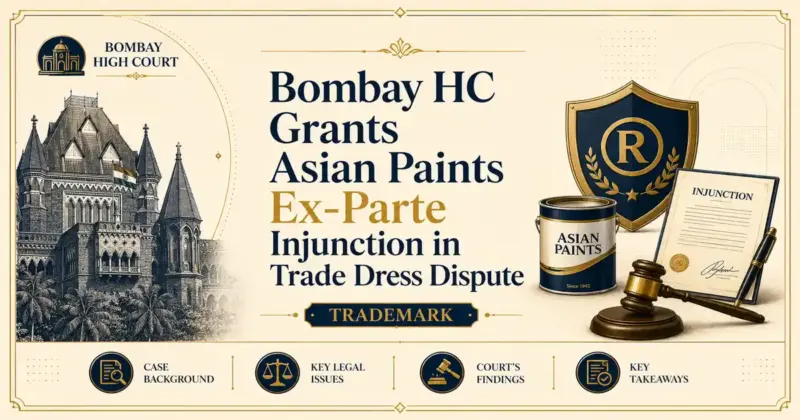
Asian Paints Secures Ex-Parte Injunction in Trade Dress Battle
The Bombay High Court has granted Asian Paints an ex-parte ad-interim injunction against Deepak Kumar Panwar, affirming protection for its 'APEX' trade dress and marks.
Browse every analysis published on Its IP Time.
The Bombay High Court has granted Asian Paints an ex-parte ad-interim injunction against Deepak Kumar Panwar, affirming protection for its 'APEX' trade dress and marks.
The August 2026 Indian IP law digest highlights a landmark Delhi High Court seven-step test for Section 3(m) patentability and key rulings on trademark well-known marks.
The Registrar of Copyrights has formally rejected the application naming an AI system, DABUS, as an author, reaffirming that statutory authorship under the Copyright Act 1957 is strictly reserved for legal persons. While algorithmic outputs may satisfy the originality standard under the Modak precedent, the person who initiates the creative process must be identified as the author. The order underscores that artificial intelligence lacks the legal personality necessary to hold property rights, and any attempt to grant such status remains a matter for Parliamentary legislative reform.
Stay updated with our Weekly Indian IP Law Digest covering crucial rulings from the Delhi, Bombay, and Madras High Courts, alongside essential updates from the CGPDTM.
The Madras High Court has dismissed a John Doe suit filed by YouTube Google LLC against Sri Eshwar College of Engineering, citing a critical lack of specificity in the pleadings regarding registered trademark infringement. Under the Commercial Courts Act and Order VII Rule 11 of the CPC, courts now demand rigorous evidentiary standards for injunctions. Plaintiffs must definitively identify the specific trademark registrations breached and demonstrate a concrete legal injury, rather than relying on broad, speculative assertions to justify the use of John Doe procedural mechanisms.
The Madras High Court in Vinbros and Co v. Chamundi Winery has decisively ruled that the mere administrative situs of the Trademark Registry cannot confer territorial jurisdiction for infringement litigation. Jurisdictional competence under Section 134 of the Trade Marks Act and Section 62 of the Copyright Act remains tethered to the plaintiff’s place of business or the defendant's actions, rather than the location of the registry office. This prevents forum shopping and ensures that judicial resources are aligned with the operational realities of the parties involved in the dispute.
The Madras High Court has established that possession of photographic materials does not equate to ownership of copyright. In a ruling concerning historical film assets, the court denied injunctive relief because the plaintiffs failed to produce a written assignment proving a clear chain of title. This case serves as a critical precedent for IP practitioners, emphasizing that without valid legal instruments as per Section 17 of the Copyright Act, claimants cannot sustain a declaration of ownership. Establishing the initial authorship and the subsequent transfer of rights is non-negotiable in copyright litigation.
The Delhi High Court is currently examining the threshold for territorial jurisdiction in disparagement and IP infringement cases where digital content is involved. Relying on the Banyan Tree framework, the court evaluates whether a plaintiff can sue at a branch office or if they are restricted to the principal place of business. This case highlights that mere website accessibility is insufficient to establish jurisdiction; plaintiffs must provide concrete evidence of purposeful availment, such as targeted commercial activities, to successfully defend a jurisdictional challenge under Section 20 of the CPC.
The Bombay High Court has upheld the use of Section 9 of the Arbitration and Conciliation Act, 1996, to grant interim protection against hold-over franchisees. By enforcing negative covenants in a franchise agreement, the court restrained the unauthorized use of the trademark KIDGEE, citing it as deceptively similar to the registered brand KIDZEE. This ruling confirms that post-termination disputes are fundamentally contractual and arbitrable, allowing franchisors to protect their intellectual property and brand equity through targeted interim relief despite the infringer's attempt to use a generic-sounding mark.
Stay updated with the latest Indian IP law developments, including Madras HC dynamic blocking orders, Delhi HC trademark cancellation rulings, and new CGPDTM manuals.
The Delhi High Court has reaffirmed that parties seeking ex-parte injunctions must uphold uberrima fides, or the duty of utmost good faith. In a recent ruling, the court vacated an ad-interim order due to the suppression of material facts, specifically prior cease-and-desist notices and trademark opposition filings. This judgment clarifies that manufactured urgency cannot be used to bypass procedural safeguards under the Commercial Courts Act. Practitioners must ensure full disclosure in pleadings to avoid the risk of having equitable relief vacated for failing the test of judicial candor.
The Supreme Court of India has ruled that courts must ensure procedural fairness by linking contempt applications with pending Order XXXIX Rule 4 applications under the Code of Civil Procedure, 1908. This landmark directive prevents the premature penalization of litigants when an injunction itself is under challenge. For IP practitioners, this decision underscores the tactical necessity of synchronizing interlocutory proceedings in commercial litigation to ensure that the validity of an injunction is adjudicated before breach proceedings are enforced, ultimately upholding the principle of natural justice in high-stakes commercial disputes.