Also Read: Bombay HC Restrains ‘Pune Mirror’ Dispute: Rules on Section 124 Delay
Key Precedents & Statutory Guidance
- Search recent High Court judgments in our Latest Indian IP Law Cases Directory.
- Examine core statutory doctrines in our Indian Trademark Law Guide.
- Procedural Breakdown: Customs IP Recordal in India & ICER Portal Procedures.
- Review nationwide litigation trends in our Monthly IP Law Roundup.
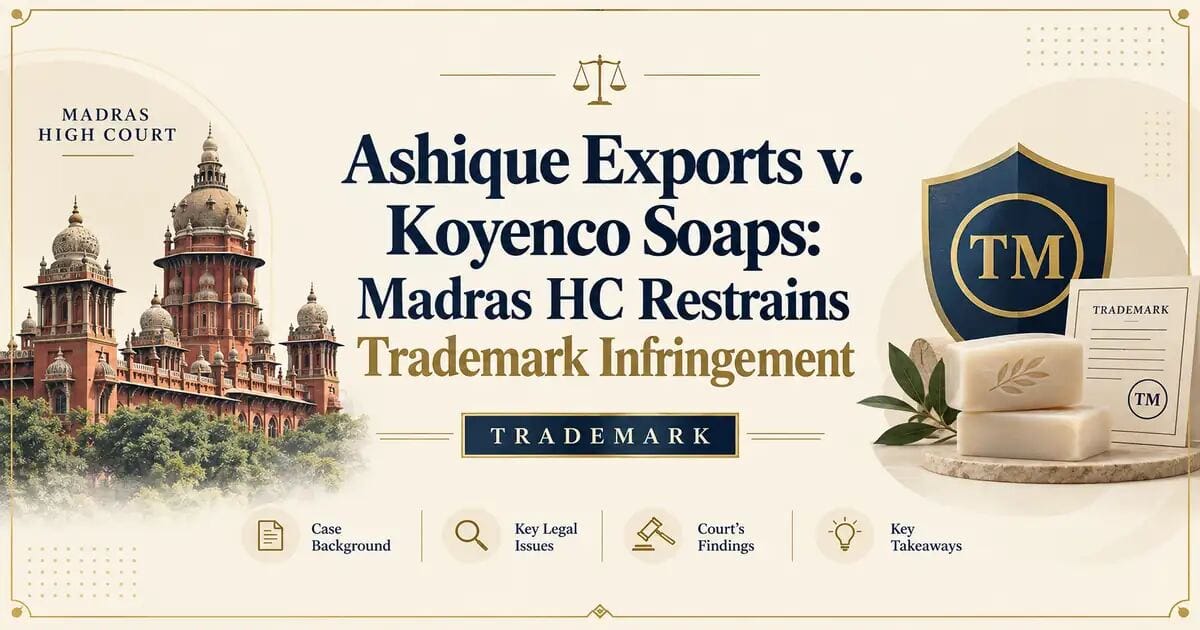
A Shield for the Soaps: Examining the Madras High Court’s Ruling in Ashique Exports
New to Indian Trademark Law? Start with our comprehensive Trademark Law Guide.
The marketplace for fast-moving consumer goods is a relentless arena of visual competition, where a product’s survival often hinges on a sliver of consumer recognition. When two entities clash over the right to dress their soap offerings in similar colors and motifs, the conflict is never just about aesthetics. It becomes a battle for the brand’s identity in the mind of the average buyer. In the dispute of Ashique Exports Pvt. Ltd. Vs Koyenco Soaps and Detergents, the Madras High Court faced such a contest, centering on the sanctity of registered trademarks and the broader protection afforded to a manufacturer’s unique visual presence.
Background & Material Facts
The origin of the legal friction lies in the long-standing commercial activity of the plaintiff, Ashique Exports. As the registered proprietor of the “Dr. WASH” trademark under Registration No. 1130214 in Class 3, the entity had been peddling its wares for over 15 years. Their claim before the court rested on a foundation of established goodwill, supported by evidence of consistent usage and market presence. The plaintiff asserted that their product was not merely a commodity but a bundle of intellectual property, including a specific, identifiable artistic work, a distinct color scheme, and a curated trade dress. This visual identity was intended to serve as a beacon for consumers navigating the crowded aisles of retail stores. When the defendants allegedly introduced washing soap bearing marks and packaging that mirrored these unique features, the plaintiff sought the intervention of the law to prevent what it termed as a blatant infringement and a calculated effort to mislead the public.
Legal Issues
At the core of the conflict was the alleged violation of the Trade Marks Act, 1999, specifically regarding the exclusive rights conferred upon a registered proprietor. The court had to address whether the defendants had infringed upon the “Dr. WASH” mark under the provisions of Sections 28, 134, and 135. Beyond simple trademark infringement, the suit raised serious questions regarding the tort of passing off, where the visual deception could cause a customer of average intelligence and imperfect recollection to mistake the defendant’s goods for the plaintiff’s. Furthermore, the legal complexity was compounded by a pending rectification petition, previously before the now-defunct Intellectual Property Appellate Board, seeking to cancel the very registration the plaintiff relied upon. The court, therefore, had to balance the immediate need for injunctive relief with the ongoing challenge to the validity of the underlying trademark. The primary legal hurdle involved determining whether the plaintiff’s marks had acquired such secondary meaning that their protection was warranted despite the opposition.
Court’s Reasoning & Findings
The judiciary approached the dispute by applying the established triple identity test, a standard tool for assessing consumer confusion in the Indian legal landscape. This analysis requires the court to look at three factors: the similarity of the marks, the similarity of the products, and the similarity of the trade channels through which these products reach the public. It became evident that both parties were operating in the same market, peddling essentially identical washing soaps to the same demographic of consumers. Because they utilized the same trade channels, the court noted that the risk of consumer confusion was not just theoretical but immediate. By acknowledging that the plaintiff’s long-standing use of the trademark and its associated artistic elements had cemented a unique association in the minds of the public, the court found the defense’s encroachment untenable. The evidence of acquired distinctiveness essentially neutralized the threat posed by the rectification petition in the context of the requested injunction. The court recognized that allowing the defendants to persist would dilute the value of the plaintiff’s intellectual property and potentially trap the unwary purchaser.
Decision & Significance
The Madras High Court’s ruling confirms that a registered trademark remains a formidable shield, especially when it is backed by a consistent commercial history. By granting a permanent injunction, the court underscored the necessity of protecting the visual identity and trade dress of established products against imitators. This decision provides a clear path for companies that have invested in building a brand presence to prevent competitors from piggybacking on their hard-earned reputation. The significance of this judgment lies in its adherence to the triple identity test as an effective filter for sorting out legitimate competition from deceptive imitation. It reinforces the principle that when goods are sold through the same channels, even subtle similarities in get-up or color scheme can invite legal scrutiny. For corporate counsel, the lesson is clear: maintaining precise records of use and artistic works is vital for when the time comes to defend that identity in a courtroom. As this case shows, the visual language of a brand is just as protected as the name itself, provided the owner can show that the public truly knows the difference.
Case Details: Ashique Exports Pvt.Ltd. Vs Koyenco Soaps and Detergents | Case Number: CS.687/2017 | Court: Madras High Court | Date: 26-09-21