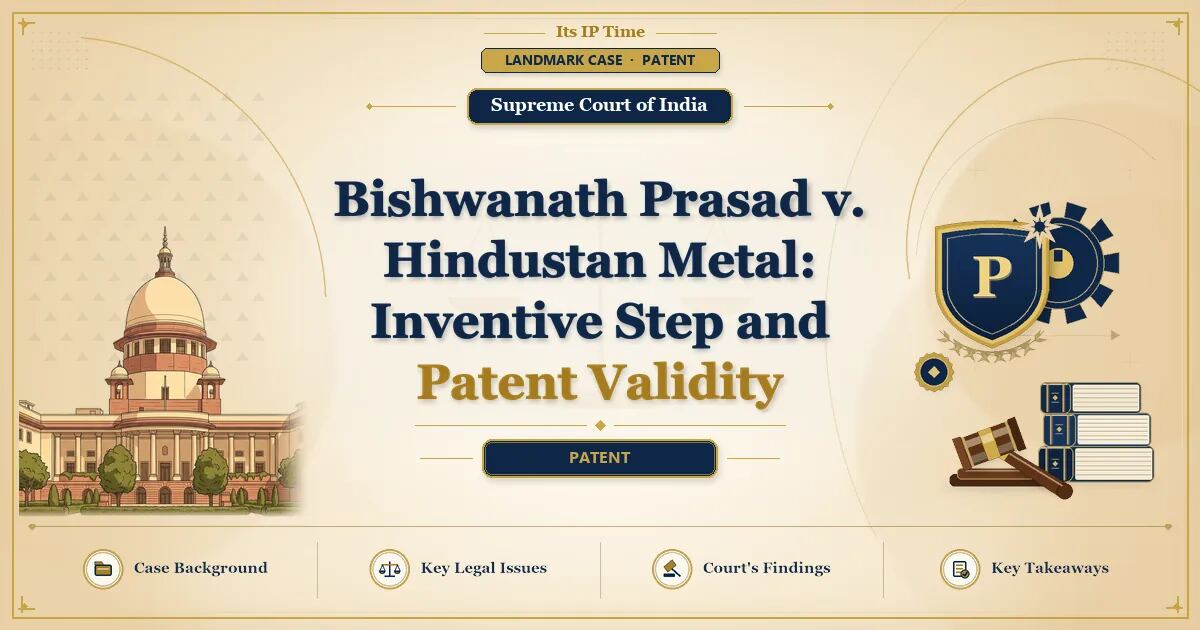
In the jurisprudence of Indian patent law, the boundary between a genuinely patentable invention and an unpatentable workshop modification remains a key battleground. The Supreme Court of India addressed this boundary in Bishwanath Prasad Radhey Shyam v. Hindustan Metal Industries, establishing fundamental principles governing inventive step, obviousness, and the legal weight attached to a granted patent. Decided during a period of industrial growth in post-independence India, this decision dismantled the misconception that obtaining a patent registration shields a patentee from scrutiny during infringement litigation. By setting a clear threshold for inventive step and confirming that patent grants carry no presumption of validity, the Supreme Court created an enduring precedent that shapes patent prosecution and enforcement strategy across Indian courts today.
Origins of the Bishwanath Prasad Utensil Patent Dispute
Looking to master Indian Patent Law & Jurisprudence jurisprudence? Read our full Patent Law Guide.
The dispute originated in Mirzapur, Uttar Pradesh, a traditional hub for brass utensil manufacturing. Hindustan Metal Industries, a partnership firm, claimed to have created an improved apparatus for manufacturing brass utensils. Specifically, the claimed invention related to a device for holding and mounting hollow metallic utensils, such as bowls (katoris), onto a lathe machine to enable efficient turning and polishing without causing structural distortion or damage to the vessel walls.
In 1951, Hindustan Metal Industries obtained Patent No. 46096 under the Indian Patents and Designs Act, 1911. The patented apparatus combined a faceplate, a central spindle, and adjustable wooden plugs designed to secure hollow utensils during mechanical rotation.
In 1953, the patentee discovered that a competing local business, Bishwanath Prasad Radhey Shyam, was using an identical lathe setup to produce similar metallic vessels. Hindustan Metal Industries filed a suit for patent infringement in the District Court of Allahabad, seeking an injunction and damages. Bishwanath Prasad Radhey Shyam resisted the action by filing a counter-claim for revocation under Section 26 of the 1911 Act, which corresponds to Section 64 of the Patents Act, 1970. The defendant contended that the alleged invention lacked novelty and inventive step, representing nothing more than an obvious workshop improvement commonly known to artisans skilled in the trade.
The trial court referred the revocation issue to the High Court of Allahabad. The High Court ruled in favor of the patentee, holding that the machine demonstrated sufficient novelty and utility. The defendant subsequently appealed to the Supreme Court of India.
Key Patent Validity Questions Before the Supreme Court
The central subject matter of the dispute was a mechanical assembly designed to mount thin-walled metallic utensils on a conventional lathe for polishing operations. The Supreme Court was called upon to evaluate whether the mere assembly of standard mechanical components to solve an everyday manufacturing problem qualified as a patentable invention.
The Apex Court framed and determined three primary legal questions:
1. Does the grant of a patent by the Patent Office create a statutory presumption of validity in favor of the patentee in subsequent infringement or revocation proceedings? 2. What constitutes the legal standard for inventive step and non-obviousness under Indian patent law when evaluating combinations of known mechanical components? 3. Did the claimed apparatus represent a patentable invention or merely a routine workshop improvement that a Person Having Ordinary Skill in the Art (PHOSITA) could construct without inventive ingenuity?
Inventive Step and Obviousness Under Sections 2(1)(j) and 64
Although the patent in question was granted under the Indian Patents and Designs Act, 1911, the Supreme Court analyzed the statutory framework in harmony with the foundational principles codified under the Patents Act, 1970.
The Court examined Section 2(1)(j) of the Patents Act, 1970, which defines an invention as a new product or process involving an inventive step and capable of industrial application. To satisfy this standard, the subject matter must not be obvious to a person skilled in the art. The Court integrated this requirement with Section 64(1)(e) and Section 64(1)(f), which allow revocation where the invention is publicly known or obvious in light of prior knowledge.
Justice R.S. Sarkaria highlighted that patent law requires a distinct qualitative threshold. A simple aggregation or juxtaposition of well-known integers, where each component performs its predictable function without producing a new synergistic effect, fails to satisfy the statutory test. The Court emphasized that an inventive step requires technical advancement over existing knowledge or economic significance, coupled with non-obviousness to a skilled worker.
Also, the Court addressed the procedural effect of a patent grant under Section 13(4) of the 1970 Act. Interpreting the statutory scheme, the Court affirmed that the grant of a patent is purely administrative. It does not guarantee the validity of the patent, nor does it erect a statutory presumption in favor of the owner during litigation. The defendant in an infringement suit retains an absolute right to challenge the validity of the patent under Section 64, placing the burden of proving patentability firmly back onto the proprietor once a credible challenge is raised.
Why Patent Grant Carries No Presumption of Validity
The Supreme Court undertook a careful evidentiary review of the prior art in metal turning and polishing techniques. Analyzing the testimony of artisans and technical witnesses, the Court observed that mounting hollow items on lathes using wooden chucks, plugs, or adapters was a longstanding practice in the traditional metalworking industry.
The ratio decidendi of the judgment rests on two structural pillars:
First, on the standard of obviousness and inventive step: The Court held that to be patentable, an improvement must produce something more than a predictable mechanical result. If a workshop mechanic possessed of ordinary skill, knowledge, and experience in the relevant art can arrive at the device by combining old integers without exercising inventive ingenuity, the creation is an unpatentable workshop improvement. The Court observed that placing a wooden adapter on a lathe spindle to hold a bowl was a standard application of existing workshop knowledge. The arrangement produced no synergistic result because each component functioned precisely as expected in isolation.
Second, on the presumption of validity: The Court decisively rejected the argument that a grant by the Controller of Patents creates a protective shield against legal attack. The Court noted that the examination process conducted by the Patent Office is not conclusive. A patent grant does not bar the court from re-evaluating novelty and inventive step de novo when challenged under Section 64.
So, the Supreme Court set aside the Allahabad High Court judgment, revoked Patent No. 46096, and dismissed the infringement suit.
Practical Lessons for Patent Drafting and Revocation Defense
The principles laid down in Bishwanath Prasad provide critical guidance for contemporary patent drafting, risk assessment, and litigation strategy:
1. Dual-Track Defense Strategy: Defendants facing patent infringement suits in India can confidently assert invalidity under Section 64 as a defense and counter-claim, knowing that courts will not grant deference to the Patent Office decision to grant the patent. 2. Synergistic Combination Drafting: When drafting patent specifications involving combinations of existing elements, patent agents must explicitly articulate and demonstrate a synergistic technical effect rather than a simple sum of component parts. 3. Evidentiary Focus on PHOSITA: Litigators challenging or defending patents must build clear evidentiary records regarding the common general knowledge of the ordinary artisan at the priority date. Expert testimony must focus precisely on whether the progression from prior art to the claimed subject matter required inventive skill. 4. Commercial Success is Not Inventive Step: Commercial utility or improved manufacturing convenience does not equal inventive step. In-house counsel evaluating research output must guard against seeking patent protection for internal process optimizations that lack non-obvious technical advancement.
Also Read: Madras High Court Overturns Patent Rejection for Omega SA
Key Precedents & Statutory Guidance
- Search recent High Court judgments in our Latest Indian IP Law Cases Directory.
- Examine core statutory doctrines in our Indian Patent Law & Jurisprudence Guide.
- Estimate official CGPDTM fees and FER deadlines with our IP Fee & Deadline Calculator or practice with Patent Agent Exam Prep.
- In-Depth Guide: Indian Patent Agent Exam 2026: Eligibility, Syllabus & Paper Strategy.
- In-Depth Guide: Patentability of Computer-Related Inventions under Section 3(k).
- Catch up in 2 minutes with our latest Weekly Indian IP Law Digest: November 15 to 21, 2026 | Its IP Time (or browse the Weekly IP Digest Archive).
- Review nationwide litigation trends in our Latest Monthly IP Law Roundup.
Bishwanath Prasad v. Hindustan Metal: Summary and Citation
- Case Name: Bishwanath Prasad Radhey Shyam v. Hindustan Metal Industries
- Official Citation: (1979) 2 SCC 511; AIR 1979 SC 989
- Deciding Bench: Hon’ble Mr. Justice R.S. Sarkaria and Hon’ble Mr. Justice O. Chinnappa Reddy
- Date of Judgment: December 13, 1978
- Core Holding: A patent grant carries no statutory presumption of validity in an infringement or revocation suit. A juxtaposition of known mechanical elements or a routine workshop improvement without a synergistic technical effect does not constitute an inventive step under patent law.