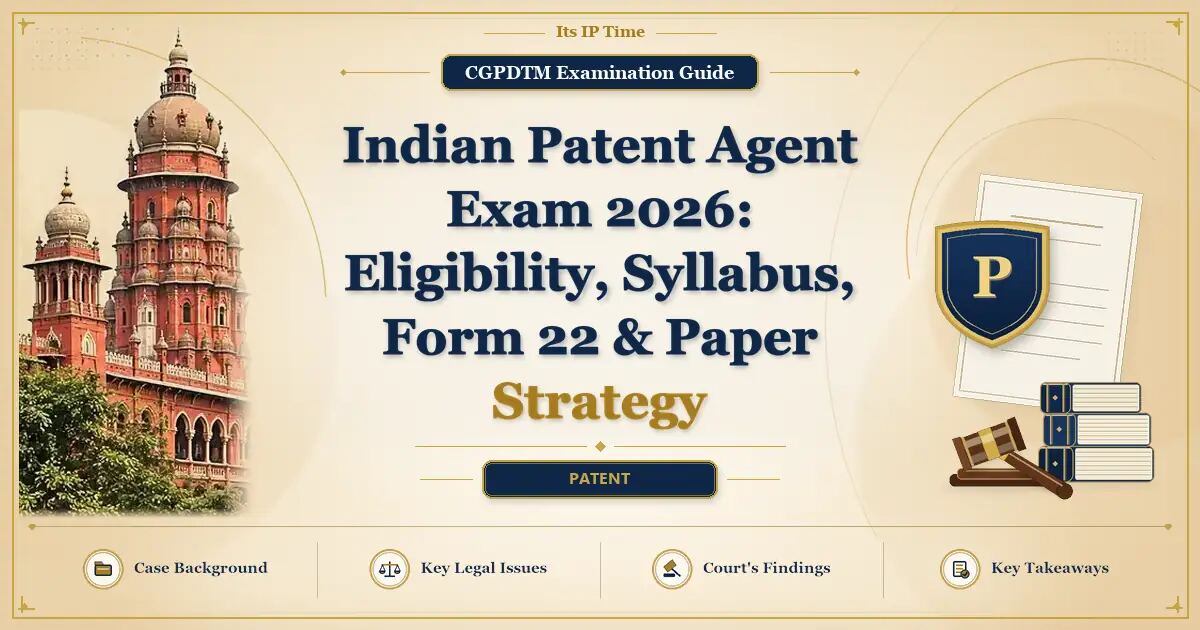
Who Is Eligible for the Indian Patent Agent Examination?
For foundational statutory analysis, consult our in-depth Patent Law Guide.
Eligibility to register as a Patent Agent in India is governed strictly by Section 126 of the Patents Act, 1970 and Rule 110 of the Patents Rules, 2003. Unlike Trademark Agent qualification (where law or graduate practitioners follow Rule 144 of the Trade Marks Rules, 2017), Patent Agent registration specifically requires technical and scientific qualification.
- Citizenship: Must be a citizen of India.
- Age Limit: Must have completed 21 years of age (there is no upper age cap).
- Educational Qualification: Must hold a degree in science, engineering, or technology from a recognized Indian university (or equivalent technical qualification recognized by the Central Government). Pure commerce, arts, or non-science LL.B. degrees without a science/engineering degree do not qualify under Section 126(1)(c).
Exam Pattern, Paper 1 & Paper 2 Syllabus, and Passing Marks
| Paper / Stage | Marks | Format & Core Topics Tested | Qualifying Threshold |
|---|---|---|---|
| Paper 1 | 100 Marks (2 Hours) | Objective MCQs + descriptive statutory questions on Patents Act 1970, Patents Rules 2003, Forms 1-30, deadlines (Rule 24B, Sec 8, Sec 25), SICLD Act, Biodiversity Act & PCT/TRIPS | Minimum 50% (50/100 marks) |
| Paper 2 | 100 Marks (3 Hours) | Drafting patent specifications, claims, abstract, legal case scenarios (Sec 3, Sec 84, FER analysis, prior art responses) | Minimum 50% (50/100 marks) |
| Viva Voce | 50 Marks | In-person/virtual panel testing practical prosecution, statutory amendments, ethical duties & current case law | Combined 60% overall aggregate (150/250 total) |
High-Yield Statutory Topics That Repeatedly Decide Paper 1
Recent CGPDTM question papers consistently test cross-statute boundaries alongside hardcore Patent Rules deadlines. Preparing these targeted clusters early directly boosts Paper 1 scores:
- IP Statute Distinctions & Related Acts: Questions frequently ask which Indian statute protects electronic circuit topographies (the Semiconductor Integrated Circuits Layout-Design Act, 2000), plant varieties (PPVFR Act), or biological resources (Biological Diversity Act, Section 6 NBA permission).
- Forms, Timelines & Statutory Fees: Know exact windows for Form 1 Proof of Right (6 months, Rule 10), Form 3 foreign filings (6 months, Rule 12), Form 9 early publication, Form 18 / 18A examination requests (31 months post-2024 rules for new filings), Rule 24B FER reply (6 + 3 months), and Form 22 registration after passing. Verify official fees instantly using our Indian IP Fee Calculator.
- Non-Patentable Subject Matter (Section 3): Master pharmaceutical efficacy tests under Section 3(d), CRI software tests under Section 3(k), mental acts under Section 3(m), and Compulsory Licensing (Section 84-92A).
Free Interactive Practice: Attempt timed practice sets, Paper 2 claim-drafting templates, and Trademark Agent Exam drills in our CGPDTM Exam Prep Workbench.
Also Read: First Examination Report (FER) Reply in India: Rule 24B Deadlines and Prosecution Strategy
Key Precedents & Statutory Guidance
- Search recent High Court judgments in our Latest Indian IP Law Cases Directory.
- Examine core statutory doctrines in our Indian Patent Law & Jurisprudence Guide.
- Estimate official CGPDTM fees and FER deadlines with our IP Fee & Deadline Calculator or practice with Patent Agent Exam Prep.
- In-Depth Guide: Compulsory Licensing in India: Grounds, Procedure & Section 84 Guide.
- In-Depth Guide: Semiconductor Layout-Design Law in India (SICLD Act 2000) Complete Guide.
- Catch up in 2 minutes with our latest Weekly Indian IP Law Digest: November 15 to 21, 2026 | Its IP Time (or browse the Weekly IP Digest Archive).
- Review nationwide litigation trends in our Latest Monthly IP Law Roundup.
Frequently Asked Questions
Can an LL.B. graduate without a science degree take the Indian Patent Agent Exam?
No. Under Section 126(1)(c) of the Patents Act, 1970, a candidate must hold a degree in science, engineering, or technology from a recognized university. Law graduates without a science/engineering degree remain eligible to appear for the Trademark Agent Examination under Rule 144 instead.
What is the passing score for the Indian Patent Agent Examination?
Under Rule 110 of the Patents Rules, 2003, candidates must score at least 50% in Paper 1, at least 50% in Paper 2, and achieve a combined overall aggregate of 60% across Paper 1, Paper 2, and Viva Voce (150 out of 250 marks).
What is Form 22 after clearing the Patent Agent Exam?
Once declared successful in both written papers and the Viva Voce, candidates file Form 22 (Application for Registration as a Patent Agent) under Rule 111 with the prescribed CGPDTM fee to obtain their official Patent Agent registration number.